UC ANR is committed to providing an accessible and inclusive web experience for all users. If you encounter an accessibility barrier or need content in an alternative or remediated accessible format, please contact anraccessibility@ucanr.edu.
Lady beetles, aka ladybugs, eat lots of aphids. Did we say lots of aphids? Lots of aphids. They have no portion control. If you watch closely, you'll see them gobble aphids like theater-goers devour buttered popcorn.
Charles "Charlie" Summers is outstanding in his field. And come Monday, March 30, the Pacific Branch of the Entomological Society of America will honor the University of California entomologist whose career spans 39 years in the pest management of field and vegetable crops.
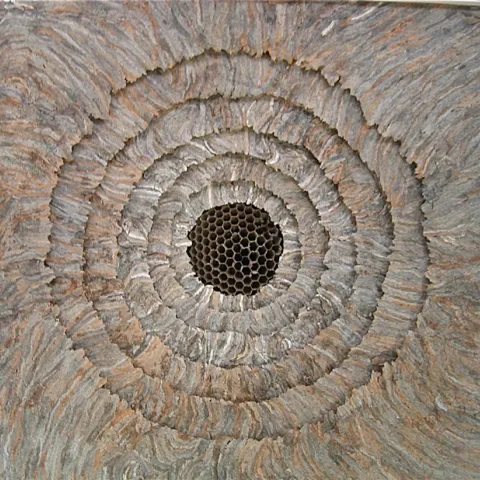
The secret's out. Or, rather, the secret's in. Inside. A number of years ago, UC Davis entomologist Diane Ullman created a ceramic sign outside the Harry H. Laidlaw Jr. Honey Bee Research Facility, located on Bee Biology Road, west of the UC Davis campus.
What are insect pollinators worth to the global economy? Well, it's a lot less than the Wall Street bailout...er...rescue plan. Recent research published in the journal Ecological Economics reveals just how important insect pollinators are.
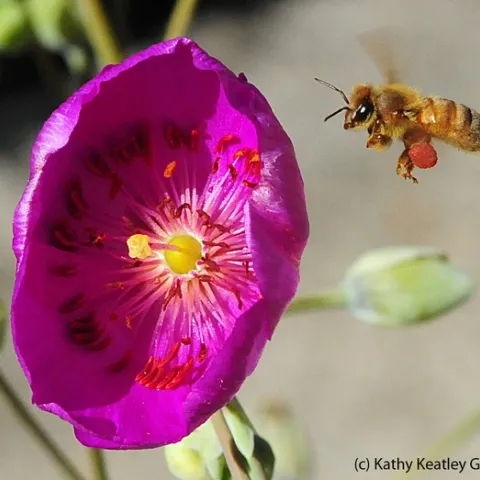
They danced in it, rolled in it, and bathed in it. The honey bees just couldn't get enough of the rock purslane (Calandrinia grandiflora). Last week when we visited Vacaville's El Rancho Nursery and Landscaping. nursery, owned by Ray and Maria Lopez, it was like a free-for-all at the French Laundry.
If you love pomegranates, you can thank a honey bee. If you love capturing images of pomegranates, you can thank a honey bee. And, if you love juicing them and making pomegranate jellyas I doyou can thank a honey bee. The honey bee makes it all possible.
It's all about the bees. When A. G. Kawamura, secretary of the California Department of Food and Agriculture, and the newly selected State Apiary Board meet from 10 a.m. to 4 p.m. on Friday, Oct. 3 at the Harry H. Laidlaw Jr.
Quick! How long have insects inhabited this earth? If you're taking a biology or an entomology course, you'll be asked that question on an exam. If you're attending the Entomological Society of America conference Nov. 16-20 in Reno, you probably already know that. A good answer: 400 million years.
It's tough being a drone honey bee this time of year. The drones, or male bees, don't survive the winter. Bee breeder-geneticist Susan Cobey of the Harry H. Laidlaw Jr. Honey Bee Research Facility at UC Davis admits to having a soft spot for drones.
A bee on a ball. When it flowers, the button-willow (Cephalanthus occidentalis), also known as willow, buttonbush, honey ball, and button ball (oh, that's so close to butter ball!) attracts honey bees and butterflies like you wouldn't believe.