A Natural Solution for California's Herds: African Catfish Peptides

California's cattle producers and agricultural communities are all too familiar with the rising challenge of antibiotic resistance, making common bacterial infections harder to treat in livestock. But imagine a future where we could tackle these infections with a natural, powerful alternative. Our research points to just that: antimicrobial peptides (AMPs) found in African catfish.

We're really excited about these peptides because African catfish thrive in pathogen-rich freshwater, naturally producing these robust immune compounds in their skin mucus as a defense. This natural origin makes them highly appealing alternatives to synthetic drugs.

Predicted Safety and Potent Action

One of the most compelling aspects of these AMPs is their predicted safety for mammals. Our initial computer analyses suggest that various catfish AMPs are generally recognized as safe (GRAS). We predict they'll be absorbed in the human intestine without causing liver, brain, or heart toxicity. Furthermore, lab tests on a promising peptide, NACAP-II, confirmed it was non-hemolytic, meaning it didn't damage rabbit red blood cells—a strong indicator of its potential safety for mammalian cells.

Beyond safety, these peptides demonstrate effectiveness against problematic bacteria. One study revealed NACAP-II's strong activity against Extended-Spectrum Beta-Lactamase (ESBL)-producing Escherichia coli—a critical concern for both animal and human health due to its resistance to many common antibiotics. Another peptide, ACAP-IV, also showed antibacterial activity against E. coli and Staphylococcus aureus. We believe these AMPs work by directly disrupting bacterial cell membranes, a mechanism that makes it harder for bacteria to develop resistance compared to how they resist traditional antibiotics.

Primary Image
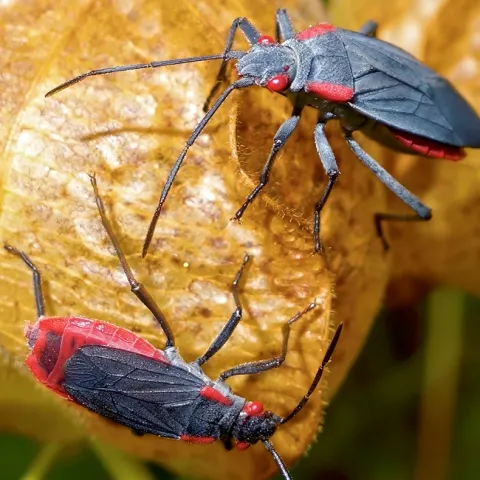
Soapberry bugs flying and flightless morphs together on balloon vine. (Photo by Scott Carroll)
Entomology & Nematology News: Article

Research: How Soapberry Bugs 'Evolved in Unexpected Ways' Due to Hurricane Harvey

October 12, 2023
By Kathy Keatley Garvey
The seed-feeding, red-shouldered soapberry bugs evolved in unexpected ways when the catastrophic Hurricane Harvey hit Houston in August of 2017, according to a group of researchers, including evolutionary biologist Scott Carroll of the UC Davis Department of Entomology and Nematology and founding di...
View Article
Primary Image
Author sitting at a desk, wearing a blue vest, smiling.
The Stanislaus Sprout: Article

Winged Beauties

October 12, 2023
By Anne E Schellman
Fly free; fly high. Wings wafted upward by gentle breeze. Soar above the land. Wings buffeted by gusty wind. Survey the land below. Seek forage from land, sea and sky. Toil under the sun splendid creatures resplendently garbed. Find rest in night's stillness and quietude.
View Article
Livestock, Range and Natural Resources: Article

Fall 2023

October 12, 2023
In this issue: Wolf Compensation Program Vesicular Stomatitis Virus 6 Years of Forage Data Upcoming Poultry Webinar...
View Article
Livestock, Range and Natural Resources: Article

Invierno 2021

October 12, 2023
En este nmero: Actualizaciones para la oficina UCCE Pronosticando la Produccin de Forraje Publicaciones Nuevos Aviso de CDFA en la Eutanasia...
View Article
Primary Image
Sapsucker damage. Photo by Michelle Davis
Under the Solano Sun: Article

Sapsucker

October 12, 2023
Late this spring, my dad pointed out a line of small holes evenly spaced circumferentially on a large grapefruit branch in his backyard. The tree is very large, looks healthy and is a prolific producer of sweet white grapefruit. The branch also appears healthy with glossy green leaves.
View Article