A Natural Solution for California's Herds: African Catfish Peptides

California's cattle producers and agricultural communities are all too familiar with the rising challenge of antibiotic resistance, making common bacterial infections harder to treat in livestock. But imagine a future where we could tackle these infections with a natural, powerful alternative. Our research points to just that: antimicrobial peptides (AMPs) found in African catfish.

We're really excited about these peptides because African catfish thrive in pathogen-rich freshwater, naturally producing these robust immune compounds in their skin mucus as a defense. This natural origin makes them highly appealing alternatives to synthetic drugs.

Predicted Safety and Potent Action

One of the most compelling aspects of these AMPs is their predicted safety for mammals. Our initial computer analyses suggest that various catfish AMPs are generally recognized as safe (GRAS). We predict they'll be absorbed in the human intestine without causing liver, brain, or heart toxicity. Furthermore, lab tests on a promising peptide, NACAP-II, confirmed it was non-hemolytic, meaning it didn't damage rabbit red blood cells—a strong indicator of its potential safety for mammalian cells.

Beyond safety, these peptides demonstrate effectiveness against problematic bacteria. One study revealed NACAP-II's strong activity against Extended-Spectrum Beta-Lactamase (ESBL)-producing Escherichia coli—a critical concern for both animal and human health due to its resistance to many common antibiotics. Another peptide, ACAP-IV, also showed antibacterial activity against E. coli and Staphylococcus aureus. We believe these AMPs work by directly disrupting bacterial cell membranes, a mechanism that makes it harder for bacteria to develop resistance compared to how they resist traditional antibiotics.

UC Science Connect: Page

#2 Building relationships and belonging while teaching coding

Every child should have the opportunity to learn computer science.  Coding can be an expression of youth’s identity and their artistic selves. The iCode curriculum develops computational thinking, computer science skills, and career motivations by focusing on identity and cultural heritage.Before they…
View Page
UC Science Connect: Page

#1 Addressing inequity in Computer Science

Social justice youth development fosters critical thinking in young people while encouraging them to act toward achieving an equitable distribution of resources and opportunity for all. The iCode curriculum is designed to empower young people by bringing together critical thinking about social justice with…
View Page

Cover Crops, Soil Health, Compost Tea, Anyone?

October 7, 2025
By Annemiek M Schilder
Climate-Smart Farming Demonstration Field MeetingWhen:  Tuesday October 21, 2025Time:    9:00 – 11:00 amWhere:  UC Hansen Agricultural Research and Extension Center, 5836 Beardsley Rd, Camarillo, CALearn …
View Article
Fresno County 4-H: Article

October 2025 Newsletter updated

October 7, 2025
By Elizabeth Ramirez
In This Edition… 2- Committee & Council Mtgs. 2- Water-Wise Event 3- Livestock Judging Event 3– County Fair Horse Show 4- Festive Food Faire 4- Livestock Camp 4- Calvacade of Pigeons 4- Summer Camp– JC 5- Livestock Achievement 5- Emerald & Impact Stars 6- Club Officer Books 6- Wanted– Clover Fest 6-…
View Article
UC Science Connect: Page

iCode Educator Learning Modules

 iCode develops computational thinking, computer science skills, and career motivations by focusing on identity and cultural heritage. The activities encourage exploration, discourse, and reflection to foster positive ethnic-racial identity. The curriculum integrates culturally relevant and experiential…
View Page
Primary Image
plants in pots on shelves
Under the Solano Sun: Article

Therapeutic Gardens

October 7, 2025
By Jennifer M Baumbach
 Blog by Nanelle Jones-SullivanI have been visiting therapeutic gardens in Southern California as a part of a Horticultural Therapy class. Dorn and Relf, in "The Profession and Practice of Horticultural Therapy,” write that the basic premise is “working with and around plants brings about positive…
View Article
Primary Image
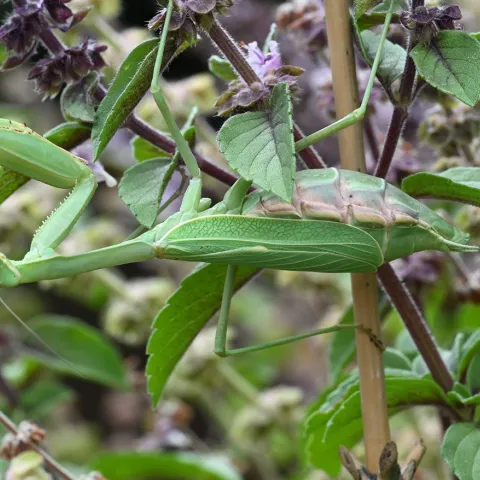
Praying mantis, Stagmomantis limbata, in patch of African blue basil. (Photo by Kathy Keatley Garvey)
Bug Squad: Article

Whatcha Doing, Ms. Mantis?

October 6, 2025
By Kathy Keatley Garvey
 A praying mantis, Stagmomantis limbata, is hanging out in a patch of African blue basil in a Vacaville garden.Me: "Whatcha doing, Ms. Mantis?"Ms. Mantis: "Oh, just watching the bees. Look at how much pollen and nectar they're collecting! It's a bee-utiful thing!"Me: "Just watching them?"Ms. Mantis: …
View Article
Primary Image
garden to the max book and a brown journal
Under the Solano Sun: Article

New Treasures from the Plant Exchange

October 6, 2025
By Jennifer M Baumbach
September 20th's plant exchange was a big success, as always! The tables were loaded with various plants, cuttings, bulbs, and seeds, and there was a separate room for pots, tools, books, and other garden items.  At 9:00 am sharp, after dropping off their donations at the door, the public streamed in…
View Article