A Natural Solution for California's Herds: African Catfish Peptides

California's cattle producers and agricultural communities are all too familiar with the rising challenge of antibiotic resistance, making common bacterial infections harder to treat in livestock. But imagine a future where we could tackle these infections with a natural, powerful alternative. Our research points to just that: antimicrobial peptides (AMPs) found in African catfish.

We're really excited about these peptides because African catfish thrive in pathogen-rich freshwater, naturally producing these robust immune compounds in their skin mucus as a defense. This natural origin makes them highly appealing alternatives to synthetic drugs.

Predicted Safety and Potent Action

One of the most compelling aspects of these AMPs is their predicted safety for mammals. Our initial computer analyses suggest that various catfish AMPs are generally recognized as safe (GRAS). We predict they'll be absorbed in the human intestine without causing liver, brain, or heart toxicity. Furthermore, lab tests on a promising peptide, NACAP-II, confirmed it was non-hemolytic, meaning it didn't damage rabbit red blood cells—a strong indicator of its potential safety for mammalian cells.

Beyond safety, these peptides demonstrate effectiveness against problematic bacteria. One study revealed NACAP-II's strong activity against Extended-Spectrum Beta-Lactamase (ESBL)-producing Escherichia coli—a critical concern for both animal and human health due to its resistance to many common antibiotics. Another peptide, ACAP-IV, also showed antibacterial activity against E. coli and Staphylococcus aureus. We believe these AMPs work by directly disrupting bacterial cell membranes, a mechanism that makes it harder for bacteria to develop resistance compared to how they resist traditional antibiotics.
Primary Image
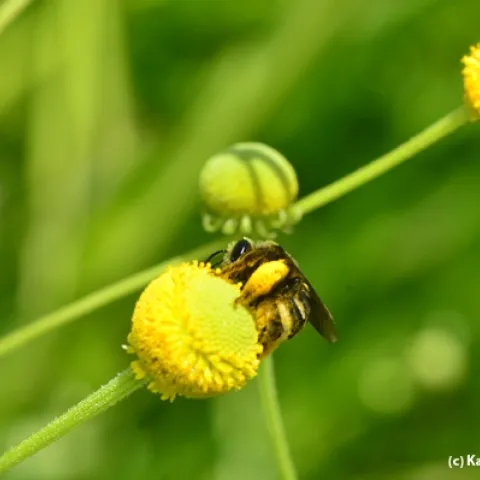
A golden honey bee (Cordovan of the Italian subspecies) nectaring lavender. (Photo by Kathy Keatley Garvey)
Bug Squad: Article

Honey! I Hardly Know You!

August 1, 2014
By Kathy Keatley Garvey
Every time I see a golden jar of honey, I'm reminded of the Cordovan bee (Italian subspecies) that visited the Garvey bee garden back in 2010. I managed to capture a photo of her and labeled the image "Golden Bee Nectaring on Lavender," because that's what she was doing. Nectaring on lavender.
View Article
Primary Image
vole 1
Topics in Subtropics: Article

Vole Damage in Citrus Revisited

August 1, 2014
By Ben A Faber
Since the first publication of this article on vole damage in citrus, a recent field observation regarding vole activity is worth noting. Voles prefer a situation where there is cover and shelter generally from weed or grass.
View Article
Primary Image
A praying mantis eyes the photographer. (Photo by Kathy Keatley Garvey)
Bug Squad: Article

Please Don't Eat the Pollinators!

July 31, 2014
By Kathy Keatley Garvey
If I were in charge of a praying mantis' daily diet, I would enforce one stringent rule: "Please don't eat the pollinators! Do not, I repeat, target the bees or butterflies.
View Article
Colusa County: Article

August 2014

July 31, 2014
Water Management to Mitigate Blanking, Rice Yields Components, Rice Strawlage, Planning Harvest and Rice Field Day announcement.
View Article
Colusa County: Article

August 2014

July 31, 2014
The Colusa County 2014-15 4-H year kicks off with Hot August ENROLLMENT Nights! Also included are New Leader Orientation dates, information on Primary 4-H Camp, California 4-H at Raley Field...
View Article
Primary Image
Greater efficiencies and brighter economics in California agriculture could be achieved by employing conservation principles.
Conservation Agriculture: Article

Conservation agriculture applies to California

July 31, 2014
By Jeannette Warnert
The belief that an unrivaled record of productivity, deep soils and dry climate mean conservation agriculture doesn't apply in California is flat wrong, said Jeff Mitchell, UC Cooperative Extension specialist in the Department of Plant Sciences at UC Davis.
View Article
IGIS: Article

Update from the White House on their Climate Data Initiative

July 30, 2014
By Maggi Kelly
Yesterday the White House launched the second phase of the Climate Data Initiative, focused on leveraging climate data and innovation to make food systems more resilient to climate change and reduce the impact of agriculture on climate change.
View Article
Primary Image
McCormack Hall superintendent Gloria Gonzalez hangs "Butterfly Lovers" by Tina Waycie of Vallejo. (Photo by Kathy Keatley Garvey)
Bug Squad: Article

A Winged Affair

July 30, 2014
By Kathy Keatley Garvey
Say the word wings to folks who attend fairs and festivals and they may think of something to eat--buffalo wings or chicken wings. But if you head over to McCormack Hall at the Solano County Fair, Vallejo, you'll be thinking of insect flight. Flight of butterflies and moths.
View Article