A Natural Solution for California's Herds: African Catfish Peptides

California's cattle producers and agricultural communities are all too familiar with the rising challenge of antibiotic resistance, making common bacterial infections harder to treat in livestock. But imagine a future where we could tackle these infections with a natural, powerful alternative. Our research points to just that: antimicrobial peptides (AMPs) found in African catfish.

We're really excited about these peptides because African catfish thrive in pathogen-rich freshwater, naturally producing these robust immune compounds in their skin mucus as a defense. This natural origin makes them highly appealing alternatives to synthetic drugs.

Predicted Safety and Potent Action

One of the most compelling aspects of these AMPs is their predicted safety for mammals. Our initial computer analyses suggest that various catfish AMPs are generally recognized as safe (GRAS). We predict they'll be absorbed in the human intestine without causing liver, brain, or heart toxicity. Furthermore, lab tests on a promising peptide, NACAP-II, confirmed it was non-hemolytic, meaning it didn't damage rabbit red blood cells—a strong indicator of its potential safety for mammalian cells.

Beyond safety, these peptides demonstrate effectiveness against problematic bacteria. One study revealed NACAP-II's strong activity against Extended-Spectrum Beta-Lactamase (ESBL)-producing Escherichia coli—a critical concern for both animal and human health due to its resistance to many common antibiotics. Another peptide, ACAP-IV, also showed antibacterial activity against E. coli and Staphylococcus aureus. We believe these AMPs work by directly disrupting bacterial cell membranes, a mechanism that makes it harder for bacteria to develop resistance compared to how they resist traditional antibiotics.
UC Weed Science (weed control, management, ecology, and minutia): Article

Can herbicide resistance move from crops to weeds?

July 28, 2014
By Brad Hanson
The risks of GMO herbicide-resistant crops as a source for resistance traits in weeds has garnered recent attention in discussions of so-called superweeds. [I've commented previously on my general disagreement with the term "superweed" when talking about herbicide resistance].
View Article
Primary Image
A camouflaged jumping spider eyes a honey bee on Japanese anemone. (Photo by Kathy Keatley Garvey)
Bug Squad: Article

Bumble Bees and Spiders Don't Mix?

July 25, 2014
By Kathy Keatley Garvey
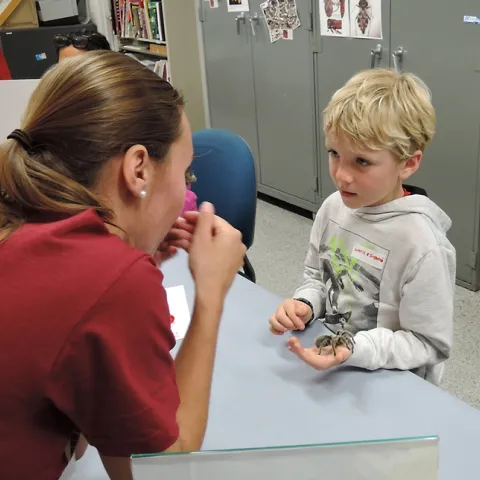
Bumble bees and spiders don't mix, you say? Well, they will at the Bohart Museum of Entomology's open house from 1 to 4 p.m., Saturday, July 26. The family-centered event, free and open to the public, takes place in Room 1124 of the Academic Surge building on Crocker Lane, UC Davis campus.
View Article
UC Weed Science (weed control, management, ecology, and minutia): Article

The Efficacy of Weed Killers

July 25, 2014
By Gale Perez
Here's an article by Paul Franson | Wines & Vines | 07.22.2014 Napa, Calif.Last week John Roncoroni, a Napa County UC Cooperative Extension weed science advisor, held a field demonstration about the efficacy of herbicides newly registered for vineyard application.
View Article
Primary Image
Anise swallowtail foraging on lantana. (Photo by Kathy Keatley Garvey)
Bug Squad: Article

So Beautful, So Exquisite

July 24, 2014
By Kathy Keatley Garvey
There's something about seeing a butterfly that makes your eyes light up, your smile widen, and your feet feel like skipping. Nature's joy.
View Article
Primary Image
Wax moth larvae and a hive beetle (top left). (Photo by Kathy Keatley Garvey)
Bug Squad: Article

It's National Moth Week!

July 23, 2014
By Kathy Keatley Garvey
It's National Moth Week! The event, which runs through Sunday, celebrates "the beauty, life cycles, and habitats of moths," according to its website. Scientists and citizen scientists are encouraged to document their findings. It's now a worldwide event.
View Article
UC Weed Science (weed control, management, ecology, and minutia): Article

Plant science students earn top honors at UC Davis Weed Day

July 23, 2014
By Gale Perez
From the Fresno State website Jul 18, 2014 by Tom Uribes A team of three Fresno State plant science students took first place in the weed identification category at the 58th annual Weed Day seminar hosted by University of California, Davis.
View Article
Primary Image
A jumping spider ready to jump. (Photo by Kathy Keatley Garvey)
Bug Squad: Article

Spiders and Spiders, Oh, My!

July 22, 2014
By Kathy Keatley Garvey
Odds are that Justin Timberlake won't be there. Neither will J. K. Rowling, author of the wildly popular Harry Potter series of books. They hate spiders. In fact, by all accounts, they have arachnophobia, an intense fear of spiders that affects some 3.5 to 6.1 percent of the U.S. population.
View Article
UC Weed Science (weed control, management, ecology, and minutia): Article

Intra Row Weeding Machine Demonstration

July 22, 2014
By Gale Perez
University of California Cooperative Extension Intra Row Weeding Machine Demonstration Wednesday, July 23, 2014 9:00 to 10:00 a.m. USDA East Alisal Research Station 1636 East Alisal Road (follow signs) The area of mechanical weed control is developing rapidly in Europe.
View Article
UC Weed Science (weed control, management, ecology, and minutia): Article

new WSSA Herbicide Handbook (10th ed) now available for $95

July 22, 2014
By Brad Hanson
Link today to the newest edition of an important reference book for herbicides - the Weed Science Society of America's "Herbicide Handbook". Dr. Dale Shaner took on the updating and revision of the 10th Edition (at over 500 pages of very dense information, this was no small task!).
View Article
UC Weed Science (weed control, management, ecology, and minutia): Article

UC Davis Weed Day draws capacity crowd

July 22, 2014
By Gale Perez
More from Todd Fitchette| Western Farm Press | July 17, 2014 on Weed Day 2014 The UC Davis Weed Day is popular among a cross-section of agricultural interests.
View Article