A Natural Solution for California's Herds: African Catfish Peptides

California's cattle producers and agricultural communities are all too familiar with the rising challenge of antibiotic resistance, making common bacterial infections harder to treat in livestock. But imagine a future where we could tackle these infections with a natural, powerful alternative. Our research points to just that: antimicrobial peptides (AMPs) found in African catfish.

We're really excited about these peptides because African catfish thrive in pathogen-rich freshwater, naturally producing these robust immune compounds in their skin mucus as a defense. This natural origin makes them highly appealing alternatives to synthetic drugs.

Predicted Safety and Potent Action

One of the most compelling aspects of these AMPs is their predicted safety for mammals. Our initial computer analyses suggest that various catfish AMPs are generally recognized as safe (GRAS). We predict they'll be absorbed in the human intestine without causing liver, brain, or heart toxicity. Furthermore, lab tests on a promising peptide, NACAP-II, confirmed it was non-hemolytic, meaning it didn't damage rabbit red blood cells—a strong indicator of its potential safety for mammalian cells.

Beyond safety, these peptides demonstrate effectiveness against problematic bacteria. One study revealed NACAP-II's strong activity against Extended-Spectrum Beta-Lactamase (ESBL)-producing Escherichia coli—a critical concern for both animal and human health due to its resistance to many common antibiotics. Another peptide, ACAP-IV, also showed antibacterial activity against E. coli and Staphylococcus aureus. We believe these AMPs work by directly disrupting bacterial cell membranes, a mechanism that makes it harder for bacteria to develop resistance compared to how they resist traditional antibiotics.
Pollen-Packin' Carpenter Bee

May 26, 2010
By Kathy Keatley Garvey
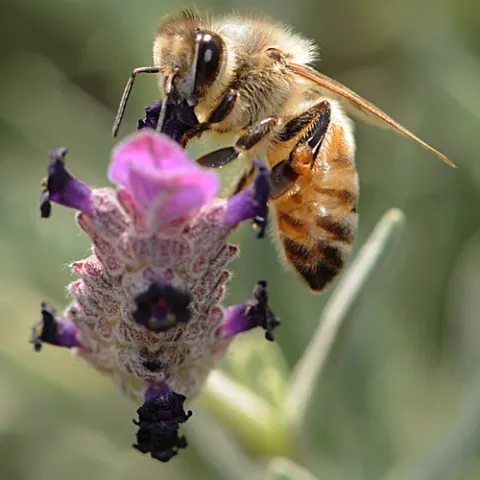
Carpenter bees pack pollen, too. A carpenter bee (Xylocopa tabaniformis orpifex) visiting our gaura last weekend was packing bright yellow pollen, a sharp contrast against her black body.
View Article

A Flamin' Dragonfly

May 25, 2010
By Kathy Keatley Garvey
Dragonflies occasionally hang around our fish pond to catch flying insects, such as flies and mosquitoes. Last weekend a gorgeous flame skimmer swooped down in our garden--a few yards from our fish pond--and landed on a bamboo stake. She absolutely glowed in the late afternoon sun.
View Article

Of Butterflies and Moths

May 24, 2010
By Kathy Keatley Garvey
Florian Altermatt (right) describes himself as a "keen biologist and naturalist." "I'm interested in community ecology, metapopulation, biologoy and evolutionary biology. Besides that, my pleasures are--as Vladimir Nabokov said once-the most intense known to man: writing and butterfly hunting.
View Article

Frolicking in the Poppies

May 21, 2010
By Kathy Keatley Garvey
The Campus Buzzway is buzzing with bees. The quarter-acre wildflower garden, located by the Harry H. Laidlaw Jr.
View Article

Just Hovering

May 20, 2010
By Kathy Keatley Garvey
Every insect looks prettier when it lands on a tower of jewels (Echiium wildpretti). When in full bloom, the 9-to-10-foot-high plant, native to the Canary Islands, blazes with firecracker-red flowers. It's a showstopper.
View Article

They're Pollinators, Too

May 19, 2010
By Kathy Keatley Garvey
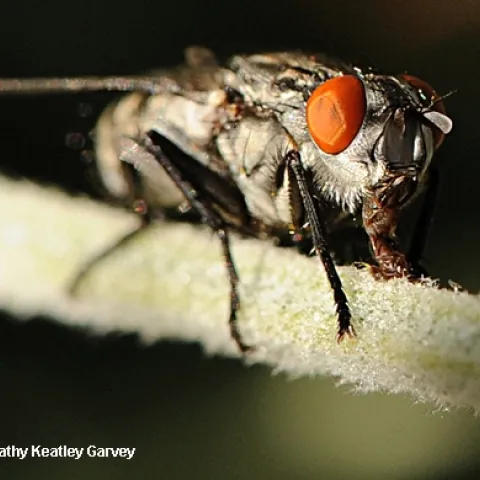
When we think of pollinators, we usually think of honey bees, bumble bees, carpenter bees, syrphid or flower flies, and butterflies. But wait, blow flies can be pollinators, too.
View Article

The Hunter and the Hunted

May 18, 2010
By Kathy Keatley Garvey
The crab spider is a clever and skillful hunter. Last Sunday we spotted a camouflaged crab spider (family Thomisidae) lying flat on a sedum. The spider's pink and white abdomen blended so well into the pink and white blossoms that you couldn't tell where the abdomen ended and where the flower began.
View Article

Killer in Our Midst

May 17, 2010
By Kathy Keatley Garvey
There's a killer in our midst, and a chemical ecologist will tell us all about it. The killer: thousand cankers disease. The victim: native black walnuts. The speaker: Steve Seybold.
View Article

Nasty Little Parasites

May 14, 2010
By Kathy Keatley Garvey
If you have a bee hive, you most likely have mites. Varroa mites, those blood-sucking parasites that latch onto the brood and also thrive on the adult bees, can weaken and destroy a hive.
View Article