A Natural Solution for California's Herds: African Catfish Peptides

California's cattle producers and agricultural communities are all too familiar with the rising challenge of antibiotic resistance, making common bacterial infections harder to treat in livestock. But imagine a future where we could tackle these infections with a natural, powerful alternative. Our research points to just that: antimicrobial peptides (AMPs) found in African catfish.

We're really excited about these peptides because African catfish thrive in pathogen-rich freshwater, naturally producing these robust immune compounds in their skin mucus as a defense. This natural origin makes them highly appealing alternatives to synthetic drugs.

Predicted Safety and Potent Action

One of the most compelling aspects of these AMPs is their predicted safety for mammals. Our initial computer analyses suggest that various catfish AMPs are generally recognized as safe (GRAS). We predict they'll be absorbed in the human intestine without causing liver, brain, or heart toxicity. Furthermore, lab tests on a promising peptide, NACAP-II, confirmed it was non-hemolytic, meaning it didn't damage rabbit red blood cells—a strong indicator of its potential safety for mammalian cells.

Beyond safety, these peptides demonstrate effectiveness against problematic bacteria. One study revealed NACAP-II's strong activity against Extended-Spectrum Beta-Lactamase (ESBL)-producing Escherichia coli—a critical concern for both animal and human health due to its resistance to many common antibiotics. Another peptide, ACAP-IV, also showed antibacterial activity against E. coli and Staphylococcus aureus. We believe these AMPs work by directly disrupting bacterial cell membranes, a mechanism that makes it harder for bacteria to develop resistance compared to how they resist traditional antibiotics.
Primary Image
leaf roller avocado
Topics in Subtropics: Article

No Longer a New Pest

July 2, 2021
By Ben A Faber
This article was first posted in July of 2020 when it wasn't clear what this leaf roller/leaf miner was going to do. In the last couple of weeks I have heard from two PCAs from Ventura saying that they are having to spray for it. So, it is back and it is probabl6y going to hang around for a while.
View Article
Primary Image
Svastra sunflower bee, Jeanette Alosi
The Real Dirt: Article

Why Attract Native Bees?

July 2, 2021
It's important to protect our bee populations because their survival and reproduction provides pollination benefits for agricultural, urban, and wildland environments. This is especially evident here when we welcome commercial bees to pollinate almond orchards each spring.
View Article
Article

Listen To "This Month In The Garden" on In The Garden Radio

July 1, 2021
Deep water your large landscape trees then let them dry out a bit before the next round. Be careful though because your citrus and avocados may drop fruit if allowed to dry out this month and next. Well-established, drought-tolerant plants are one of the exceptions.
View Article
Primary Image
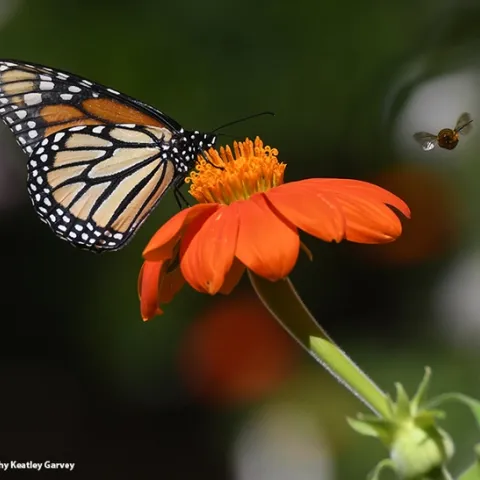
A female sunflower bee, Svastra obliqua expurgata, forages on a Mexican sunflower, Tithonia rotundifola, in Vacaville, Calif. (Photo by Kathy Keatley Garvey)
Bug Squad: Article

Life Is Not Always Sunny for the Sunflower Bee

July 1, 2021
By Kathy Keatley Garvey
Life is not always sunny for the sunflower bee, Svastra obliqua, a native longhorned bee. The gals have trouble foraging when a male longhorned bee, Melissodes agilis, targets them. The male M. agilis are very territorial--and their kamikaze-like maneuvers are spectacular.
View Article
Primary Image
The new Net Zero Initiative project will examine the effects of value-added dairy manure products. Composted dairy manure used as fertilizer shown in an almond orchard. Photo by Sat Darshan Khalsa
Food Blog: Article

Dairy’s Net Zero Initiative gets boost with $10 million research grant

July 1, 2021
By Pamela S Kan-Rice
The Foundation for Food & Agriculture Research has awarded a $10 million grant to support U.S. dairy's Net Zero Initiative as a critical on-farm pathway to advance the industrywide 2050 Environmental Stewardship Goals set through the Innovation Center for U.S. Dairy.
View Article
Article

Reminder: Proof of COVID-19 vaccine required by July 15

July 1, 2021
By Pamela S Kan-Rice
For the safety and well-being of the entire university community, UC has proposed a COVID-19 vaccination policy. This policy will require, with few exceptions, that all students, faculty and staff be vaccinated against the COVID-19 virus.
View Article
Primary Image
Adult California ground squirrel
From Soil to Science: Article

New online course on the management of ground squirrels and pocket gophers

July 1, 2021
Cheryl Reynolds, UC Statewide IPM Program UC Statewide IPM Program is pleased to announce that a new online course on managing ground squirrels and pocket gophers has been added to UC IPM's growing library of online training courses. This course consists of eight video segments recorded by Dr.
View Article
ANR Employee News: Article

Accellion breach to be discussed at July 15 town hall

July 1, 2021
By Pamela S Kan-Rice
Join the ANR monthly town hall meeting 2-3 p.m. on Thursday, July 15, to learn more about the Accellion data breach. Our guest speakers will be Hoyt Sze, managing counsel of the Health Affairs & Technology Law Group at UC Office of the President, and Michael Bruemmer from Experian.
View Article
Primary Image
2801 Second Street
ANR Employee News: Article

Reopening guidelines posted online

July 1, 2021
By Pamela S Kan-Rice
UC ANR officially reopened all locations on July 1. Risk & Safety Services Director Brian Oatman and Interim Human Resources Executive Director Bethanie Brown recently reviewed and updated UC ANR's guidelines on re-opening and remote work.
View Article