A Natural Solution for California's Herds: African Catfish Peptides

California's cattle producers and agricultural communities are all too familiar with the rising challenge of antibiotic resistance, making common bacterial infections harder to treat in livestock. But imagine a future where we could tackle these infections with a natural, powerful alternative. Our research points to just that: antimicrobial peptides (AMPs) found in African catfish.

We're really excited about these peptides because African catfish thrive in pathogen-rich freshwater, naturally producing these robust immune compounds in their skin mucus as a defense. This natural origin makes them highly appealing alternatives to synthetic drugs.

Predicted Safety and Potent Action

One of the most compelling aspects of these AMPs is their predicted safety for mammals. Our initial computer analyses suggest that various catfish AMPs are generally recognized as safe (GRAS). We predict they'll be absorbed in the human intestine without causing liver, brain, or heart toxicity. Furthermore, lab tests on a promising peptide, NACAP-II, confirmed it was non-hemolytic, meaning it didn't damage rabbit red blood cells—a strong indicator of its potential safety for mammalian cells.

Beyond safety, these peptides demonstrate effectiveness against problematic bacteria. One study revealed NACAP-II's strong activity against Extended-Spectrum Beta-Lactamase (ESBL)-producing Escherichia coli—a critical concern for both animal and human health due to its resistance to many common antibiotics. Another peptide, ACAP-IV, also showed antibacterial activity against E. coli and Staphylococcus aureus. We believe these AMPs work by directly disrupting bacterial cell membranes, a mechanism that makes it harder for bacteria to develop resistance compared to how they resist traditional antibiotics.

Cooperative Extension, Sutter-Yuba Counties: Article

April 2019

April 18, 2019
Dates to Remember 4-H County Ambassador Senior Scholarships Beale Kits Day State Leadership Conference (SLC) 4-H Shooting Sports Workshops 4-H Calendar of Events Spring Fair Update Raise Your Hand for 4-H True Leaders in Service TSC Paper Clover Pictures 4-H Record Book Program Update 4-H Club Meeti...
View Article
Tehama County: Article

2019 April SVR WALNUT Newsletter Vol #5

April 18, 2019
Orchard Management Considerations: Budbreak through Early Summer Walnut Blight Management in 2019 Revisiting Your Codling Moth IPM Program in a Lean Crop Year Pulling the trigger for the start of irrigation in the spring: Too much too soon for walnuts?
View Article
Primary Image
Fig 1. Rose petals with early Botrytis symptoms. Note necrotic spots with dark halos.
Nursery and Flower Grower: Article

It's Spring and Botrytis Is in the Air

April 17, 2019
By Steven A Tjosvold
Gray mold caused by the fungus Botrytis cinerea is one of the more destructive plant pathogens, and it attacks a wide variety of plants. It is a common springtime disease, favored by cool rainy periods and high humidity. Conditions just like we have seen in California recently.
View Article
UCCE in the County of San Luis Obispo: Article

APR 20 RANCH FIELD DAY POSTPONED

April 17, 2019
Hello, Due to low registration, the decision was made to postpone this "Ranch Field Day" We will let you know once we set up a new date. Thank you for your understanding and our apologies for the inconvenience.
View Article
Primary Image
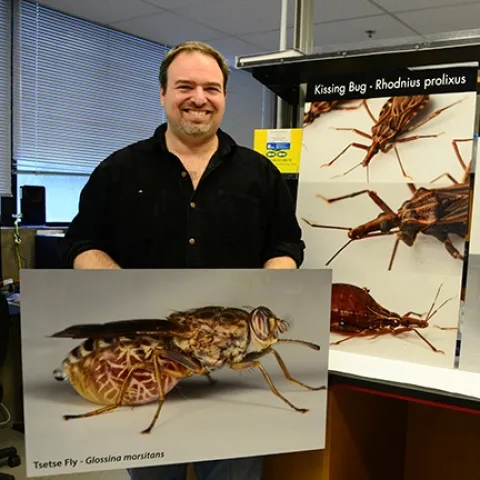
UC Davis medical entomologist Geoffrey Attardo shows Sebastian and Kamila Ehrlich examples of what insects they might want to see in virtual reality. In back is their mother, Carollina Ehrlich. (Photo by Kathy Keatley Garvey)
Bug Squad: Article

'Adventure Awaited' at Virtual Reality Demonstration

April 17, 2019
By Kathy Keatley Garvey
"Adventure Awaits!" the theme proclaimed. And that it did Saturday at the 105th annual UC Davis Picnic Day--especially at the second annual "Virtual Reality Bugs" display at Briggs Hall, the administrative home of the UC Davis Department of Entomology and Nematology.
View Article
Primary Image
Charley Hess
ANR Employee News: Article

In memoriam: Charley Hess

April 17, 2019
By Pamela S Kan-Rice
Charles E. Charley Hess, a UC Davis Medal recipient and dean emeritus of the College of Agricultural and Environmental Sciences who never took the word retirement seriously, died April 13 of congestive heart failure at the age of 87.
View Article
Primary Image
photo by Erin Mahaney
Under the Solano Sun: Article

Just Grubbin' Around

April 17, 2019
Shoveling isn't usually my idea of fun, but after months of rain, I was so excited to get into the garden and start prepping the raised vegetable beds for spring and summer.
View Article