A Natural Solution for California's Herds: African Catfish Peptides

California's cattle producers and agricultural communities are all too familiar with the rising challenge of antibiotic resistance, making common bacterial infections harder to treat in livestock. But imagine a future where we could tackle these infections with a natural, powerful alternative. Our research points to just that: antimicrobial peptides (AMPs) found in African catfish.

We're really excited about these peptides because African catfish thrive in pathogen-rich freshwater, naturally producing these robust immune compounds in their skin mucus as a defense. This natural origin makes them highly appealing alternatives to synthetic drugs.

Predicted Safety and Potent Action

One of the most compelling aspects of these AMPs is their predicted safety for mammals. Our initial computer analyses suggest that various catfish AMPs are generally recognized as safe (GRAS). We predict they'll be absorbed in the human intestine without causing liver, brain, or heart toxicity. Furthermore, lab tests on a promising peptide, NACAP-II, confirmed it was non-hemolytic, meaning it didn't damage rabbit red blood cells—a strong indicator of its potential safety for mammalian cells.

Beyond safety, these peptides demonstrate effectiveness against problematic bacteria. One study revealed NACAP-II's strong activity against Extended-Spectrum Beta-Lactamase (ESBL)-producing Escherichia coli—a critical concern for both animal and human health due to its resistance to many common antibiotics. Another peptide, ACAP-IV, also showed antibacterial activity against E. coli and Staphylococcus aureus. We believe these AMPs work by directly disrupting bacterial cell membranes, a mechanism that makes it harder for bacteria to develop resistance compared to how they resist traditional antibiotics.
Primary Image
Creeping sage by Cindy Weiner
The Real Dirt: Article

Sage Advice: Welcome Salvias into Your Garden

September 21, 2018
By Brent McGhie, UC Master Gardener of Butte County, September 21, 2018 With just under 1000 varieties, Salvia is the largest genus in the mint family (Lamiaceae). Commonly known as sages, Salvias come in a dizzying variety of forms and colors.
View Article
Primary Image
2018 Common Wheat Yield Heat Map
UC Small Grains Blog: Article

2017-18 UC Statewide Small Grain Variety Testing Results Update

September 20, 2018
By Mark E Lundy, Sarah E Light, Steven D Wright, Nicholas E Clark, Michelle M Leinfelder-Miles, Brian H Marsh
The most up-to-date results from the 2017-18 UC Small Grain Variety Testing Program trials as well as trials from previous seasons can be found at the UC Agronomy Research and Information Center Small Grains websites.
View Article
Primary Image
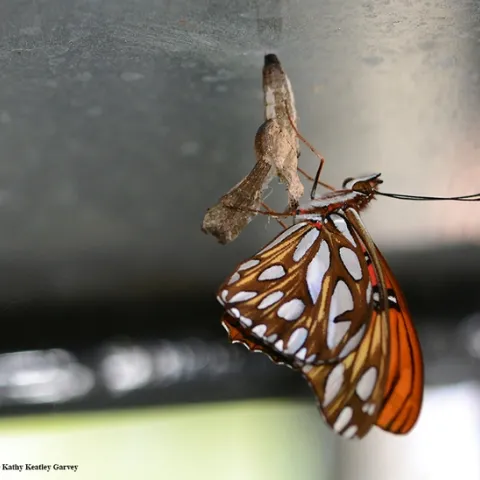
An aggressive caterpillar attacks another 'cat trying to pupate. (Photo by Kathy Keatley Garvey)
Bug Squad: Article

Curiosity Didn't Kill the 'Cat

September 20, 2018
By Kathy Keatley Garvey
Curiosity didn't kill the 'cat. An aggressive 'cat did. We were delighted to find 10 monarch caterpillars (the first of the year!) on our narrowleaf milkweed a couple of weeks ago in our Vacaville pollinator garden--but not so delighted to see what happened to one of them.
View Article
Primary Image
IMG 9293
Choe Laboratory News: Article

Yellowjacket image was selected for a cover photo of JEE

September 20, 2018
By Dong Hwan Choe
The yellowjacket image we used for a recent publication is selected as the cover photo for August 2018 issue of Journal of Economic Entomology. (D.-H. Choe, K. Campbell, M. S. Hoddle, J. Kabashima, M. Dimson, and M. K. Rust. 2018.
View Article
Primary Image
naturescandy
UC CalFresh Tulare / Kings Counties: Article

Nature's Candy Anyone?

September 20, 2018
With the new school year in full swing, UC CalFresh has taken the time to provide students with healthy messages in their school cafeterias! Nutrition corners have been posted in all Hanford Unified elementary schools.
View Article
Primary Image
photos by Betty Homer

White Pomegranate

September 20, 2018
Most people are familiar with a red pomegranate variety called 'Wonderful', which is commonly sold in most nurseries.
View Article
Primary Image
Dr. Beth Grafton-Cardwell in front of the state-of-the-art fruit grader. The equipment purchase was funded by the Citrus Research Board.
ANR News Blog: Article

Citrus Research Board relies on UC ANR scientists

September 20, 2018
By Jeannette Warnert
The Citrus Research Board is celebrating 50 years of careful scientific study to improve the sustainability of the California citrus industry, worth more than $7 billion per year.
View Article
ANR Adventures: Article

Need to look to new ways of solving challenges

September 20, 2018
By Wendy Powers
Did you happen to see the nice callout in Western Farm Press that UC ANR received? The piece cited the important work that personnel around the state do to provide science and support to the agriculture community.
View Article
Kern County: Article

Volume 17, Summer 2018

September 20, 2018
Native Pollinators of California Avocado as Affected by Introduced Pollinator Gardens Which Way World Avocados?
View Article
Noticias: Article

De salsera a educadora, Myriam Acevedo

September 20, 2018
By Miguel Sanchez
Myriam Acevedo, no recuerda con certeza que lleg primero a su vida de nia, si las zapatillas para bailar la Salsa, que le encanta hasta la fecha, o las muecas con las que jugaba a la mam, todo es parte de su cultura en su natal Puerto Rico.
View Article