A Natural Solution for California's Herds: African Catfish Peptides

California's cattle producers and agricultural communities are all too familiar with the rising challenge of antibiotic resistance, making common bacterial infections harder to treat in livestock. But imagine a future where we could tackle these infections with a natural, powerful alternative. Our research points to just that: antimicrobial peptides (AMPs) found in African catfish.

We're really excited about these peptides because African catfish thrive in pathogen-rich freshwater, naturally producing these robust immune compounds in their skin mucus as a defense. This natural origin makes them highly appealing alternatives to synthetic drugs.

Predicted Safety and Potent Action

One of the most compelling aspects of these AMPs is their predicted safety for mammals. Our initial computer analyses suggest that various catfish AMPs are generally recognized as safe (GRAS). We predict they'll be absorbed in the human intestine without causing liver, brain, or heart toxicity. Furthermore, lab tests on a promising peptide, NACAP-II, confirmed it was non-hemolytic, meaning it didn't damage rabbit red blood cells—a strong indicator of its potential safety for mammalian cells.

Beyond safety, these peptides demonstrate effectiveness against problematic bacteria. One study revealed NACAP-II's strong activity against Extended-Spectrum Beta-Lactamase (ESBL)-producing Escherichia coli—a critical concern for both animal and human health due to its resistance to many common antibiotics. Another peptide, ACAP-IV, also showed antibacterial activity against E. coli and Staphylococcus aureus. We believe these AMPs work by directly disrupting bacterial cell membranes, a mechanism that makes it harder for bacteria to develop resistance compared to how they resist traditional antibiotics.
Primary Image
Diaphorencyrtus
Topics in Subtropics: Article

A New Natural Enemy of Asian Citrus Psyllid

March 10, 2015
By Ben A Faber
Mark Hoddle of UC Riverside Entomology Department has intorduced a second species of natural enemy of Asian Citrus Psyllid (ACP), Diaphoencyrtus aligarhensis, imported from Punjab, Pakistan. It was officially released December 16, 2014 at the Biological Control Grove at UCR.
View Article
Primary Image
A honey bee heads for lupine. (Photo by Kathy Keatley Garvey)

Loving the Lupine

March 9, 2015
By Kathy Keatley Garvey
It's a given: Honey bees love lupine. We watched them buzzing around a flower patch of blue (lupine) and gold (California poppies) today along Hopkins Road, University of California, Davis, west of the central campus. Those are Aggie colors: blue and gold.
View Article

Stored Rice Insect Pest Management Workshop

March 9, 2015
By Luis Espino
Stored Product Insect Pest Management in Rice Mills and Storage Facilities Workshop Optimizing Insect Control and Grain Quality Sponsored by University of California Cooperative Extension and Lundberg Family Farms April 7, 2015 9:00 am 3:00 pm Lundberg Family Farms 5311 Midway Richvale, CA 95974 We...
View Article
UC Weed Science (weed control, management, ecology, and minutia): Article

New directions for weed science

March 7, 2015
By Steven A Fennimore
There are few new herbicide active ingredients in the pipeline now. In the 1970s and 1980s several new active ingredients were introduced every year. There were lots of jobs in industry and weed science was the place to be. I myself was with ICI/Zeneca from 1983 to 1994 in their R&D group.
View Article
Primary Image
Ventral view: a cabbage white butterfly sprayed pink. (Photo by Greg Kareofelas)

In the Pink?

March 6, 2015
By Kathy Keatley Garvey
He's never seen anything like it. A pink cabbage white butterfly? Pieris rapae are not pink--they're white Yet there it was, flying around Cypress Lane in West Davis around noon Thursday, March 15. It was sporting a new do, a strange pinkish/red hue.
View Article
Primary Image
citrus greening
Topics in Subtropics: Article

Citrus Greening or Regreening?

March 6, 2015
By Ben A Faber
Huanglongbing or Citrus Greening caused by Asian Citrus Psyllid and its associated bacterium Candidatus Liberibacter A. causes misshapened fruit and causes the fruit to have a green portion on the skin. Hence the name citrus greening.
View Article
Primary Image
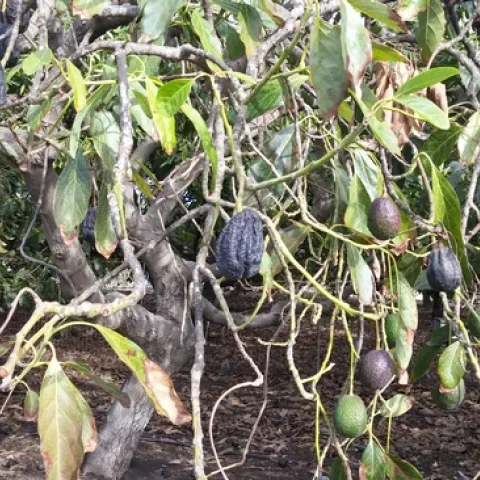
asphyxiated avocado
Topics in Subtropics: Article

New UC IPM photo repository shows plant damage from herbicides

March 5, 2015
By Ben A Faber
UC Statewide IPM Program Identifying nontarget crop and ornamental plant damage from herbicides has become much easier with the launch of a new online photo repository by the Statewide IPM Program, University of California Division of Agriculture and Natural Resources.
View Article