A Natural Solution for California's Herds: African Catfish Peptides

California's cattle producers and agricultural communities are all too familiar with the rising challenge of antibiotic resistance, making common bacterial infections harder to treat in livestock. But imagine a future where we could tackle these infections with a natural, powerful alternative. Our research points to just that: antimicrobial peptides (AMPs) found in African catfish.

We're really excited about these peptides because African catfish thrive in pathogen-rich freshwater, naturally producing these robust immune compounds in their skin mucus as a defense. This natural origin makes them highly appealing alternatives to synthetic drugs.

Predicted Safety and Potent Action

One of the most compelling aspects of these AMPs is their predicted safety for mammals. Our initial computer analyses suggest that various catfish AMPs are generally recognized as safe (GRAS). We predict they'll be absorbed in the human intestine without causing liver, brain, or heart toxicity. Furthermore, lab tests on a promising peptide, NACAP-II, confirmed it was non-hemolytic, meaning it didn't damage rabbit red blood cells—a strong indicator of its potential safety for mammalian cells.

Beyond safety, these peptides demonstrate effectiveness against problematic bacteria. One study revealed NACAP-II's strong activity against Extended-Spectrum Beta-Lactamase (ESBL)-producing Escherichia coli—a critical concern for both animal and human health due to its resistance to many common antibiotics. Another peptide, ACAP-IV, also showed antibacterial activity against E. coli and Staphylococcus aureus. We believe these AMPs work by directly disrupting bacterial cell membranes, a mechanism that makes it harder for bacteria to develop resistance compared to how they resist traditional antibiotics.
Primary Image
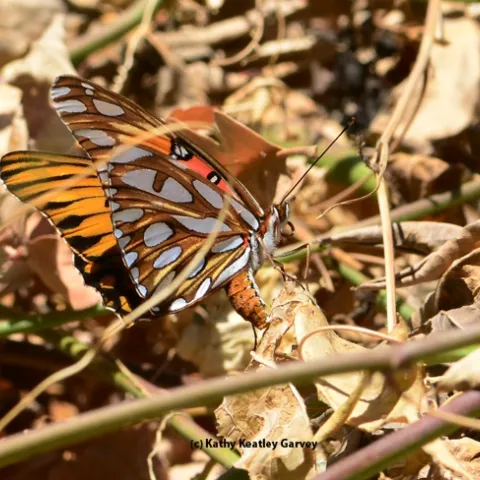
Buckeye butterfly on sedum. Note the missing chunks of its wings. (Photo by Kathy Keatley Garvey)

A Miss Is as Good as a Mile

September 12, 2013
By Kathy Keatley Garvey
A miss is as good as a mile...or a smile. The Buckeye (Junonia coenia) is a striking butterfly patterned with eyespots and white bars. We saw one today nectaring on sedum, but with chunks of a wing missing. Perhaps a bird or a praying mantis tried to grab it. It narrowly escaped predation.
View Article
Primary Image
Apiculturist Dewey Caron at a Western Apicultural Society meeting. (Photo by Kathy Keatley Garvey)

Honey Bee Biology

September 11, 2013
By Kathy Keatley Garvey
The newly revised book, Honey Bee Biology and Beekeeping, by Dewey Caron with Lawrence (Larry) John Connor, is a wealth of information. Published by Wicwas Press of Kalamazoo, Mich., it doubles as a university textbook and a "how-to" resource for beekeepers.
View Article
Primary Image
S-AV-CULT-IR[1]
Topics in Subtropics: Article

Citrus and Avocado Leaf Analysis

September 11, 2013
By Ben A Faber
Its that time of year when citrus and avocado growers need to collect leaf samples for nutrient analysis to guide fertilizer applications. Leaves are collected between August 15 and October 15 and sent to the lab for analysis.
View Article
Primary Image
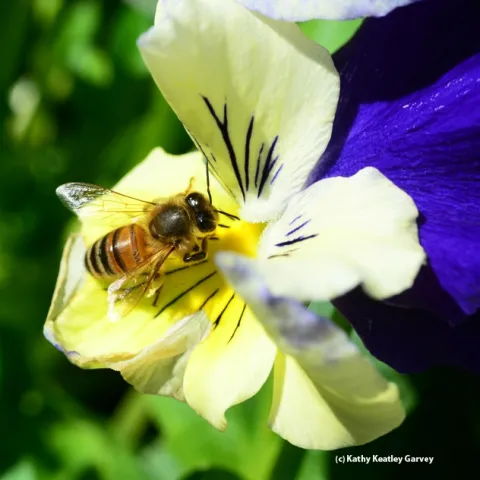
Honey bee foraging on a tidy tips wildflower, Layia platyglossa. (Photo by Kathy Keatley Garvey)

About That Bee Nutrition...

September 10, 2013
By Kathy Keatley Garvey
Honey bee guru Eric Mussen never misses an opportunity to talk about the importance of honey bee nutrition It's critical issue.
View Article
Primary Image
image 18054
IGIS: Article

Fall 2013 GIS class ideas...

September 10, 2013
By Maggi Kelly
Here are the tag clouds from this year's GIS class: the why, how and what of our upcoming semester's projects. Word clouds from Wordle. The Why: what are the key problems class members want to focus on... The How: possible methods we will use... The What: some of the datasets that might be used...
View Article
Primary Image
Backlit honey bee heading toward tower of jewels in the early morning. (Photo by Kathy Keatley Garvey)

To Bee or Not to Bee--a Photographer

September 9, 2013
By Kathy Keatley Garvey
To bee or not to bee--a photographer. Capturing images of honey bees is a delightful leisure activity. You don't have to sign up for a safari on another continent, or invest in thousands of dollars worth of camera gear.
View Article
Primary Image
smog
Topics in Subtropics: Article

Volatile Organic Compound (VOC) Emissions from Pesticides

September 9, 2013
By Ben A Faber
(This article summarizes California Department of Pesticide Regulations online VOC information.) Its that time of year again when hot weather fuels the creation of ground-level ozone, also called smog. High levels of ozone can harm people and crops.
View Article
Primary Image
image 18021
IGIS: Article

Welcome to Fall 2013!

September 9, 2013
By Maggi Kelly
Fall semester is here! Summer was a great adventure, with a terrific Intro to GIS workshop at the Forest Camp (see Sam's photo below), and a just fantastic workshop down at Google where we learned about some really cool new Google tools with former Kellylabber Karin Tuxen and the rest of the Google...
View Article
Primary Image
A female Valley carpenter bee is covered with yellow pollen. (Photo by Kathy Keatley Garvey)

Passionate About the Passionflower Vines

September 6, 2013
By Kathy Keatley Garvey
Valley carpenter bees are passionate about passionflower vines (Passiflora). You see these black bees foraging on the blossoms. Tiny grains of golden pollen, looking like gold dust, dot the thorax. Their loud buzz frightens many a person, but wait, they're pollinators.
View Article
Primary Image
avocado
Topics in Subtropics: Article

Read all about it! Read all about it!

September 6, 2013
By Ben A Faber
UCCE Farm Advisor Gary Bender finally has his 14 chapter book on avocado history, botany and cultural practices on the San Diego County web site. Check it out: http://ucanr.
View Article