A Natural Solution for California's Herds: African Catfish Peptides

California's cattle producers and agricultural communities are all too familiar with the rising challenge of antibiotic resistance, making common bacterial infections harder to treat in livestock. But imagine a future where we could tackle these infections with a natural, powerful alternative. Our research points to just that: antimicrobial peptides (AMPs) found in African catfish.

We're really excited about these peptides because African catfish thrive in pathogen-rich freshwater, naturally producing these robust immune compounds in their skin mucus as a defense. This natural origin makes them highly appealing alternatives to synthetic drugs.

Predicted Safety and Potent Action

One of the most compelling aspects of these AMPs is their predicted safety for mammals. Our initial computer analyses suggest that various catfish AMPs are generally recognized as safe (GRAS). We predict they'll be absorbed in the human intestine without causing liver, brain, or heart toxicity. Furthermore, lab tests on a promising peptide, NACAP-II, confirmed it was non-hemolytic, meaning it didn't damage rabbit red blood cells—a strong indicator of its potential safety for mammalian cells.

Beyond safety, these peptides demonstrate effectiveness against problematic bacteria. One study revealed NACAP-II's strong activity against Extended-Spectrum Beta-Lactamase (ESBL)-producing Escherichia coli—a critical concern for both animal and human health due to its resistance to many common antibiotics. Another peptide, ACAP-IV, also showed antibacterial activity against E. coli and Staphylococcus aureus. We believe these AMPs work by directly disrupting bacterial cell membranes, a mechanism that makes it harder for bacteria to develop resistance compared to how they resist traditional antibiotics.
Primary Image
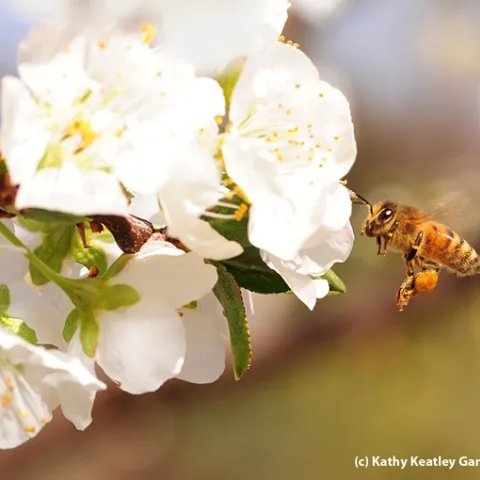
A golden honey bee nectaring lavender. Seventeen states list the honey bee as their state insect. (Photo by Kathy Keatley Garvey)
Bug Squad: Article

Know Your State Insect(s)

October 25, 2012
By Kathy Keatley Garvey
Quick, what's the state insect of South Dakota? If you answered "the European honey bee," you're right.
View Article
Primary Image
Honey bee heading for borage. (Photo by Kathy Keatley Garvey)
Bug Squad: Article

Blue October

October 24, 2012
By Kathy Keatley Garvey
It's "Orange October" for the San Francisco Giants, who just defeated the Detroit Tigers in the opening game of the World Series. But over at the Luther Burbank's Gold Ridge Experiment Farm at 7781 Bodega Ave., Sebastopol, it's Blue October.
View Article
Primary Image
GHG table
UC Rice Blog: Article

Rice contribution to greenhouse gas production

October 24, 2012
By Luis Espino
I recently read an interesting article that forecasts the production of greenhouse gases (GHG) from ricelands by the end of the 21st century1. The authors used data from 63 studies conducted in 30 different locations in 8 different countries.
View Article
Primary Image
Madagascar hissing cockroaches are a big attraction at the Bohart Museum of Entomology. (Photo by Kathy Keatley Garvey)
Bug Squad: Article

Boo, Hiss (What Was THAT?)

October 23, 2012
By Kathy Keatley Garvey
When you combine a "boo" with a "hiss," what do you get? The Bohart Museum of Entomology's annual pre-Halloween open house. The "boo"--in the way of costumes and decorations--is traditional. The hiss? That's the sound emanating from the Madagascar hissing cockroaches, aka "hissers.
View Article
Primary Image
Gulf Fritillary butterfly showing signs of a predatory miss. (Photo by Kathy Keatley Garvey)
Bug Squad: Article

Close Call

October 22, 2012
By Kathy Keatley Garvey
Whew! That was close! When you see a butterfly with a gaping hole in its wingspan, you wonder what predator tried to grab it. A praying mantis? A bird? A crab spider or jumping spider? A playful cat or dog? Whatever tried to grab it, it missed.
View Article
Primary Image
A jumping spider on a pink rose soaks in some sun. (Photo by Kathy Keatley Garvey)
Bug Squad: Article

Why Spiders Are Not Insects

October 19, 2012
By Kathy Keatley Garvey
It's almost time for Halloween, when all self-respecting little ghosts, goblins and ghouls take a special interest in spiders. We saw this little jumping spider (below) on a pink rose. It doesn't look like it could scare anything--except for maybe a sweat bee or hover fly.
View Article
Primary Image
A frame of honey from the Harry H. Laidlaw Jr. Honey Bee Research Facility, UC Davis. (Photo by Kathy Keatley Garvey)
Bug Squad: Article

Debut Event of UC Davis Honey and Pollination Center

October 18, 2012
By Kathy Keatley Garvey
If you want to know more about honey and pollination, then mark your calendar for Saturday, Oct. 27. That's the date of the debut event of the newly established Honey and Pollination Center of the Robert Mondavi Institute for Wine and Food Science (RMI).
View Article
Colusa County: Article

Sacramento Valley Almond News

October 18, 2012
Introduction to Almond Production meetings Pocket Gopher Management for Autumn Annual Almond Conference moved to Sacramento Hull Rot Leaf Blight Navel Orangeworm Weed Management...
View Article
Primary Image
Syrphid fly (right) circles a blanket flower, unaware of the jumping spider. (Photo by Kathy Keatley Garvey)
Bug Squad: Article

A Bug-Eat-Bug World

October 17, 2012
By Kathy Keatley Garvey
It's a bug-eat-bug world out there. Today we watched a syrphid fly, aka "hover fly" and "flower fly," circling a blanket flower (Gaillardia) and then touching down to sip a little nectar. Syrphids are called "hover flies" for good reason. They "hover" over a blossom, helicoperlike.
View Article
Primary Image
Leaffooted bug nymphs, Leptoglossus clypealis. (Photo by Kathy Keatley Garvey)
Bug Squad: Article

Well, Hello There!

October 16, 2012
By Kathy Keatley Garvey
At first they appeared on our pomegranate tree, our 85-year-old pomegranate tree. Then they migrated over to our passion flower vine, Passiflora, where we're trying to rear Gulf Fritillary butterflies (Agraulis vanillae). They're leaffooted bug nymphs, Leptoglossus clypealis.
View Article