A Natural Solution for California's Herds: African Catfish Peptides

California's cattle producers and agricultural communities are all too familiar with the rising challenge of antibiotic resistance, making common bacterial infections harder to treat in livestock. But imagine a future where we could tackle these infections with a natural, powerful alternative. Our research points to just that: antimicrobial peptides (AMPs) found in African catfish.

We're really excited about these peptides because African catfish thrive in pathogen-rich freshwater, naturally producing these robust immune compounds in their skin mucus as a defense. This natural origin makes them highly appealing alternatives to synthetic drugs.

Predicted Safety and Potent Action

One of the most compelling aspects of these AMPs is their predicted safety for mammals. Our initial computer analyses suggest that various catfish AMPs are generally recognized as safe (GRAS). We predict they'll be absorbed in the human intestine without causing liver, brain, or heart toxicity. Furthermore, lab tests on a promising peptide, NACAP-II, confirmed it was non-hemolytic, meaning it didn't damage rabbit red blood cells—a strong indicator of its potential safety for mammalian cells.

Beyond safety, these peptides demonstrate effectiveness against problematic bacteria. One study revealed NACAP-II's strong activity against Extended-Spectrum Beta-Lactamase (ESBL)-producing Escherichia coli—a critical concern for both animal and human health due to its resistance to many common antibiotics. Another peptide, ACAP-IV, also showed antibacterial activity against E. coli and Staphylococcus aureus. We believe these AMPs work by directly disrupting bacterial cell membranes, a mechanism that makes it harder for bacteria to develop resistance compared to how they resist traditional antibiotics.
Primary Image
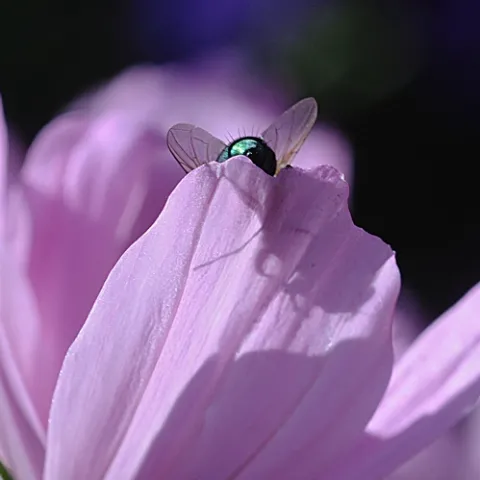
The parasitic tachinid fly feeds on nectar in the Storer Gardens, UC Davis Arboretum. (Photo by Kathy Keatley Garvey)
Bug Squad: Article

Pity the Poor Caterpillar

October 9, 2008
Pity the poor caterpillar. Here you are, minding your own business, and this tachinid fly comes along and lays eggs in your head. Good day for the tachinid fly. Bad day for the caterpillar.
View Article
Primary Image
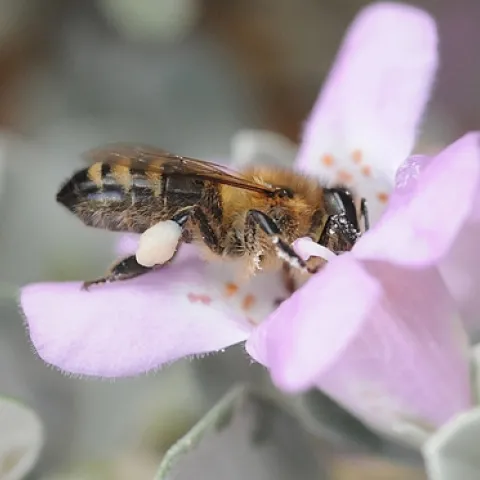
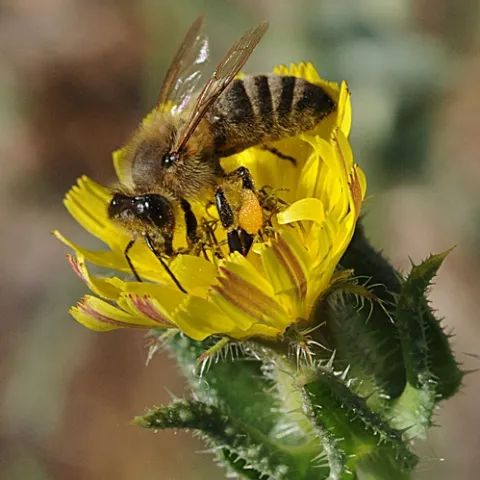
A pollen-packed honey bee dips her head in cenizo in the Storer Gardens, UC Davis Arboretum.(Photo by Kathy Keatley Garvey)
Bug Squad: Article

Cenizo!

October 8, 2008
If you've ever visited the Storer Gardens, UC Davis Aboretum, you've probably noticed the honey bees enjoying the cenizo(Leucophyllum frutescens), an evergreen shrub with silvery foliage and bell-shaped pinkish-lavender flowers.
View Article
Primary Image
A pollen-packed honey bee curls up in a pomegranate blossom. (Photo by Kathy Keatley Garvey)
Bug Squad: Article

Queen of the Crops

October 7, 2008
We often hear of "cream of the crop," but the honey bee is the "queen of the crops." Honey bees are crucial to Californias $32 billion agriculture industry.
View Article
Primary Image
The praying mantis, camouflaged, lies in wait. Hmmm, is that camera edible?(Photo by Kathy Keatley Garvey)
Bug Squad: Article

What's for Dinner?

October 6, 2008
The praying mantis isn't at all concerned about culinary choices. It doesn't worry about who's coming to dinner, only that dinner will come. This aggressive, predatory insect will eat just about anything it can get its claws on, entomologists agree.
View Article
Primary Image
See the ceramic hive on this sign at the Harry H. Laidlaw Jr. Honey Bee Research Facility? The black hole leads to a real hive, located in back of the sign. (Photo by Kathy Keatley Garvey)
Bug Squad: Article

The Secret's Out

October 3, 2008
The secret's out. Or, rather, the secret's in. Inside. A number of years ago, UC Davis entomologist Diane Ullman created a ceramic sign outside the Harry H. Laidlaw Jr. Honey Bee Research Facility, located on Bee Biology Road, west of the UC Davis campus.
View Article
Primary Image
A honey bee checks out a minute black scavenger fly at the Harry H. Laidlaw Jr. Honey Bee Research Facility, UC Davis. (Photo by Kathy Keatley Garvey)
Bug Squad: Article

The Bee and the Fly

October 2, 2008
UC Davis forensic entomologist Robert Kimsey is a genius, to be sure. Show him a fly and he'll tell you exactly what it is and what it's all about. I shot this photo at the Harry H. Laidlaw Jr. Honey Bee Research Facility at UC Davis. The honey bee looked huge and the fly, tiny.
View Article
Primary Image
The honey bee, resplendent here with silvery wings, is gold to the global economy. (Photo by Kathy Keatley Garvey)
Bug Squad: Article

What Price Pollination?

October 1, 2008
What are insect pollinators worth to the global economy? Well, it's a lot less than the Wall Street bailout...er...rescue plan. Recent research published in the journal Ecological Economics reveals just how important insect pollinators are.
View Article
Primary Image
A ladybug crawls along the leaf of a Russian sage. (Photo by Kathy Keatley Garvey)
Bug Squad: Article

Seeing Spots

September 30, 2008
If you spot a ladybug, don't just start reciting "Ladybug, ladybug, fly away home." Aim, click and shoot. With a camera, that is. Agricultural Research Service scientists and entomologists at Cornell University, Ithaca, N.Y.
View Article
Primary Image
A honey bee can't wait for the Calandrinia grandiflora to open. (Photo by Kathy Keatley Garvey)
Bug Squad: Article

Heaven Can Wait

September 29, 2008
They danced in it, rolled in it, and bathed in it. The honey bees just couldn't get enough of the rock purslane (Calandrinia grandiflora). Last week when we visited Vacaville's El Rancho Nursery and Landscaping. nursery, owned by Ray and Maria Lopez, it was like a free-for-all at the French Laundry.
View Article
Bug Squad: Article

Getting the Red In

September 26, 2008
If you love pomegranates, you can thank a honey bee. If you love capturing images of pomegranates, you can thank a honey bee. And, if you love juicing them and making pomegranate jellyas I doyou can thank a honey bee. The honey bee makes it all possible.
View Article