A Natural Solution for California's Herds: African Catfish Peptides

California's cattle producers and agricultural communities are all too familiar with the rising challenge of antibiotic resistance, making common bacterial infections harder to treat in livestock. But imagine a future where we could tackle these infections with a natural, powerful alternative. Our research points to just that: antimicrobial peptides (AMPs) found in African catfish.

We're really excited about these peptides because African catfish thrive in pathogen-rich freshwater, naturally producing these robust immune compounds in their skin mucus as a defense. This natural origin makes them highly appealing alternatives to synthetic drugs.

Predicted Safety and Potent Action

One of the most compelling aspects of these AMPs is their predicted safety for mammals. Our initial computer analyses suggest that various catfish AMPs are generally recognized as safe (GRAS). We predict they'll be absorbed in the human intestine without causing liver, brain, or heart toxicity. Furthermore, lab tests on a promising peptide, NACAP-II, confirmed it was non-hemolytic, meaning it didn't damage rabbit red blood cells—a strong indicator of its potential safety for mammalian cells.

Beyond safety, these peptides demonstrate effectiveness against problematic bacteria. One study revealed NACAP-II's strong activity against Extended-Spectrum Beta-Lactamase (ESBL)-producing Escherichia coli—a critical concern for both animal and human health due to its resistance to many common antibiotics. Another peptide, ACAP-IV, also showed antibacterial activity against E. coli and Staphylococcus aureus. We believe these AMPs work by directly disrupting bacterial cell membranes, a mechanism that makes it harder for bacteria to develop resistance compared to how they resist traditional antibiotics.
Primary Image
THE LADYBUG--The ladybug is an indicator of health and sustainability in olive orchards, scientists in Spain have found. (Photo by Kathy Keatley Garvey)
Bug Squad: Article

Another Good Reason

January 9, 2009
By Kathy Keatley Garvey
Heres another good reason to be kind to ladybugs. But we are, arent we? EurekAlert! alerted us Jan. 6 to a study relating that an abundance of ladybugs in olive orchards is an indicator of health and sustainability.
View Article
Primary Image
AT THE RECEPTION--From left are entomologist Diane Ullman, associate dean of Undergraduate Academic Programs, College of Agricultural and Environmental Sciences, and co-director of the UC Davis Art/Science Fusion experimental learning program; artist Catherine Chalmers; and UC Davis Department of Art faculty members Matthias Geiger and Darrin Martin. (Photo by Kathy Keatley Garvey)
Bug Squad: Article

The Insect We Love to Hate

January 8, 2009
By Kathy Keatley Garvey
Catherine Chalmers hates cockroaches. She said so at her presentation Wednesday night, Jan. 7, at UC Davis. The occasion: The Consilience of Art and Science centennial colloquium, sponsored by the UC Davis Art/Science Fusion experimental learning program. We have an adversarial relationship.
View Article
Primary Image
LARVAE INSIDE WALNUT--This fallen walnut contained three larvae. (Photo by Kathy Keatley Garvey)
Bug Squad: Article

Aw, Nuts!

January 7, 2009
By Kathy Keatley Garvey
Walnuts are packed with vitamins, minerals and antioxidants, right? Right. And sometimes a little protein. Protein, as in larvae. That's not a welcome sight. Sometimes you'll find two or three navel orangeworm (NOW) larvae inside a single walnut, along with copious amounts of webbing and frass.
View Article
Primary Image
BACK TO UC DAVIS--After receiving his doctorate in population biology at UC Davis in 2006 and then serving as a UC President's Postdoctoral Fellow in the Department of Ecology, Evolution and Marine Biology at UC Santa Barbara, Louie Yang is back at UC Davis. He joined the Department of Entomology faculty on Jan. 2. (Photo by Kathy Keatley Garvey)
Bug Squad: Article

Back to UC Davis

January 6, 2009
By Kathy Keatley Garvey
DAVISHe's back. Entomology folks at UC Davis remember when Louie Yang was a doctoral candidate, studying population biology with major professor Rick Karban.
View Article
Primary Image
LUCKY BUG--This ladybug soaks up sunshine after being discovered in a garbage can. Her two-legged rescuers saved her from a trip to the landfill.(Photo by Kathy Keatley Garvey)
Bug Squad: Article

The L-Bug

January 5, 2009
By Kathy Keatley Garvey
There she was, snuggled beneath a garbage can lid, seeking warmth as temperatures dipped to freezing levels. She was lucky. It was City Garbage Pick-Up Day. She could have been trucked to the local landfill had we not rescued her. Luck be a lady and she was.
View Article
Primary Image
PISTACHIO LOVER--This navel orangeworm showed a preference for pistachios. (Photo by Kathy Keatley Garvey)
Bug Squad: Article

Penchant for Pistachios Leads to Startling Find

January 2, 2009
By Kathy Keatley Garvey
Chemical ecologists at the University of California, Davis, are changing their navel-orangeworm research direction after an elementary school students science project found that the major agricultural pest prefers pistachios over almonds and walnuts.
View Article
Primary Image
ROCK PURSLANE--The magenta-colored rock purslane (Calandrinia grandiflora) is a favorite of honey bees. (Photo by Kathy Keatley Garvey)
Bug Squad: Article

Twenty-Nine Days to Go

January 1, 2009
By Kathy Keatley Garvey
Twenty-nine days to go. If you love bees and know how to design a bee friendly garden, remember Jan. 30. Jan. 30 is the deadline to submit your design for the half-acre bee friendly garden at the Harry H. Laidlaw Jr. Honey Bee Research Facility, UC Davis.
View Article
Primary Image
TURN OVER A NEW LEAF--and there's a praying mantis. (Photo by Kathy Keatley Garvey)
Bug Squad: Article

Turning Over a New Leaf

December 31, 2008
By Kathy Keatley Garvey
For my New Year's resolution, I resolve to turn over a new leaf. Oh, sure, most folks resolve to eat less, exercise more, drink less, read more, stress less, save more, gripe less, and volunteer more. Not me. I'm turning over a new leaf.
View Article
Primary Image
BLUE BUTTERFLY--This butterfly in the live butterfly display at the Entomological Society of America's recent meeting in Reno prompted photographers to aim, focus and shoot. (Photo by Kathy Keatley Garvey)
Bug Squad: Article

Flying Flower

December 30, 2008
By Kathy Keatley Garvey
Ponce Denis couchard Lebrun compared the butterfly to a flying flower: The butterfly is a flying flower, The flower a tethered butterfly. At the recent Entomological Society of America meeting in Reno, a blue butterfly drew the attention of lepidopterists and photographers alike.
View Article
Primary Image
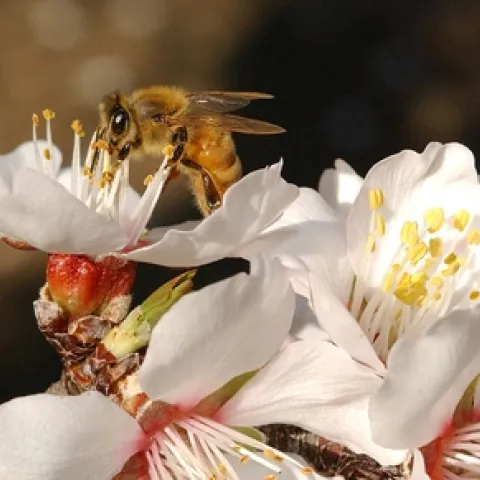
GATHERING NECTAR--This honey bee at the University of California, Davis, is gathering nectar on Cenizo (Leucophyllum frutescens). Newly published research from the University of Illinois finds that honey bees on cocaine dance more, and that the bees are motivated by feelings of reward. (Photo by Kathy Keatley Garvey)
Bug Squad: Article

What a Buzz!

December 29, 2008
By Kathy Keatley Garvey
Right out of Champaign, Ill., comes a research story about honey bees on coke. Cocaine. University of Illinois entomology and neuroscience professor Gene Robinson and his colleagues have found that honey bees on cocaine dance more.
View Article