A Natural Solution for California's Herds: African Catfish Peptides

California's cattle producers and agricultural communities are all too familiar with the rising challenge of antibiotic resistance, making common bacterial infections harder to treat in livestock. But imagine a future where we could tackle these infections with a natural, powerful alternative. Our research points to just that: antimicrobial peptides (AMPs) found in African catfish.

We're really excited about these peptides because African catfish thrive in pathogen-rich freshwater, naturally producing these robust immune compounds in their skin mucus as a defense. This natural origin makes them highly appealing alternatives to synthetic drugs.

Predicted Safety and Potent Action

One of the most compelling aspects of these AMPs is their predicted safety for mammals. Our initial computer analyses suggest that various catfish AMPs are generally recognized as safe (GRAS). We predict they'll be absorbed in the human intestine without causing liver, brain, or heart toxicity. Furthermore, lab tests on a promising peptide, NACAP-II, confirmed it was non-hemolytic, meaning it didn't damage rabbit red blood cells—a strong indicator of its potential safety for mammalian cells.

Beyond safety, these peptides demonstrate effectiveness against problematic bacteria. One study revealed NACAP-II's strong activity against Extended-Spectrum Beta-Lactamase (ESBL)-producing Escherichia coli—a critical concern for both animal and human health due to its resistance to many common antibiotics. Another peptide, ACAP-IV, also showed antibacterial activity against E. coli and Staphylococcus aureus. We believe these AMPs work by directly disrupting bacterial cell membranes, a mechanism that makes it harder for bacteria to develop resistance compared to how they resist traditional antibiotics.

Primary Image
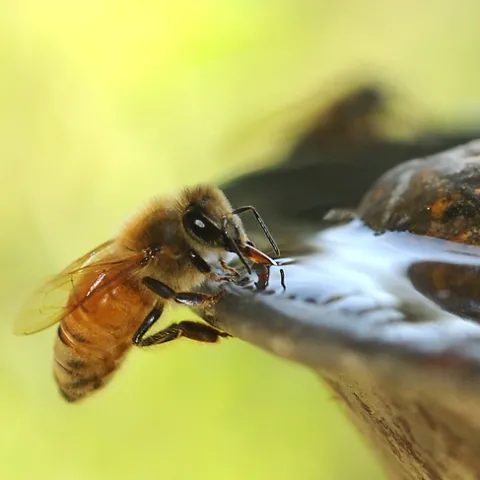
GATHERING NECTAR--This honey bee at the University of California, Davis, is gathering nectar on Cenizo (Leucophyllum frutescens). Newly published research from the University of Illinois finds that honey bees on cocaine dance more, and that the bees are motivated by feelings of reward. (Photo by Kathy Keatley Garvey)
Bug Squad: Article

What a Buzz!

December 29, 2008
By Kathy Keatley Garvey
Right out of Champaign, Ill., comes a research story about honey bees on coke. Cocaine. University of Illinois entomology and neuroscience professor Gene Robinson and his colleagues have found that honey bees on cocaine dance more.
View Article
Primary Image
DEAD BEES--Drones are pushed out of the hive, cold and hungry, as the honey-gathering season ends and the weather turns colder. Some of these bees are drones (males) and some are worker bees (infertile females). This photo was taken Dec. 20, 2008. (Photo by Kathy Keatley Garvey)
Bug Squad: Article

Not Brotherly Love

December 26, 2008
By Kathy Keatley Garvey
'Tis the season for brotherly love, but not in the bee hive. As the honey-gathering season ends and the weather turns colder, the worker bees (infertile females) push their brothers--the drones--out of the hive. Drones are of no use to the colony in the winter. They're another mouth to feed.
View Article
Primary Image
BEELINE--A pollen-packed honey bee makes a beeline for a red-hot poker, variety "Christmas Cheer," in the Storer Gardens at UC Davis. The date: Dec. 20, five days before Christmas. (Photo by Kathy Keatley Garvey)
Bug Squad: Article

Christmas Cheer

December 25, 2008
By Kathy Keatley Garvey
I always thought the red-hot poker was primarily red. Not. This one in the Storer Gardens at the University of California, Davis, was mostly yellow. It was Saturday, Dec.
View Article
Primary Image
LADYBUG--You should treat the ladybug with kid gloves; it's a beneficial insect. Here a ladybug, aka lady beetle, crawls on a gardener's glove. (Photo by Kathy Keatley Garvey)
Bug Squad: Article

Christmas Bug

December 24, 2008
By Kathy Keatley Garvey
If there ever were a Christmas bug, it would be the ladybug, aka lady beetle. The insects (family Coccinellidae) are brightly colored and spread joy in the garden when they feast on aphids. Last summer we enjoyed watching them hanging out and hooking up.
View Article
Primary Image
A HONEY OF A BEE--Newly published research in the journal Current Biology finds that the buzz of honey bee wings scares off plant predators, like caterpillars. This bee is gathering nectar from a guara. (Photo by Kathy Keatley Garvey)
Bug Squad: Article

Superman, Meet the Super Girls

December 23, 2008
By Kathy Keatley Garvey
You're sitting around discussing the importance of honey bees. The points include: they give us honey, they pollinate agricultural crops, and they serve as an example of a well-organized society. But wait, there's more. They scare off plant predators.
View Article
Primary Image
DOUBLE VISION?--Keep your eyes open for a cabbage white butterfly in California's Central Valley (Sacramento, Solano or Yolo counties). UC Davis professor Arthur Shapiro will trade a pitcher of beer for the first cabbage white of 2009. This photo was taken Sept. 7, 2008. (Photo by Kathy Keatley Garvey)
Bug Squad: Article

Beer for a Butterfly

December 22, 2008
By Kathy Keatley Garvey
Seen any cabbage whites lately? If you capture one before UC Davis professor Arthur Shapiro does, he'll trade you a beer for your butterfly. Actually, a pitcher of beer or its cash equivalent. Yes, it's time for Shapiro's 38th annual Butterfly-for-Beer contest.
View Article
Primary Image
HMMMM--Randy Veirs of the UC Davis Department of Entomology, admires the ladybug cupcakes his wife made for the entomology office. (Photo by Kathy Keatley Garvey)
Bug Squad: Article

Eat a Bug

December 19, 2008
By Kathy Keatley Garvey
You CAN have your cake and eat it, too. You can also "have your BUG and eat it, too." Even if you're not into entomophagy.
View Article
Primary Image
PROTECTIVE GEAR--Beekeepers wear protective gear to ward off bee stings. Here UC Davis beekeeper Kim Fondrk tends his bees. These are not Africanized bees (as mentioned in the text above), but European or Western honey bees. (Photo by Kathy Keatley Garvey)
Bug Squad: Article

Run for Cover

December 18, 2008
By Kathy Keatley Garvey
Who put the killer in killer bees? Someone named B. Melon asked that question on the Strange but True segment of the Web site, readthehook.com. To answer the bee question, Bill Sones and Rich Sones did what many do.
View Article
Primary Image
THE ARTIST--Noted artist Catherine Chalmers will speak on "Sex, Food Chains and Cockroaches" from 6:30 to 8 p.m., Wednesday, Jan. 7 at the Wyatt Pavilion, UC Davis.
Bug Squad: Article

Sex, Food Chains and Cockroaches

December 17, 2008
By Kathy Keatley Garvey
American humorist-entertainer Will Rogers said "I never met a man I didn't like." I wonder if he would have said the same thing about insects. Oh, sure, he probably liked--and appreciated--the butterflies, the honey bees and the ladybugs. But cockroaches? I bet not.
View Article
Primary Image
THE QUEEN--The queen bee (center) lays about 2000 eggs a day during the peak season. Here she's surrounded by worker bees (infertile females). (Photo courtesy of Susan Cobey, Harry H. Laidlaw Jr. Honey Bee Research Facility, UC Davis)
Bug Squad: Article

What Has Five Eyes, Six Legs and Two Pairs of Wings?

December 16, 2008
By Kathy Keatley Garvey
What has five eyes, six legs, two pairs of wings and can fly about 20 miles per hour? Got to be an insect, right? Right. But which one? More hints: Its been around for 30 million years. Its primary form of communication is a chemical called a pheromone. Well, that could be Okay, now it gets easier.
View Article