
By Bonnie Bradt, UC Master Gardener of Nevada County
From The Curious Gardener, Winter 2022
Our planet is getting smaller. Movement of everything, and everyone, is a constant but unpredictable fact. We either import items from countries all over the world or we fly or cruise on huge vessels, any of which can transport extraneous “passengers” clinging to the sides. Movement of goods and people from one area to another is so common that keeping critters in one country from finding their way to another has become almost impossible.
These “exotics”, defined as a species (or their eggs, seeds, spores etc.) which are not native to their current habitat can often become pests in their new home. They may be native somewhere, but often the habitat they have moved into does not possess the biological controls that kept their populations in check in their native homes. Thus, the birth of an invasive pest!! I will try to cover a few of the more famous “invasives” that we will need to watch for, as they are already here in California, just not yet in our counties. For information on the many hundreds of others, see the IPM websites of UC.
Africanized Honey Bees
In any discussion of the invasive and infamous Africanized honey bees (AHBs), originally imported from Africa in the 1950’s for a research study in South America, remember one thing: even the “normal” honey bees that we all know and love, are exotics. They were imported back in the 1600’s from Europe as an aid to the pollination of certain crops that were also imported from Europe. Honey bees in general, are so well adapted to colonize many environments that they have spread all over the planet. It is therefore not surprising that the AHBs have spread from South America, north into the US and finally arrived in California in the 1990’s. They have spread from the southern counties of San Diego, Riverside, Los Angeles etc., north to reach Napa and Sacramento counties and most counties in between including the Bay area. Nevada and Placer counties have not yet seen any Africanized swarms but we should remain vigilant as it may only be a matter of time.
One can’t easily tell the difference between individual European (EHBs) and AHBs so we must watch for possible aggressive behavior of wild hives. Often those at the forefront of such discoveries are exterminators who are called to relocate a hive or swarm. They know to look for highly aggressive behavior in the hive residents and will report such activity. We must do the same. That is the main difference between the AHBs and the EHBs – severe aggression in the defense of the hive. EHBs may defend their hive by sending out a hundred workers to attack the threat and chase them for hundreds of feet from the hive. AHBs may send out thousands of attackers and chase the threat for more than a quarter of a mile. Individual AHBs, however, foraging on local flowers are no more aggressive than their European counterparts. That is why we have not heard of massive numbers of attacks on humans in San Diego and Los Angeles counties where AHBs are common. There is no need to panic, as most of us have spent time in AHB territory without incident. It is also known that AHBs are not well adapted to the cold so our higher elevations may be inhospitable to their local spread. But let’s be on the lookout anyway.
Citrus Greening Disease
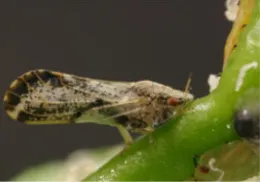
This is a bacterial disease aka Huanglongbing (HLB). It is one of the most serious diseases of citrus in the world. While it poses no danger to humans, it has devastated millions of acres of citrus crops worldwide. It was first described in Asia in the early 1900’s and first detected in the USA in Florida in 2005. It has reduced citrus production by 75% there. By 2012 it had spread across the south into California. It is vectored by a tiny insect called the Asian citrus psyllid. Symptoms of HLB-infected trees include blotchy mottled leaves, stunted growth, reduced fruit size, bitter taste, premature fruit drop, corky veins, and root decline. HLB causes tree death within a few years.
Currently the disease itself has been found in either trees or insects in five southern California counties (Los Angeles, Orange, Riverside, San Bernardino, and San Diego). The counties of Alameda, Contra Costa, Fresno, Kern, Kings, Madera, Marin, Merced, Monterey, Placer, Sacramento, San Benito, San Francisco, San Joaquin, San Luis Obispo, San Mateo, Santa Barbara, Santa Clara, Solano, Stanislaus, Tulare, Ventura and Yolo are at least partially infested with the uninfected psyllid insect vectors, which await only the appearance of the bacterial disease organism in an infected plant, to feed, become infected and spread it to other locations. We must do our part to prevent movement of any kind of citrus including nursery stock, from any infected area. Even a 20% reduction in the acreage of citrus production in California could mean hundreds of thousands of dollars removed from the state’s income. If you suspect an HLB infection, report it to the USDA or the local Ag commissioner’s office in your county.
Japanese Beetle
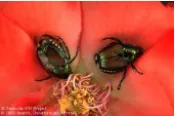
Native to northern Japan, these beetles were first found in New Jersey in 1916, and possibly imported as larvae in a shipment of iris bulbs. The beetles have caused extensive damage in the Eastern USA where they feed on more than 300 species of trees, shrubs, ornamentals and grasses. Almost half a billion dollars per year is spent there to manage this serious pest. For years there have been accidental introductions of this pest into California and so far, each has been eradicated. No populations have become established here. That is due to the vigilance of state agencies which maintain traps throughout the state to detect Japanese beetles in the area. The adults are about ½" long with green head and thorax and copper-colored wing covers. They also have twelve white “spots” around the edge of the wing covers. If you find one or trap one, keep it for identification and give it to your local Ag commissioner’s office or call the CDFA pest hotline, at 800-491-1899.
Sudden Oak Death (Phytophthora ramorum)
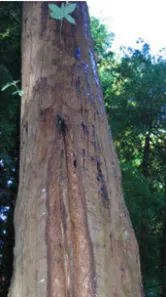
The origin of this dreaded disease of oak and tanoak trees is not known with certainty but is thought to have originated in Asia and been transported to Europe and the USA by commercial or privately collected plants. It is an emerging forest disease associated with extensive tree death in coastal California forests. It is an algae-like organism called a “water mold” and it attacks many different species of host plant, each differing in its ability to transmit the disease and withstand its effects. The disease causes lethal stem cankers on oak trees which “bleed” a sticky red material on the surface of the bark. The cankers spread over time until the tree is girdled and killed. At this time, the disease has not reached our area and is confined to the coastal California forests, but we must keep watch for the cankers which precede the worst of the disease in oak trees and can be accompanied by infestation of Ambrosia beetles which, as with other borers, may take up residence in any weakened tree.
References
- Lin, Wei, and Jakob McBroome, Mahwish Rehman, et al. Africanized bees extend their distribution in California. PLOS One. January 18, 2018. https://journals.plos.org/plosone/article?id=10.1371/journal.pone.0190604
- Frankel, Susan J., and Katharine M. Harrell. Proceedings of the sudden oak death sixth science symposium. USDA/U.S. Forest Service. 2017. https://doi.org/10.2737/PSW-GTR-255
- Windbiel-Rojas, Karey. Seeing Japanese beetles in your California landscape? Not likely. UCANR/Pests in the Urban Landscape. July 10, 2018. https://ucanr.edu/blogs/blogcore/postdetail.cfm?postnum=21937