

Photo by Kevin Marini.
There was a point last year when I started to appreciate the length of time that had gone by since a big fire had occurred. Most of the time, paranoia takes over daily during the summer and it’s hard to recognize “good” fire years in the midst of them. I find myself thinking about fire all year around these days. There is so much concern in our community regarding fire safety—from creating defensible space to getting insurance coverage to knowing your neighborhood escape routes—we have to be proactive on all these things, all the time.
When I was kid, one of my favorite things to do was to hide in the large juniper bushes that circled our home. We had juniper berry wars in the neighborhood as almost every house had the bushes all around their homes. Of course, we now know that it is one of the most flammable plants around and, as a popular foundation planting decades ago, is now something we have to consider removing from around our homes. When it comes to “firewise” plants, we have much more insight (data) into which plants to AVOID rather than which plants to PLANT.
Catching Fire
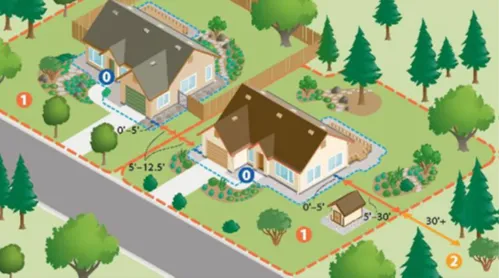
According to Cal Fire, the majority of homes burn down in a wildland fire from embers that fly in, land in landscapes around homes or on the home itself and ignite vegetation or other materials (like outdoor furniture!). This is why there is emphasis on the Ember Ignition Zone—the 0-5 foot area around structures. In many cases, there are shrubs, hedges and organic mulches in this zone that can catch fire from embers and proceed to cause a whole house fire very quickly.
Moving out from this 0-5 feet zone, we have two other defensible space landscape zones: the 5-30 feet lean, clean and green zone and the 30-100 feet reduced fuel zone. Again, in these zones, homeowners may have dense plantings, organic mulches, and other flammable items that need to be assessed and potentially altered to become more resilient to fire. It is crystal clear that the actions we take in our defensible space zones around our house can contribute to improved fire safety.
Landscape Considerations
As convenient as it may seem to swap out all the plants in our landscape with so-called “Firewise” plants and earn landscape fire resilience in that manner, it is not the recommended approach to creating defensible space for many reasons. First, all plants burn—there are no “fireproof” plants, even though some are more resistant to catching fire and burning hot than others. Second, unmaintained plants with dead material in and under them occur all the time in landscapes whether or not the plant itself has live tissue less prone to igniting than others. Finally, the design and organization of plants in the landscape can contribute to the spread of fire towards the home and therefore, simply creating space in the landscape devoid of combustible materials like plants is a much wiser approach to creating defensible space. Let’s look at each one of these components in greater detail.
No “Fireproof” Plants
It’s not only the case that all plants burn but also true that our care of plants influences their ability to be more or less resistant to fire. Furthermore, a plant’s life cycle, seasonal variation, and growth habit can play a big role. Here is an excerpt from UC ANR Publication 8695, “Vegetation and Landscape Guidance”:
A plant’s environment and maintenance generally have more influence on the combustibility of the plant than does its characterization as fire safe or not fire safe. For example, a plant with a good water supply could have a greater growth form (that is, grow taller and wider) and hold leaves longer, whereas a plant in a stressed or drought condition may have stunted growth and accumulate dead materials. Therefore, a certain species may be relatively fire resistant in one environment and less so in another.
It is crucial to differentiate between “Firewise” plant lists and “Plant flammability” lists—there are data on the flammability of some plants, shrubs and trees, but we have no research showing that a certain palette of plants in a landscape confers greater fire resilience than a different palette of plants. Of course, we can make some decisions in our landscape based on plant flammability; for example, avoiding juniper bushes all around our houses!
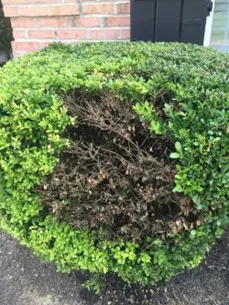
Photo by Kevin Marini
Maintaining Plants
One of the most popular ways of maintaining plants in our landscape is the unfortunate practice of hedging. Rather than taking the time needed to prune correctly and allow woody perennials and shrubs to attain their natural form, the easier and faster approach is simply to constantly shear them back. I call these hedges “ember catchers”; that is, if you peer into the middle of these plants beyond the outside layer of greenery, one finds a perfect spot for embers to land and catch dead material inside the plant on fire. I see these “ember catchers” in defensible space zones in landscapes all over our communities. This needs to change and it has nothing to do with the type of plant but instead with how maintenance is performed.
Many plants listed on “Firewise” plant lists have a period of time where they may be young and lush and resistant to fire but over time become woody and full of dead material (lavender plants being a great example!). Again, this is where specific techniques regarding maintenance of plants can rejuvenate that lush growth and keep them free of accumulating dried out vegetation.
Organizing Landscape Defensible Space Zones
When it comes to landscape design, it is common practice to organize a landscape to maximize varying colors, layers and textures. Defensible space considerations should focus on the “layering” part. There are two types of layering in the landscape that we want to avoid for fire safety: horizontal and vertical layering.
Many people have heard the term “fire ladders”—which refers to a situation where a small plant is under a medium sized plant that is under a large shrub under a large tree—a ladder of vegetation. This type of vertical layering is undesirable as it allows fire to creep upwards into the crowns of trees where embers get spit out.
The same layering applies for horizontal spacing; in many landscapes, there is a constant flow of vegetation from one end of the yard to the other, sometimes all the way to the house. Again, breaking up this layering with SPACING is crucial to stopping the path of fire. This can be achieved through simple plant removal, by grouping plantings in islands but also through the addition of hardscape or pathways to break up paths of vegetation.
Final Thoughts
Over time, more experimentation and research will be done on plants to ascertain their worthiness in Firewise landscapes. Currently, we do not have all the data collected to understand the best way to characterize or utilize “Firewise Plants.” Again, UC ANR Publication 8695 explains:
Be cautious about “fire safe” plant lists and labels. In general, there is little evidence to support fire safe claims. In a recent review of 20 years of plant flammability studies, Bethke et al. (2016) determined that fire safe labels often relied on inconsistent types of testing or no testing at all—in part because, according to the researchers, “no consistent, standardized plant flammability testing or criteria for rating” exists to assess flammability.
For now, let’s remember that the most important elements of creating defensible space don’t rely on utilizing special types of plants. Work on creating a vegetation free Ember Ignition Zone (0-5 feet). Maintain plants so that dead material doesn’t accumulate in or around them (5-30 feet). Remove “ladders” in the landscape and create space (5-100 feet). If these three items are crossed off your list, you are well on your way to improving the resiliency of your landscape when fire approaches.
References
- Valachovic, Yana and Stephen L. Quarles, Steven V. Swain. Reducing the Vulnerability of Buildings to Wildfire: Vegetation & Landscaping Guidance. University of California Agriculture and Natural Resources. July 2021. https://anrcatalog.ucanr.edu/pdf/8695.pdf
- Wildfire Is Coming… Are You Ready? Cal Fire. n.d. https://www.readyforwildfire.org/
- Fernandes, P.M. and M. G. Cruz. 2012. Plant Flammability Experiments Offer Limited Insight Into Vegetation—Fire Dynamic Interactions. New Phytologist 194: 606-609. https://www.researchgate.net/publication/221790438_Plant_flammability_experiments_offer_limited_insight_into_vegetation-fire_dynamics_interactions