

What is Defensible Space?
Defensible space describes the area adjacent to a structure where vegetation and other combustible materials are carefully located and maintained to provide defense from an approaching wildfire burning or to minimize the spread of a structure fire to wildlands or surrounding areas. The purposes of a defensible space are:
- Minimize fire pathways to the house
- Reduce potential heat exposures to house components
- Reduce the potential for embers to ignite materials adjacent to the house
Provide a safe place for fire personnel to defend the home and allow evacuation
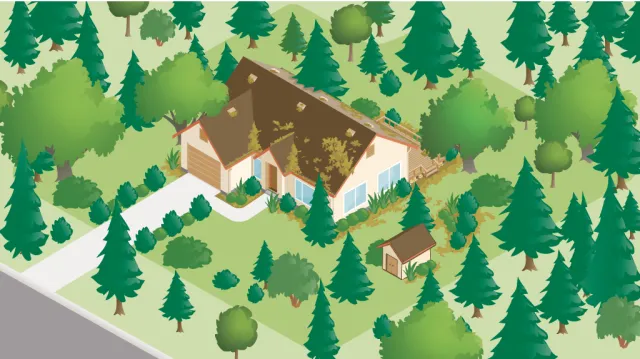

The images above show before (left) and after (right) implementation of a three zone defensible space strategy. While these figures are in a forested setting, the same concepts apply to other vegetation types and more residential settings.
It is recommended to start at the house and work outwards giving the greatest effort to avoid combustible vegetation and other materials within five feet of the house and any attached decks. The California Department of Forestry and Fire Protection defines three zones of a defensible space, respectively Zone 0 (0-5 ft), Zone 1 (5-30 ft), and Zone 2 (30-100+ ft). The table below describes the intent behind each zone as well as recommended strategies for implementation.
Zone | Purpose | Recommendations |
Zone 0 (0-5 ft)"The Ember Resistant Zone" | Zone 0 can reduce the likelihood of structure ignition by reducing the potential for:
|
|
Zone 1 (5-30 ft)"The Lean, Clean, and Green Zone" | Zone 1 emphasizes fuel modification such that there is a disconnection between planting groups and trees so that fire does not travel directly to the structure. |
|
Zone 2 (30-100 ft)"The Reduced Fuel Zone" | Zone 2 is focused on changing the behavior of fire to help personnel defend a structure safely.
|
|

If any of your defensible space zones extend into a neighbor's yard, work with them to enhance collective efforts. For larger properties, consider creating a stewardship plan (i.e., Forest Management Plan, Rangeland Management Plan, Oak Woodland Management Plan, etc.) for the property. These plans will help you determine your goals and objectives for that space and what tools and methods you might want to use. For more information about land stewardship and plans, visit the UCCE Forest Stewardship page.
First responders access
Road access is crucial for your personal safety as well as those of first responders. Ensure that there is enough space for firefighting equipment to move onto your lot, as close as possible to your home and multiple access points to your parcel. During incidents, power lines or trees falling across roads are not uncommon. Work to develop:
- Two or more roads in and out of your parcel provides an alternate route in case of emergency. Dead-end roads should have a turnaround as approved by the local fire authority.
- Each road should be accessible year round and at least 20 feet wide.
Road grades should be less than 5% (5 foot rise for each 100-foot distance) are more accessible for larger fire equipment.

Implementing Defensible Space on Steep Slopes
If the home is located on a slope, in a drainage, in a windy area, or an area surrounded by unusually dense, tall, or combustible vegetation, thinning and spacing requirements increase. Additionally, if the home is in a vegetation type that is especially prone to wildfire or has an active fire history, a greater clearance and separation between plants and plant groupings may be beneficial. However, the areas cleared from vegetation should be monitored and maintained to prevent the spread of invasive and flammable grasses.
When the home is at the top of a slope, keep in mind that fire and heat rise, allowing for pre-heating of the upslope fuels, resulting in the potential for more intense fire behavior. In these cases, greater effort should be directed at the area downslope of the home with even higher levels of fuel treatments given to the area below a deck.
Additional Resources
Check out these defensible space-related resources from UC ANR Fire Network Members and our colleagues!
- Reducing the Vulnerability of Building to Wildfire: Vegetation and Landscaping Guidance UC ANR Publication 8695 (2021).
- Defensible Space Landscaping: Mulches factsheet from the UC ANR Fire Network (2026).
- Living with Fire Defensible Space Guide from Tahoe Living with Fire
- Visit CAL FIRE's Prepare For Wildfire website