A Natural Solution for California's Herds: African Catfish Peptides

California's cattle producers and agricultural communities are all too familiar with the rising challenge of antibiotic resistance, making common bacterial infections harder to treat in livestock. But imagine a future where we could tackle these infections with a natural, powerful alternative. Our research points to just that: antimicrobial peptides (AMPs) found in African catfish.

We're really excited about these peptides because African catfish thrive in pathogen-rich freshwater, naturally producing these robust immune compounds in their skin mucus as a defense. This natural origin makes them highly appealing alternatives to synthetic drugs.

Predicted Safety and Potent Action

One of the most compelling aspects of these AMPs is their predicted safety for mammals. Our initial computer analyses suggest that various catfish AMPs are generally recognized as safe (GRAS). We predict they'll be absorbed in the human intestine without causing liver, brain, or heart toxicity. Furthermore, lab tests on a promising peptide, NACAP-II, confirmed it was non-hemolytic, meaning it didn't damage rabbit red blood cells—a strong indicator of its potential safety for mammalian cells.

Beyond safety, these peptides demonstrate effectiveness against problematic bacteria. One study revealed NACAP-II's strong activity against Extended-Spectrum Beta-Lactamase (ESBL)-producing Escherichia coli—a critical concern for both animal and human health due to its resistance to many common antibiotics. Another peptide, ACAP-IV, also showed antibacterial activity against E. coli and Staphylococcus aureus. We believe these AMPs work by directly disrupting bacterial cell membranes, a mechanism that makes it harder for bacteria to develop resistance compared to how they resist traditional antibiotics.
Primary Image
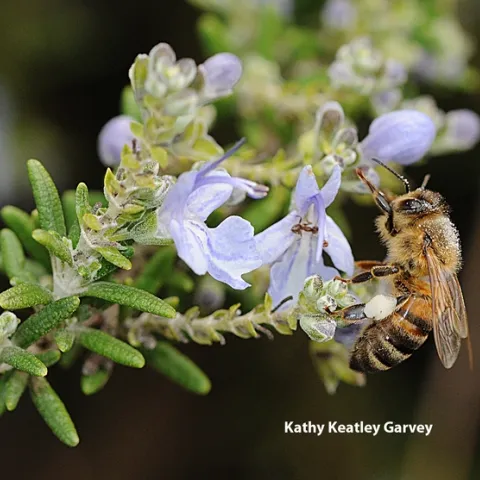
Honey bee nectaring lavender. (Photo by Kathy Keatley Garvey)

What's That Buzz?

October 18, 2011
By Kathy Keatley Garvey
Things are buzzing over at the Robert Mondavi Wine and Food Science on the University of California, Davis campus. The RMI folks are gearing up for the big Honey! event, set for 9 a.m. to 6:30 p.m., Friday, Oct. 21 in the UC Davis Conference Center.
View Article
Primary Image
IMG 0031
UC Rice Blog: Article

Harvesting of Rice Variety Trials

October 18, 2011
By Luis Espino
Harvest is starting to pick up again, and the UC Rice Project is starting to harvest the statewide variety trials. The trials are conducted in collboration with the breeders at the Rice Experiment Station (RES).
View Article
Primary Image
Lygus bug (Lygus hesperus) is a major agricultural pest. (Photo by Kathy Keatley Garvey)

Targeting Lygus Bugs

October 17, 2011
By Kathy Keatley Garvey
If you've ever grown strawberries, you're probably familiar with what the lygus bug does. This major agricultural pest is one of the causes of those cat-faced strawberries you see in your garden or in the field. Cat-faced? Think misshapened, deformed or irregularly shaped berries.
View Article
UC Weed Science (weed control, management, ecology, and minutia): Article

Herbicide terminology basics

October 16, 2011
By Brad Hanson
When talking about chemical weed control, a lot of different terms are used to describe the chemicals and application techniques being used. Some are terms are pretty straight forward while others are a little more specific or specialized.
View Article
Primary Image
Honeybee Trio is comprised of (from left) Karli Bosler, 16; Natalie Angst, 16, and Sarah McElwain, 15. In back is Donna Billick's bee sculpture. (Photo by Kathy Keatley Garvey)

Show Me the Honey! (And the Wonder of Bees!)

October 14, 2011
By Kathy Keatley Garvey
Honey in the morning Honey in the evening Honey at suppertime Be my little honey And love me all the time... So sang the McGuire Sisters in their 1958 hit tune, "Sugartime." And so will sing the Honeybee Trio of Vacaville at the Honey! event on Friday, Oct. 21 in the UC Davis Conference Center.
View Article
Primary Image
IMG 2566
UC Rice Blog: Article

Crop Production Estimates

October 14, 2011
By Luis Espino
On October 12, the National Agricultural Statistics Service (NASS) released its rice crop production estimate. California's estimate was adjusted down from the September estimate; from 8,400 lbs to 8,300 lbs/a.
View Article
Primary Image
Franklin's bumble bee. (Photo by Robbin Thorp)

Have You Seen Me?

October 13, 2011
By Kathy Keatley Garvey
It's good to see so many people looking for the critically imperiled Franklin's bumble bee, which the U.S. Fish and Wildlife Service may soon list as endangered and provide protective status.
View Article
Primary Image
UC Davis chemical ecologist Walter Leal is the recipient of ESA's Nan-Yao Su Award for Innovation and Creativity in Entomology. (Photo by Kathy Keatley Garvey)

Hail to the Chairs

October 12, 2011
By Kathy Keatley Garvey
It's a Good News Day. The Entomological Society of America (ESA) just announced that among the 2011 award recipients are two UC Davis faculty: Michael Parrella and Walter Leal.
View Article
Primary Image
Praying mantis with remnants of a meal. (Photo by Kathy Keatley Garvey)

What's That Bug?

October 10, 2011
By Kathy Keatley Garvey
If you don't know what it is, don't kill it. That insect in your garden could very well be a beneficial insect. If you operate on the "shoot-first-ask-questions later" or "the only good bug is a dead bug," no telling how many insects--and generations--you'll be destroying.
View Article