A Natural Solution for California's Herds: African Catfish Peptides

California's cattle producers and agricultural communities are all too familiar with the rising challenge of antibiotic resistance, making common bacterial infections harder to treat in livestock. But imagine a future where we could tackle these infections with a natural, powerful alternative. Our research points to just that: antimicrobial peptides (AMPs) found in African catfish.

We're really excited about these peptides because African catfish thrive in pathogen-rich freshwater, naturally producing these robust immune compounds in their skin mucus as a defense. This natural origin makes them highly appealing alternatives to synthetic drugs.

Predicted Safety and Potent Action

One of the most compelling aspects of these AMPs is their predicted safety for mammals. Our initial computer analyses suggest that various catfish AMPs are generally recognized as safe (GRAS). We predict they'll be absorbed in the human intestine without causing liver, brain, or heart toxicity. Furthermore, lab tests on a promising peptide, NACAP-II, confirmed it was non-hemolytic, meaning it didn't damage rabbit red blood cells—a strong indicator of its potential safety for mammalian cells.

Beyond safety, these peptides demonstrate effectiveness against problematic bacteria. One study revealed NACAP-II's strong activity against Extended-Spectrum Beta-Lactamase (ESBL)-producing Escherichia coli—a critical concern for both animal and human health due to its resistance to many common antibiotics. Another peptide, ACAP-IV, also showed antibacterial activity against E. coli and Staphylococcus aureus. We believe these AMPs work by directly disrupting bacterial cell membranes, a mechanism that makes it harder for bacteria to develop resistance compared to how they resist traditional antibiotics.

Primary Image
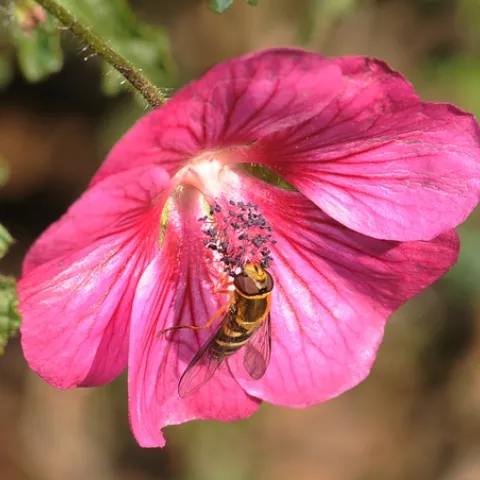
A BEE FLY nectars on sedum. (Photo by Kathy Keatley Garvey)

Not Bees--They're Flies

September 7, 2010
By Kathy Keatley Garvey
There are "bees" and there are "flies." And then there are "bee flies." Bee flies? They're so named because they look somewhat like bees. Order: Diptera. Family: Bombyliidae. We spotted a single bee fly, as identified by UC Davis forensic entomologist Bob Kimsey, foraging on our sedum yesterday.
View Article
Primary Image
WORKER BUMBLE BEE on anemone. This is a female yellow-faced bumble bee (Bombus vosnesenskii), as identified by native pollinator specialist Robbin Thorp, emeritus professor of entomology at UC Davis. (Photo by Kathy Keatley Garvey)

Give Us an A, B, and C

September 6, 2010
By Kathy Keatley Garvey
"A" is for anemone, "B" is for bumble bee and "C" is for coneflower. A visit to the Oregon state capitol grounds in Salem last Tuesday found scores of yellow-faced bumble bees (Bombus vosnesenskii) working the anemones and purple coneflowers.
View Article
Primary Image
HONEY BEE heads for catmint (Nepeta). Catmint is one of the plants in the Häagen-Dazs Honey Bee Haven that attracts honey bees, native bees, butterflies and assorted other insects. (Photo by Kathy Keatley Garvey)

Mint Condition

September 3, 2010
By Kathy Keatley Garvey
When the Hagen-Dazs Honey Bee Haven's grand opening celebration takes place on Saturday, Sept. 11, visitors can expect to see scores of flowers, including the ever-popular catmint (Nepeta). Honey bees love the mints. So do bumble bees, carpenter bees, butterflies and assorted other insects.
View Article
Primary Image
Bubbler290
Conservation Agriculture: Article

A new production model for the San Joaquin Valley

September 3, 2010
By Jeannette Warnert
Combining low-pressure, overhead sprinklers with conservation tillage may become the new ag production model for the San Joaquin Valley. This combination of practices is quite common in many irrigated regions outside of California but are relatively new here in the Golden State.
View Article
Primary Image
CAUGHT IN FLIGHT, a leafcutter bee heads toward a catmint flower (Nepeta). (Photo by Kathy Keatley Garvey)

Catching Up with a Leafcutter Bee

September 2, 2010
By Kathy Keatley Garvey
Leafcutter bees (Megachile spp.), so named because they cut leaves and petals to line their nests, are smaller than the honey bees but move faster. These native bees are easily recognizable by the black-white bands on their abdomen. Catching them in flight requires a lot of patience.
View Article
Primary Image
CABBAGE WHITE butterfly glows in the late afternoon sun as it nectars on catmint (Nepeta). (Photo by Kathy Keatley Garvey)
Bug Squad: Article

Lovely Indeed

September 1, 2010
By Kathy Keatley Garvey
If we were to describe the cabbage white butterfly (Pieris rapae) in one word, it would be "lovely." Especially when it nectars from catmint (Nepeta) in the early evening, as the sun drops low in the horizon.
View Article
Primary Image
A DEAD MOTH, a Greater Wax Moth, collected outside a bee hive. (Photo by Kathy Keatley Garvey)
Bug Squad: Article

Sneaky Moth

August 31, 2010
By Kathy Keatley Garvey
The female Greater Wax Moth (Galleria mellonella) is a sneaky creature. She flies around bee hives at night and when the opportunity presents itself--as it often does--in she goes to lay her eggs. The egg hatch into larvae, which munch and crunch just about everything in sight.
View Article
Primary Image
THESE BEES at the Harry H. Laidlaw Jr. Honey Bee Research Facility, UC Davis, are ready to swarm. A few minutes later, they took off. (Photo by Kathy Keatley Garvey)
Bug Squad: Article

All About Bee Swarms

August 30, 2010
By Kathy Keatley Garvey
The peak bee season is winding down--along with the number of bee swarms. "There aren't that many bees swarming this time of the year," said Extension apiculturist Eric Mussen, member of the UC Davis Department of Entomology faculty.
View Article