A Natural Solution for California's Herds: African Catfish Peptides

California's cattle producers and agricultural communities are all too familiar with the rising challenge of antibiotic resistance, making common bacterial infections harder to treat in livestock. But imagine a future where we could tackle these infections with a natural, powerful alternative. Our research points to just that: antimicrobial peptides (AMPs) found in African catfish.

We're really excited about these peptides because African catfish thrive in pathogen-rich freshwater, naturally producing these robust immune compounds in their skin mucus as a defense. This natural origin makes them highly appealing alternatives to synthetic drugs.

Predicted Safety and Potent Action

One of the most compelling aspects of these AMPs is their predicted safety for mammals. Our initial computer analyses suggest that various catfish AMPs are generally recognized as safe (GRAS). We predict they'll be absorbed in the human intestine without causing liver, brain, or heart toxicity. Furthermore, lab tests on a promising peptide, NACAP-II, confirmed it was non-hemolytic, meaning it didn't damage rabbit red blood cells—a strong indicator of its potential safety for mammalian cells.

Beyond safety, these peptides demonstrate effectiveness against problematic bacteria. One study revealed NACAP-II's strong activity against Extended-Spectrum Beta-Lactamase (ESBL)-producing Escherichia coli—a critical concern for both animal and human health due to its resistance to many common antibiotics. Another peptide, ACAP-IV, also showed antibacterial activity against E. coli and Staphylococcus aureus. We believe these AMPs work by directly disrupting bacterial cell membranes, a mechanism that makes it harder for bacteria to develop resistance compared to how they resist traditional antibiotics.
Primary Image
PRAYING MANTIS clings to a purple coneflower (Echinacea pupurea) in the Häagen-Dazs Honey Bee Haven at the Harry H. Laidlaw Jr. Honey Bee Research Facility, UC Davis. (Photo by Kathy Keatley Garvey)

Let Them Bee

August 27, 2010
By Kathy Keatley Garvey
If I were in charge, the praying mantis would eat only aphids, flies and stink bugs. No honey bees. Let them bee. This week we watched a praying mantis slide beneath a purple coneflower (Echinacea pupurea) at the Hagen-Dazs Honey Bee Haven at the Harry H. Laidlaw Jr.
View Article
Primary Image
NEWS REPORTER Dea Diamont (right) of KCRA TV, Channel 3, Sacramento interviews Extension apiculturist Eric Mussen (center) of UC Davis Department of Entomology at the Harry H. Laidlaw Jr. Honey Bee Research Facility, UC Davis. At left is KCRA news photographer Brian Fong. (Photo by Kathy Keatley Garvey)

It Happens

August 26, 2010
By Kathy Keatley Garvey
It may not be talked about in polite society. And most folks dont know what it is.
View Article
Colusa County: Article

September 2010

August 26, 2010
New Leader Orientation Meetings, Club Meetings and Achievement Nights...
View Article
Primary Image
SELF-DESCRIBED rock artist Donna Billick with her sculpture, "Miss Bee Haven," at the Häagen-Dazs Honey Bee Haven at the Harry H. Laidlaw Jr. Honey Bee Research Facility, UC Davis. (Photo by Kathy Keatley Garvey)

Miss Bee Haven

August 25, 2010
By Kathy Keatley Garvey
Undergraduate degree in genetics? Check. Masters degree in fine arts? Check. Scientist and artist? Check. Such is the case with scientist-artist Donna Billick, who created the Miss Bee Haven six-foot bee sculpture in the Hagen-Dazs Honey Bee Haven at the University of California, Davis.
View Article
Primary Image
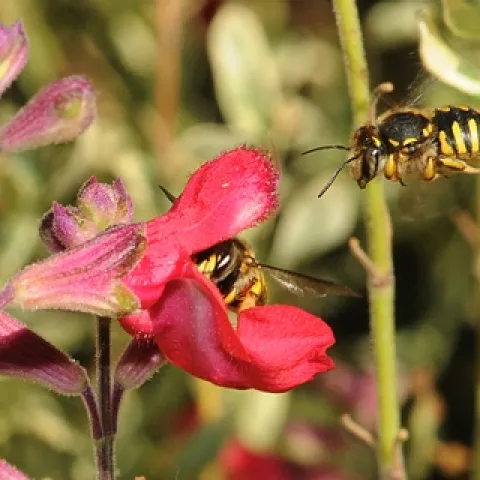
NATIVE BEE, a Svastra obliqua expurgata, forages on top of a Mexican hat flower at the Häagen-Dazs Honey Bee Haven at UC Davis. The bee is commonly known as "the sunflower bee." The flower is sometimes called a "prairie coneflower." (Photo by Kathy Keatley Garvey)

Feel Like Dancing?

August 24, 2010
By Kathy Keatley Garvey
Collecting pollen and nectar is serious business. But when a native wild bee such as the Svastra obliqua expurgata, also called "the sunflower bee," forages on a Mexican hat flower, it adds a little gaiety to the scene.
View Article

Chasing Carder Bees

August 23, 2010
By Kathy Keatley Garvey
When this insect flashes by you in your garden, at first glance you think: "Yellow jacket? Paper wasp? What's that?" Then it lands and you realize it's neither. It's a bee.
View Article

About Those Pickled Peppers

August 20, 2010
By Kathy Keatley Garvey
Peter Piper picked a peck of pickled peppers; A peck of pickled peppers Peter Piper picked; If Peter Piper picked a peck of pickled peppers, Where's the peck of pickled peppers Peter Piper picked?
View Article

Another Use of a Potted Plant

August 19, 2010
By Kathy Keatley Garvey
When temperatures soar, look for honey bees to head for water resources. On the grounds of the Harry H. Laidlaw Jr. Honey Bee Research Facility at the University of California, Davis, something as simple as a freshly watered potted plant will do.
View Article

Beetle Mania

August 18, 2010
By Kathy Keatley Garvey
Gardeners pinch them. Photographers shoot them. Hikers wonder what they are. The spotted cucumber beetle (Diabrotica) is a major agricultural pest. You'll see it on cucumbers, squash, corn, beans, watermelons, musk melons, cotton, tomatoes and other crops.
View Article
Primary Image
Sano
Conservation Agriculture: Article

Earthworms signal success on innovative tomato farm

August 18, 2010
By Jeannette Warnert
If the return of earthworms to farm fields is an indication of success, then Sano Farms is on the right track. I havent seen earthworms in these fields in years, said Firebaugh farmer Alan Sano.
View Article