A Natural Solution for California's Herds: African Catfish Peptides

California's cattle producers and agricultural communities are all too familiar with the rising challenge of antibiotic resistance, making common bacterial infections harder to treat in livestock. But imagine a future where we could tackle these infections with a natural, powerful alternative. Our research points to just that: antimicrobial peptides (AMPs) found in African catfish.

We're really excited about these peptides because African catfish thrive in pathogen-rich freshwater, naturally producing these robust immune compounds in their skin mucus as a defense. This natural origin makes them highly appealing alternatives to synthetic drugs.

Predicted Safety and Potent Action

One of the most compelling aspects of these AMPs is their predicted safety for mammals. Our initial computer analyses suggest that various catfish AMPs are generally recognized as safe (GRAS). We predict they'll be absorbed in the human intestine without causing liver, brain, or heart toxicity. Furthermore, lab tests on a promising peptide, NACAP-II, confirmed it was non-hemolytic, meaning it didn't damage rabbit red blood cells—a strong indicator of its potential safety for mammalian cells.

Beyond safety, these peptides demonstrate effectiveness against problematic bacteria. One study revealed NACAP-II's strong activity against Extended-Spectrum Beta-Lactamase (ESBL)-producing Escherichia coli—a critical concern for both animal and human health due to its resistance to many common antibiotics. Another peptide, ACAP-IV, also showed antibacterial activity against E. coli and Staphylococcus aureus. We believe these AMPs work by directly disrupting bacterial cell membranes, a mechanism that makes it harder for bacteria to develop resistance compared to how they resist traditional antibiotics.


Seeing Spots

August 11, 2010
By Kathy Keatley Garvey
If you've seen a lot of buckeye butterflies this season, you're not alone. It's a big year for buckeyes, says noted butterfly expert Arthur Shapiro, professor of evolution and ecology at the University of California, Davis. He counts between "30 and 85 a day" in West Sacramento and North Sacramento.
View Article

Oh, the Diversity in the Garden

August 10, 2010
By Kathy Keatley Garvey
The Hagen-Dazs Honey Bee Haven, the half-acre bee friendly garden planted last fall next to the Harry H. Laidlaw Jr. Honey Bee Research Facility on Bee Biology Road at the University of California, Davis, is more than just a haven for honey bees.
View Article

Bad News for Black Walnut Trees

August 9, 2010
By Kathy Keatley Garvey
The news is startling, but not totally unexpected. Thousand cankers disease, which infects and kills black walnut trees, has spread from the western United States to the eastern United States. Officials announced Aug. 5 that the disease has been detected in Knox County in east Tennessee.
View Article

Tame That Tiger

August 6, 2010
By Kathy Keatley Garvey
Tame that tiger. Wilton beekeeper Brian Fishback, president of the Sacramento Area Beekeepers' Association, stopped Friday at the Harry H. Laidlaw Jr. Honey Bee Research Facility, UC Davis, and a friendly Western tiger swallowtail greeted him. At least, it seemed quite friendly.
View Article

Lickin' Good

August 5, 2010
By Kathy Keatley Garvey
Varroa mites, those blood-sucking little parasites that are major pests of honey bee colonies, can decimate and destroy a colony if left unchecked. One way that beekeepers monitor their hives for mite infestation is "the sugar shake.
View Article

Bring on the Carpenter Bees

August 4, 2010
By Kathy Keatley Garvey
Carpenter bees, which to the uninitiated look like bumble bees, are nice to have around the garden. Maybe not so nice to have around your untreated patio or fences (as they drill holls in them to make their nests) but just think of them as pollinators, not pests.
View Article

In Search of a Bumble Bee

August 3, 2010
By Kathy Keatley Garvey
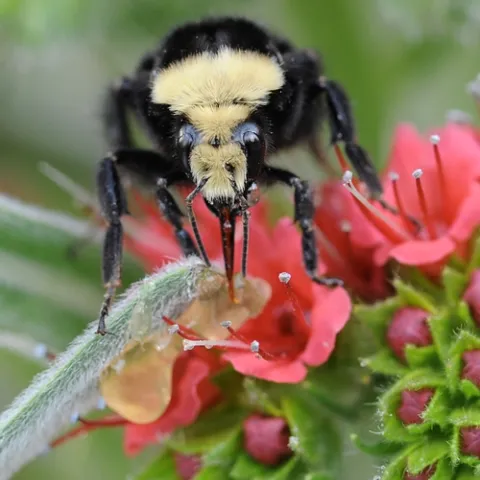
If Franklin's bumble bee were a human, you might think it part of the Federal Witness Protection Program. That's because it's rarely seen. Its narrow distribution range covers parts of southern Oregon (Jackson, Douglas and Josephine counties) and northern California (Siskiyou and Trinity counties).
View Article