A Natural Solution for California's Herds: African Catfish Peptides

California's cattle producers and agricultural communities are all too familiar with the rising challenge of antibiotic resistance, making common bacterial infections harder to treat in livestock. But imagine a future where we could tackle these infections with a natural, powerful alternative. Our research points to just that: antimicrobial peptides (AMPs) found in African catfish.

We're really excited about these peptides because African catfish thrive in pathogen-rich freshwater, naturally producing these robust immune compounds in their skin mucus as a defense. This natural origin makes them highly appealing alternatives to synthetic drugs.

Predicted Safety and Potent Action

One of the most compelling aspects of these AMPs is their predicted safety for mammals. Our initial computer analyses suggest that various catfish AMPs are generally recognized as safe (GRAS). We predict they'll be absorbed in the human intestine without causing liver, brain, or heart toxicity. Furthermore, lab tests on a promising peptide, NACAP-II, confirmed it was non-hemolytic, meaning it didn't damage rabbit red blood cells—a strong indicator of its potential safety for mammalian cells.

Beyond safety, these peptides demonstrate effectiveness against problematic bacteria. One study revealed NACAP-II's strong activity against Extended-Spectrum Beta-Lactamase (ESBL)-producing Escherichia coli—a critical concern for both animal and human health due to its resistance to many common antibiotics. Another peptide, ACAP-IV, also showed antibacterial activity against E. coli and Staphylococcus aureus. We believe these AMPs work by directly disrupting bacterial cell membranes, a mechanism that makes it harder for bacteria to develop resistance compared to how they resist traditional antibiotics.
Primary Image
BLACK WIDOW SPIDER touches her gumdrop-sized egg sac, suspended from her web in a UC Davis parking garage. (Photo by Kathy Keatley Garvey)

Black Widow!

September 20, 2010
By Kathy Keatley Garvey
The very presence of a black widow spider, shiny black with a globe-shaped abdomen, strikes fear in most people. And not just on Halloween.
View Article
Primary Image
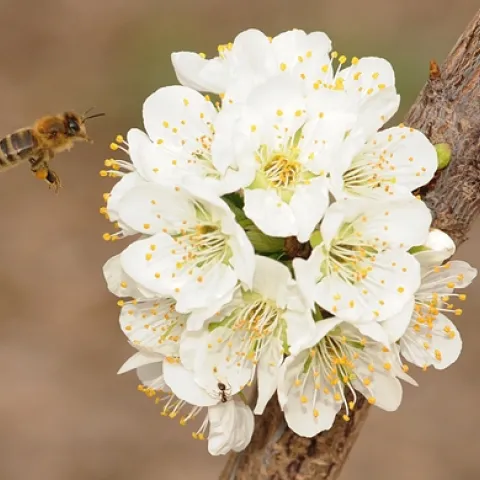
HONEY BEE nectaring lavender at the Mostly Natives Nursery, Tomales. (Photo by Kathy Keatley Garvey)

Where the Bees Are

September 17, 2010
By Kathy Keatley Garvey
Extension apiculturist Eric Mussen, member of the UC Davis Department of Entomology faculty, emphasizes that if you're planting flowers to attract bees--and you should--be sure to remember them in the fall--not just the spring and summer. In the fall, food is scarce.
View Article
Primary Image
BEE GONE--A webweaving spider with "breakfast," a honey bee in the Haagen-Dazs Honey Bee Haven at the Harry H. Laidlaw Jr. Honey Bee Research Facility, UC Davis. (Photo by Kathy Keatley Garvey)

She Didn't Come Home Last Night

September 16, 2010
By Kathy Keatley Garvey
She didn't come home last night. The little honey bee at the Harry H. Laidlaw Jr. Honey Bee Research Facility, University of California, Davis, wound up in a spider's stomach.
View Article

'The Human Bee Hive'

September 15, 2010
By Kathy Keatley Garvey
Many beekeepers keep bees, but Norman Gary wears them. Gary, who received his doctorate in entomology (apiculture) from Cornell University, served as a professor at the University of California, Davis for 32 years, retiring in 1994.
View Article
Primary Image
BEEKEEPER Frank Pendell of Pendell Apiaries, Stonyford, Calif., vice president of the California State Beekeepers' Association, chats with Dori Sera Bailey, director of consumer communications, Häagen-Dazs and Dreyer’s Grand Ice Cream. In the back are visitors touring the garden. (Photo by Kathy Keatley Garvey)

A Honey of a Garden Celebration

September 14, 2010
By Kathy Keatley Garvey
Some 1300 people, including beekeepers, entomologists, gardeners, nature lovers, and children--plus millions of bees in the vicinity--helped celebrate the grand opening of the Hagen-Dazs Honey Bee Haven last Saturday, Sept. 11. The haven, a bee friendly garden planted last fall next to the Harry H.
View Article
Primary Image
UC DAVIS bioanalytical chemist Jun-Yan Liu, the senior author of the paper, at work in the Hammock laboratory. (Photo by Kathy Keatley Garvey)

Pursuing Relief from Pain

September 13, 2010
By Kathy Keatley Garvey
Pest management. Pain management. Early in his career, entomologist Bruce Hammock, now a distinguished professor of entomology at the University of California, Davis and a newly selected fellow of the Entomological Society of America, probed regulating the development of insect larvae.
View Article
Primary Image
THIS BEE, a Svastra obliqua expurgata, forages on a purple coneflower in the Häagen-Dazs Honey Bee Haven. Native pollinator specialist Robbin Thorp, emeritus professor of entomology, is monitoring the many species of bees in the garden. To date: more than 50 over the last two years. (Photo by Kathy Keatley Garvey)

Glory Bee

September 10, 2010
By Kathy Keatley Garvey
Glory bee. There are more than just honey bees in the Hagen-Dazs Honey Bee Haven. Think butterflies, dragonflies, sweat bees, metallic sweat bees, carpenter bees, hover flies, tachinid flies, wasps, praying mantids and what not.
View Article
Primary Image
sarahdalrympleforweb

Thinking Outside the Box

September 9, 2010
By Kathy Keatley Garvey
Diane Ullman, Donna Billick and Sarah Dalrymple (Sarah is shown at right) are used to thinking outside the box. Now they are thinking inside and outside the hive. Visitors to the grand opening celebration of the Hagen-Dazs Honey Bee Haven, set from 10 a.m. to 2 p.m. on Saturday, Sept.
View Article
Primary Image
EUROPEAN PAPER WASP rests on a leaf. (Photo by Kathy Keatley Garvey)

Capitalizing on the Colors

September 8, 2010
By Kathy Keatley Garvey
Ever notice how the coloring of the wool carder bee resembles a yellowjacket and European paper wasp? Talk about capitalizing on the colors. Carder bees, so named because they card the fuzz or down from leaves to make their nests, are black and yellow.
View Article