A Natural Solution for California's Herds: African Catfish Peptides

California's cattle producers and agricultural communities are all too familiar with the rising challenge of antibiotic resistance, making common bacterial infections harder to treat in livestock. But imagine a future where we could tackle these infections with a natural, powerful alternative. Our research points to just that: antimicrobial peptides (AMPs) found in African catfish.

We're really excited about these peptides because African catfish thrive in pathogen-rich freshwater, naturally producing these robust immune compounds in their skin mucus as a defense. This natural origin makes them highly appealing alternatives to synthetic drugs.

Predicted Safety and Potent Action

One of the most compelling aspects of these AMPs is their predicted safety for mammals. Our initial computer analyses suggest that various catfish AMPs are generally recognized as safe (GRAS). We predict they'll be absorbed in the human intestine without causing liver, brain, or heart toxicity. Furthermore, lab tests on a promising peptide, NACAP-II, confirmed it was non-hemolytic, meaning it didn't damage rabbit red blood cells—a strong indicator of its potential safety for mammalian cells.

Beyond safety, these peptides demonstrate effectiveness against problematic bacteria. One study revealed NACAP-II's strong activity against Extended-Spectrum Beta-Lactamase (ESBL)-producing Escherichia coli—a critical concern for both animal and human health due to its resistance to many common antibiotics. Another peptide, ACAP-IV, also showed antibacterial activity against E. coli and Staphylococcus aureus. We believe these AMPs work by directly disrupting bacterial cell membranes, a mechanism that makes it harder for bacteria to develop resistance compared to how they resist traditional antibiotics.
Primary Image
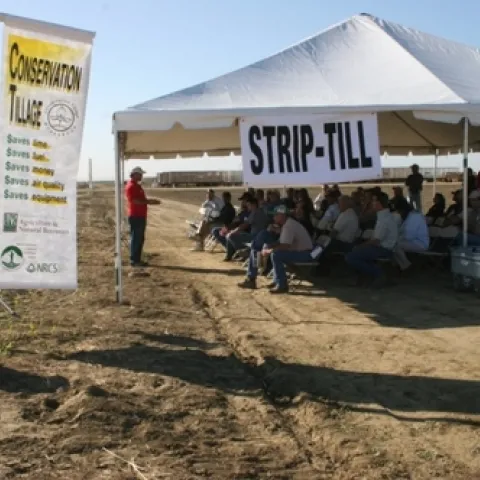
Giacomazzi (with back to camera) speaks to Australian visitors.
Conservation Agriculture: Article

Aussie no-tillers visit Valley farmers

August 18, 2010
By Jeannette Warnert
Leading San Joaquin Valley conservation tillage farmers Scott Schmidt of Five Points and Dino Giacomazzi of Hanford recently hosted a group of 38 no-till farmers from Western and South Australia.
View Article
Primary Image
Alan Sano, Jesse Sanchez and ? at the Sano Farm in Firebaugh.
Conservation Agriculture: Article

Cost-cutting tomato production approaches introduced in Firebaugh

August 18, 2010
By Jeannette Warnert
Tomato producers interested in cutting costs, reducing inputs and improving their soil, received a strong jump start to planning their 2011 seasons by participating in a recently-held how to get started with conservation tillage and cover crop systems discussion held at Sano Farms in Firebaugh.
View Article
Primary Image
Farmers get a close-up look at a CT farm.
Conservation Agriculture: Article

Common points in conservation tillage practices

August 18, 2010
By Jeannette Warnert
A number of common points came through loud and clear by each of the farmers who hosted visitors during a recent field tour. Advance planning prior to the strip-till or no-till corn season is necessary. Laying out appropriately-spaced, shallow irrigation berms is desirable.
View Article
Conservation Agriculture: Article

Tom Barcellos consistently uses strip till in silage

August 18, 2010
By Jeannette Warnert
Tom Barcellos of Barcellos Farms in Tipton, California, has been in the no-till and strip-till business perhaps longer and more consistently than just about any other dairy silage producer in the entire SJV.
View Article

Space Alien

August 17, 2010
By Kathy Keatley Garvey
If the praying mantis were six feet tall, what an incredible space alien it would make. It's a well-equipped predator, with keen eyesight, a rotating head, and two spiked forelegs that grab and grasp unsuspecting prey. It's not about "who's coming to dinner"; it's "what's coming to dinner.
View Article

Blue Butterfly

August 16, 2010
By Kathy Keatley Garvey
Timber Cove in Sonoma County has scores of insects, including honey bees, bumble bees and spotted cucumber beetles. But last week, for the first time, we spotted a male Acmon Blue, Plebejus acmon, as identified by noted butterfly expert Art Shapiro, professor of evolution and ecology at UC Davis.
View Article

Sliver of Blue

August 14, 2010
By Kathy Keatley Garvey
It's often called a "pond damselfly" or a "narrow-winged damselfly." We spotted this brilliant blue damselfly on a Great Valley gum plant (Grindelia camporum) near the Sciences Laboratory Building at the University of California, Davis.
View Article

Malaria-Proof Mosquito?

August 12, 2010
By Kathy Keatley Garvey
A malaria-proof mosquito? Research news coming out of the University of California, Davis and the University of Arizona labs recently drew international attention; the scientists have genetically engineered mosquitoes that are resistant to malaria parasites.
View Article