A Natural Solution for California's Herds: African Catfish Peptides

California's cattle producers and agricultural communities are all too familiar with the rising challenge of antibiotic resistance, making common bacterial infections harder to treat in livestock. But imagine a future where we could tackle these infections with a natural, powerful alternative. Our research points to just that: antimicrobial peptides (AMPs) found in African catfish.

We're really excited about these peptides because African catfish thrive in pathogen-rich freshwater, naturally producing these robust immune compounds in their skin mucus as a defense. This natural origin makes them highly appealing alternatives to synthetic drugs.

Predicted Safety and Potent Action

One of the most compelling aspects of these AMPs is their predicted safety for mammals. Our initial computer analyses suggest that various catfish AMPs are generally recognized as safe (GRAS). We predict they'll be absorbed in the human intestine without causing liver, brain, or heart toxicity. Furthermore, lab tests on a promising peptide, NACAP-II, confirmed it was non-hemolytic, meaning it didn't damage rabbit red blood cells—a strong indicator of its potential safety for mammalian cells.

Beyond safety, these peptides demonstrate effectiveness against problematic bacteria. One study revealed NACAP-II's strong activity against Extended-Spectrum Beta-Lactamase (ESBL)-producing Escherichia coli—a critical concern for both animal and human health due to its resistance to many common antibiotics. Another peptide, ACAP-IV, also showed antibacterial activity against E. coli and Staphylococcus aureus. We believe these AMPs work by directly disrupting bacterial cell membranes, a mechanism that makes it harder for bacteria to develop resistance compared to how they resist traditional antibiotics.
Kern County: Article

Kern UCCE/DWR Weekly Crop Water Use Report 07-03-2022

July 5, 2022
Please see below link to access "How To Use Weekly Crop Water Use (ET) Reports to Assist Farm Water Management" How To Use Weekly Crop Water Use Report Please see below link to access "Weekly ET Report 07-03-2022" ET Report 07-03-2022 Please see disclaimer link below: University of California Divisi...
View Article
Primary Image
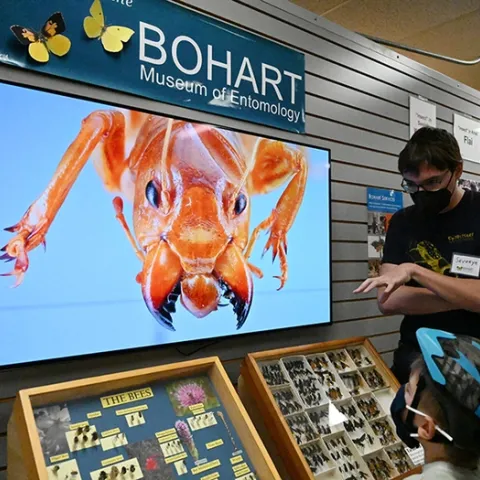
Associate Dean Jason Bond of UC Davis and Professor Eileen Hebets of the University of Nebraska, Lincoln, at the "Eight Legged Encounters" open house, hosted by the Bohart Museum of Entomology and the American Arachnological Society. (Photo by Kathy Keatley Garvey)
Entomology & Nematology News: Article

Arachnid Open House Draws Large Crowd

July 4, 2022
By Kathy Keatley Garvey
Arachnids rule! The Bohart Museum of Entomology open house, "Eight-Legged Encounters," co-sponsored by the American Arachnological Society (AAS) and held June 25 in the Academic Surge Building, drew more than 250 attendees and 40 volunteers.
View Article
Primary Image
Hurrah for the red, white and blue! And the yellow. Honey bee mobiles were spinning in the wind at a Bodega Bay campsite. (Photo by Kathy Keatley Garvey)
Bug Squad: Article

Hurrah for the Red, White and Blue! And the Yellow...

July 4, 2022
By Kathy Keatley Garvey
Today is the Fourth of July, and what better time to proclaim: "Hurray for the red, white and blue!" And the yellow. On a camping trip last week to Doran Regional Park, Bodega Bay, we admired our neighbors' display of American flagsbordered with a dozen honey bees. These bees, however, didn't buzz.
View Article
Kern County: Article

Climate Smart Newsletter - July 2022

July 4, 2022
In this issue: California Family Farm Emergency Fund Seeds for Bees: Healthier soils with cover crops! Advances in Pistachio Water Management Workshop 2022 Water Conservation Showcase...
View Article
Primary Image
Weed Science Society of America logo
UC Weed Science (weed control, management, ecology, and minutia): Article

New WSSA Backgrounder clarifies purpose and use of plant-back intervals

July 3, 2022
By Gale Perez
A press release from the Weed Science Society of America (WSSA) website :: June 27, 2022 Posted on June 27, 2022 WESTMINSTER, Colorado June 27, 2022 Plant-back intervals are a critical component of any pesticide label indicating the minimum period of time between a pesticide treatment and the pla...
View Article
UC Master Gardener Coordinators: Article

Coordinators Quarterly Newsletter - Summer 2022

July 2, 2022
By Barbra Braaten
UC Master Gardener 5-Year Program ReviewDiversity Equity and Inclusion OpportunitiesCopyright and Image Use ResourcesAppendix 4 - Request for Reinstatement FormInvasive Species Updates from UC IPMProgram Evaluation for 2022-23 EventsVMS Full Access AdministratorsStaff Appreciation and Recognition (STAR)…
View Article
Primary Image
Extension apiculturist Eric Mussen shows visitors a bee hive at the Harry H. Laidlaw Jr. Honey Bee Research Facility. (Photo by Kathy Keatley Garvey)

Reservations Underway for Celebration of Life for Eric Mussen

July 2, 2022
By Kathy Keatley Garvey
Reservations are now underway for the celebration of life for Dr. Eric Carnes Mussen, an internationally known 38-year California Cooperative Extension apiculturist and an invaluable member of the UC Davis Department of Entomology and Nematology faculty. He died June 3 of liver cancer at age 78.
View Article
Primary Image
Students eat school lunch
ANR Employee News: Article

State adds 5% to UC ANR budget and more

July 1, 2022
By Pamela S Kan-Rice
Governor Newsom signed the first budget bill (SB 154) on June 27, and the second budget bill (AB 178) June 30. Together, these bills fund the core of the state budget.
View Article