A Natural Solution for California's Herds: African Catfish Peptides

California's cattle producers and agricultural communities are all too familiar with the rising challenge of antibiotic resistance, making common bacterial infections harder to treat in livestock. But imagine a future where we could tackle these infections with a natural, powerful alternative. Our research points to just that: antimicrobial peptides (AMPs) found in African catfish.

We're really excited about these peptides because African catfish thrive in pathogen-rich freshwater, naturally producing these robust immune compounds in their skin mucus as a defense. This natural origin makes them highly appealing alternatives to synthetic drugs.

Predicted Safety and Potent Action

One of the most compelling aspects of these AMPs is their predicted safety for mammals. Our initial computer analyses suggest that various catfish AMPs are generally recognized as safe (GRAS). We predict they'll be absorbed in the human intestine without causing liver, brain, or heart toxicity. Furthermore, lab tests on a promising peptide, NACAP-II, confirmed it was non-hemolytic, meaning it didn't damage rabbit red blood cells—a strong indicator of its potential safety for mammalian cells.

Beyond safety, these peptides demonstrate effectiveness against problematic bacteria. One study revealed NACAP-II's strong activity against Extended-Spectrum Beta-Lactamase (ESBL)-producing Escherichia coli—a critical concern for both animal and human health due to its resistance to many common antibiotics. Another peptide, ACAP-IV, also showed antibacterial activity against E. coli and Staphylococcus aureus. We believe these AMPs work by directly disrupting bacterial cell membranes, a mechanism that makes it harder for bacteria to develop resistance compared to how they resist traditional antibiotics.
Primary Image
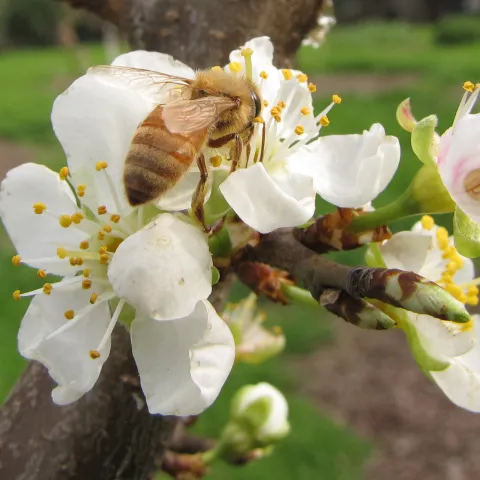
Honey bee pollinating a prune blossom. J. Alosi
The Real Dirt: Article

Backyard Beekeeping for Beginners

September 30, 2025
Keeping honey bees requires planning, knowledge and an investment of time and money to be successful. Honey bees (Apis mellifera) will pollinate the fruits and vegetables in your garden and increase production of your fruit trees. Since they fly as far as five miles, you will also be helping your neighbors…
View Article
Primary Image
Catalan and ANR scientists pose under the Kearney sign
ANR Employee News: Article

UC ANR expands partnership with Catalan researchers to work on emerging issues

September 30, 2025
By Michael Hsu, Pamela S Kan-Rice
 Catalonia, a famed region in northeast Spain, has a lot in common with California – beautiful coastline and mountains, a sunny Mediterranean climate and a robust agricultural sector that produces wine, olives and a variety of fruits and vegetables.It is also home to a public research institute with a…
View Article
UC Environmental Stewards: Event

California Naturalist Course with Museum of the American Indian

Event Date
Oct 20, 2025 - Dec 22, 2025

Museum of the American Indian is offering the California Naturalist certification course in Marin County in Novato's Miwok Park. The Museum of the American Indian (MAI) in collaboration with UC Environmental Stewards is offering a new California Naturalist certification course designed to promote a greater…
UC Environmental Stewards
View Event
UC Environmental Stewards: Page

Museum of the American Indian

Course Description Museum of the American Indian is offering the California Naturalist certification course in Marin County in Novato's Miwok Park. The Museum of the American Indian (MAI) in collaboration with UC Environmental Stewards is offering a new California Naturalist certification course…
View Page
UC Environmental Stewards: Event

California Naturalist Course with Teranga Ranch Wildlife

Event Date
Oct 15, 2025 - Oct 28, 2025

Embark on an unforgettable journey with Teranga Wildlife through California’s diverse landscapes, from the towering redwoods to the dynamic coastline, as we explore the intricate connections between land, water, and wildlife. This immersive naturalist course takes you deep into the redwoods and surrounding…
UC Environmental Stewards
View Event
Primary Image
cover crop mix 2023
Mt. Diablo Region Crops: Article

Cover crop trial shows the benefits of a diverse seed mix

September 30, 2025
By Kamyar Aram
  Where does the time go? Cover cropping season is upon us, again. After three years of running a cover trial in a walnut orchard in eastern Contra Costa County (at the northwestern reach of the San Joaquin Valley), there are some exciting results to share that could be helpful if you are deciding…
View Article
Nutrition Policy Institute: Article

California Nutrition Incentive Program Text Message (SMS) Pilot Shopper Evaluation

September 30, 2025
By Samantha Sam-Chen, Sridharshi C Hewawitharana, Ron Strochlic, Wendi Gosliner
Report • September 2025 • Download PDF (815 KB)Table of ContentsBackgroundStudy ObjectivesStudy Design and MethodsStudy sampleData collectionIntervention and Control Group Text Messages (SMS)AnalysisFindingsStudy participantsBehavioral changes among survey respondentsPerceptions of the text messages…
View Article
Primary Image
foto de un invernadero
Blog Verde: Article

¿Tiene preguntas sobre el cultivo del agave? UC ANR tiene las respuestas

September 30, 2025
By Caroline D Champlin
A medida que el cultivo de agave se populariza en California, UC ANR ofrece una serie de talleres virtuales para abordar las principales dudas de los cultivadoresLa planta de agave crece lentamente, pero la prisa por cultivar el cultivo tolerante a las sequías en California se ha acelerado  …
View Article