A Natural Solution for California's Herds: African Catfish Peptides

California's cattle producers and agricultural communities are all too familiar with the rising challenge of antibiotic resistance, making common bacterial infections harder to treat in livestock. But imagine a future where we could tackle these infections with a natural, powerful alternative. Our research points to just that: antimicrobial peptides (AMPs) found in African catfish.

We're really excited about these peptides because African catfish thrive in pathogen-rich freshwater, naturally producing these robust immune compounds in their skin mucus as a defense. This natural origin makes them highly appealing alternatives to synthetic drugs.

Predicted Safety and Potent Action

One of the most compelling aspects of these AMPs is their predicted safety for mammals. Our initial computer analyses suggest that various catfish AMPs are generally recognized as safe (GRAS). We predict they'll be absorbed in the human intestine without causing liver, brain, or heart toxicity. Furthermore, lab tests on a promising peptide, NACAP-II, confirmed it was non-hemolytic, meaning it didn't damage rabbit red blood cells—a strong indicator of its potential safety for mammalian cells.

Beyond safety, these peptides demonstrate effectiveness against problematic bacteria. One study revealed NACAP-II's strong activity against Extended-Spectrum Beta-Lactamase (ESBL)-producing Escherichia coli—a critical concern for both animal and human health due to its resistance to many common antibiotics. Another peptide, ACAP-IV, also showed antibacterial activity against E. coli and Staphylococcus aureus. We believe these AMPs work by directly disrupting bacterial cell membranes, a mechanism that makes it harder for bacteria to develop resistance compared to how they resist traditional antibiotics.
Glenn County: Article

Programs 101 for Farmers & Ranchers- 2020

December 11, 2019
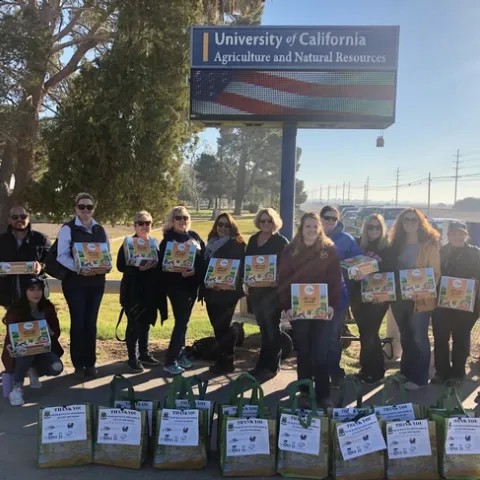
Come learn about local, state and federal funding opportunities to implement new management practices on your farm or ranch. When: Friday, January 10, 2020 8:00 am - 11:30 am Where: Glenn Success Square - Conference Center 131 W. Walker St.
View Article
Primary Image
across the country trish
Under the Solano Sun: Article

Across the Country

December 11, 2019
This summer my husband and I have been busy traveling across the country with destinations in the state of North Carolina and Florida. This blog will focus on NC, which I have to say, I am enthralled with.
View Article
Primary Image
A digger bee, Anthophoroa bomboides, at Bodega Hay, Sonoma County. This is a solitary ground nesting bee, one of the species that collaborators Rachel Vannette, Bryan Danforth, Shawn Steffan, and Quinn McFrederick will study in their grant, "The Brood Cell Microbiome of Solitary Bees: Origin, Diversity, Function, and Vulnerability.” (Photo by Kathy Keatley Garvey)
Bug Squad: Article

Rachel Vannette: Two National Science Foundation Grants

December 10, 2019
By Kathy Keatley Garvey
Congratulations to community ecologist Rachel Vannette of the UC Davis Department of Entomology and Nematology, recipient of two National Science Foundation (NSF) grants involving flower microbes.
View Article
Primary Image
Adult SLF with wings spread. Photo by Richard Gardner, Bugwood.org
From Soil to Science: Article

Help keep the spotted lanternfly out!

December 10, 2019
By Cindy Kron
The spotted lanternfly (SLF) is a new invasive pest that has recently arrived in the United States. This planthopper has a wide host range of 70+ plant species including grapevines, apple, cherries, stone fruits, ornamentals, etc with its preferred host being the tree of heaven.
View Article
Primary Image
pictures by Betty Victor
Under the Solano Sun: Article

Mendocino Botanical Gardens

December 10, 2019
A few getaway days found us in Fort Bragg. Our first destination was the Mendocino Botanical Gardens. This garden is on 47 acres that has a forest of coastal pines, some wetlands and as you walk on the path that takes you to the ocean you can hear the waves.
View Article
Livestock & Range: Article

Job Announcement - Livestock Apprentice at Swanton Pacific Ranch

December 10, 2019
By Devii R Rao
Swanton Pacific Ranch is hiring an apprentice to work with their livestock program. Swanton Pacific Ranch is working towards a regenerative approach to managing their rangelands using the decision making that considers ecological, economic, and social dimensions.
View Article
ANR Adventures: Article

Collaborations are key to success

December 10, 2019
By Wendy Powers
I am in DC for a few days this week to meet with Extension Directors and partners, including the new NIFA National Science Liaisons. These are the NIFA employees who stayed behind in DC while the rest of NIFA headquarters relocated to Kansas City a few months ago.
View Article
Primary Image
Alli Fish holding a radish.
Climate Smart Agriculture: Article

A Field Day for Cover Crops

December 10, 2019
As I have mentioned in my previous blogs, I have a certain affinity for cover crops. Mostly it is because I see enormous potential to increase the soil health and climate resiliency in Ventura County agriculture by incorporating cover crops.
View Article
UC Cooperative Extension - Madera County: Article

2019 Orchard IPM Meeting December 18

December 10, 2019
Come to the 2019 orchard IPM meeting. Hear talks on hull rot in almonds, navel orangeworm control, orchard weed management, and updates from the Madera County Agricultural Commissioner's office. Location and times in the atttached PDF.
View Article
Primary Image
Planting bare root fruit tree. (UC Master Gardener Handbook)
The Stanislaus Sprout: Article

Bare root planting season is almost here!

December 9, 2019
By Anne E Schellman
For gardeners the coming of winter means, among many other things, the beginning of the bare root planting season. Local nurseries will soon receive good supplies of bare root fruit and ornamental trees, roses, grapes, berries, and vegetables such as asparagus and rhubarb.
View Article