A Natural Solution for California's Herds: African Catfish Peptides

California's cattle producers and agricultural communities are all too familiar with the rising challenge of antibiotic resistance, making common bacterial infections harder to treat in livestock. But imagine a future where we could tackle these infections with a natural, powerful alternative. Our research points to just that: antimicrobial peptides (AMPs) found in African catfish.

We're really excited about these peptides because African catfish thrive in pathogen-rich freshwater, naturally producing these robust immune compounds in their skin mucus as a defense. This natural origin makes them highly appealing alternatives to synthetic drugs.

Predicted Safety and Potent Action

One of the most compelling aspects of these AMPs is their predicted safety for mammals. Our initial computer analyses suggest that various catfish AMPs are generally recognized as safe (GRAS). We predict they'll be absorbed in the human intestine without causing liver, brain, or heart toxicity. Furthermore, lab tests on a promising peptide, NACAP-II, confirmed it was non-hemolytic, meaning it didn't damage rabbit red blood cells—a strong indicator of its potential safety for mammalian cells.

Beyond safety, these peptides demonstrate effectiveness against problematic bacteria. One study revealed NACAP-II's strong activity against Extended-Spectrum Beta-Lactamase (ESBL)-producing Escherichia coli—a critical concern for both animal and human health due to its resistance to many common antibiotics. Another peptide, ACAP-IV, also showed antibacterial activity against E. coli and Staphylococcus aureus. We believe these AMPs work by directly disrupting bacterial cell membranes, a mechanism that makes it harder for bacteria to develop resistance compared to how they resist traditional antibiotics.

The Sneaky Cuckoo Bee

September 14, 2017
By Kathy Keatley Garvey
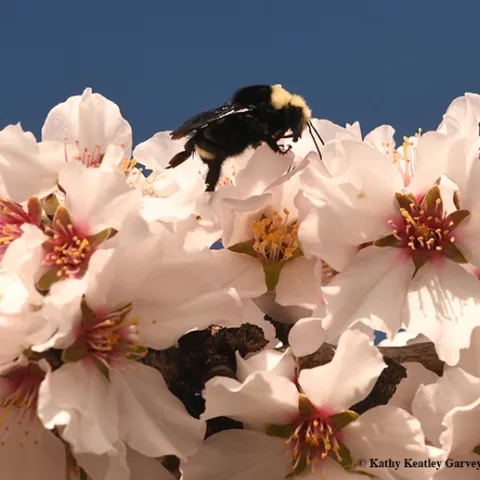
You could call it a slacker, a deadbeat, a moocher, a sponger, or a loafer. Or you could call it a cuckoo bee. Take the cuckoo bee, Xeromelecta californica, a parasite of the digger bee, Anthophora.
View Article

Flurry of Pink at Gold Ridge

September 13, 2017
By Kathy Keatley Garvey
There's a flurry of pink at the Gold Ridge. That would be the Luther Burbank Gold Ridge Experiment Farm in Sebastopol. "Luther Burbank bought his 15-acre farm on Gold Ridge in 1885 in Sebastopol," says the Western Sonoma Historical Society on its website.
View Article
Primary Image
leaffooted bugs massed
Topics in Subtropics: Article

Leaffooted Bug Alert

September 13, 2017
By Ben A Faber
0University of California Cooperative Extension Area-wide IPM Advisor, Kearney Agricultural Research and Extension Center, Parlier, CA Leaffooted Bug Populations in Ventura County - 2017 Cold winter temperatures can reduce populations of leaffooted bug, Leptoglossus zonatus (Dallas), by ~50 to 80%.
View Article
UC Weed Science (weed control, management, ecology, and minutia): Article

New Agronomy/Weed Science Farm Advisor

September 12, 2017
Hello, My name is Mariano Galla and I am the new agronomy/weed science farm advisor serving Glenn, Butte and Tehama counties.
View Article
Primary Image
IMG 5515
UC Rice Blog: Article

Stem Rot

September 11, 2017
By Luis Espino
In the past two years, I have received several reports of fields suffering yield loses due to stem rot. Last year I saw several affected fields. This year, I am starting to get reports of fields being affected. I visited one such field last week.
View Article
Primary Image
Gopher snake climbing citrus tree
Topics in Subtropics: Article

Gopher snake: friend or foe?

September 11, 2017
By Sonia I Rios
Gopher Snakes (Pituophis catenifer), known as a constrictor snake, are one of the most commonly seen snakes in California. Mainly active during the day, they are active after sundown on hot days.
View Article
Topics in Subtropics: Article

Ag Supervisor Training

September 11, 2017
By Ben A Faber
Attention agricultural employers! Give your front-line supervisors the training and skills they need! As a business owner, you know the importance of a skilled, reliable and well-managed work force.
View Article

A Bright Face in the Garden: Banded Argiope

September 11, 2017
By Kathy Keatley Garvey
We have bright faces in our Vacaville, Calif., pollinator garden. The bright faces are usually that of assorted bees and butterflies nectaring on members of the sunflower family: Mexican sunflower (Tithonia) and blanketflowers (Gaillardia).
View Article
Primary Image
leafminer adult
Topics in Subtropics: Article

The Leafminers are Here

September 11, 2017
By Ben A Faber
Leafminer, sometimes Leaf Miner. It's that time of year. Those little moths come out in the late afternoon and flit about. They lay their eggs and when they hatch the larvae start burrowing through the leaf. The recent heat and also the generally warm summer have set them off. And it is obvious now.
View Article