A Natural Solution for California's Herds: African Catfish Peptides

California's cattle producers and agricultural communities are all too familiar with the rising challenge of antibiotic resistance, making common bacterial infections harder to treat in livestock. But imagine a future where we could tackle these infections with a natural, powerful alternative. Our research points to just that: antimicrobial peptides (AMPs) found in African catfish.

We're really excited about these peptides because African catfish thrive in pathogen-rich freshwater, naturally producing these robust immune compounds in their skin mucus as a defense. This natural origin makes them highly appealing alternatives to synthetic drugs.

Predicted Safety and Potent Action

One of the most compelling aspects of these AMPs is their predicted safety for mammals. Our initial computer analyses suggest that various catfish AMPs are generally recognized as safe (GRAS). We predict they'll be absorbed in the human intestine without causing liver, brain, or heart toxicity. Furthermore, lab tests on a promising peptide, NACAP-II, confirmed it was non-hemolytic, meaning it didn't damage rabbit red blood cells—a strong indicator of its potential safety for mammalian cells.

Beyond safety, these peptides demonstrate effectiveness against problematic bacteria. One study revealed NACAP-II's strong activity against Extended-Spectrum Beta-Lactamase (ESBL)-producing Escherichia coli—a critical concern for both animal and human health due to its resistance to many common antibiotics. Another peptide, ACAP-IV, also showed antibacterial activity against E. coli and Staphylococcus aureus. We believe these AMPs work by directly disrupting bacterial cell membranes, a mechanism that makes it harder for bacteria to develop resistance compared to how they resist traditional antibiotics.
Bug Squad: Article

A Spectacular Spider

August 31, 2016
By Kathy Keatley Garvey
You may not like spiders. You may have Arachnophobia, a fear of spiders, or maybe you just dislike all spiders. But still, some spiders are spectacular. Stunning. Striking. Take the redfemured spotted orbweaver, Neoscona domiciliorum.
View Article
Primary Image
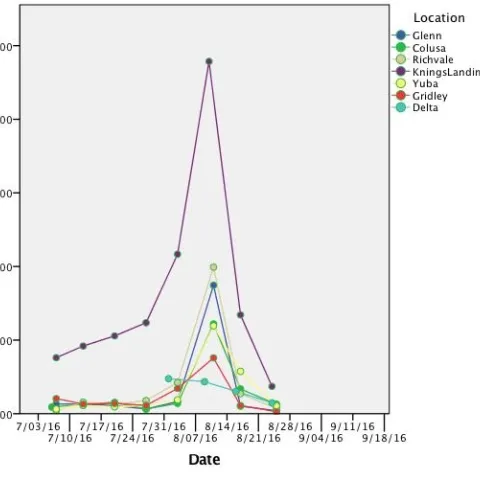
Figure 1. 2016 Armyworm populations from the Sacramento Valley to the Delta. Figure courtesy of Luis Espino, UCCE rice farm advisor in Colusa County.
SJC and Delta Field Crops: Article

Armyworm Update from the Delta to the Sacramento Valley

August 31, 2016
By Michelle M Leinfelder-Miles
Please see this article on the UC Rice Blog for an update on armyworm populations. We will continue to monitor traps in the Delta through mid-September, and we will plan to monitor populations next season.
View Article
Primary Image
aRGENTINE ANT
Topics in Subtropics: Article

Argentine Ants

August 31, 2016
By Ben A Faber
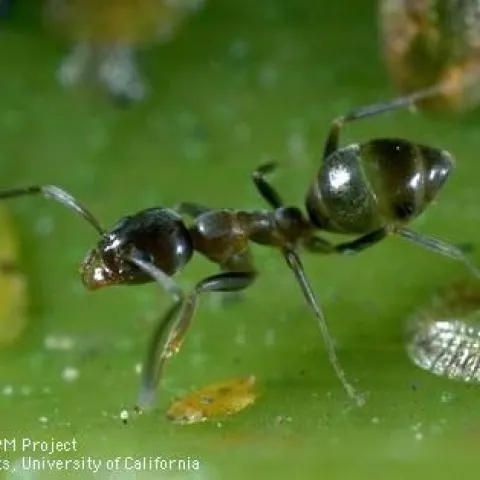
There are numerous species of ants present in citrus orchards, however, the most common are the Argentine ant (southern and coastal California), the native gray ant (San Joaquin Valley) and the southern fire ant (statewide).
View Article
Bug Squad: Article

Seconds Count When You're Photographing Butterflies

August 30, 2016
By Kathy Keatley Garvey
When you're capturing images of butterflies, seconds count. They're unpredictable. They move from fluttering to fleeting. And just when you're focused on where they are, they aren't there anymore.
View Article
Primary Image
image 38507
IGIS: Article

This year's class: the why, how and what of GIS

August 30, 2016
By Maggi Kelly
Here are the tag clouds from this year's GIS class: the why, how and what of our upcoming semester's projects. Word clouds from Wordle. The Why: what are the key problems class members want to focus on... The How: possible methods we will use... The What: some of the datasets that might be used...
View Article
Primary Image
IGIS brand color 250x242
IGIS: Article

GIS for Needs Assessments

August 30, 2016
By Andy Lyons
I recently attended a really useful ANR training from the office of Program Planning and Evaluation (PPE) on needs assessment. Incorporating needs assessments into research and extension makes a lot of sense for many reasons.
View Article
UC Weed Science (weed control, management, ecology, and minutia): Article

Sierra Valley Noxious Weed Tour: Pondering Soil Seed Life

August 29, 2016
By Thomas J Getts
Recently I was a participant on an educational noxious weed tour in Sierra Valley. It is a beautiful mountain valley where most agricultural production is devoted to grazing and hay production.
View Article
Bug Squad: Article

And Along Came a Wasp...

August 29, 2016
By Kathy Keatley Garvey
So here's this cute little reddish/orangish caterpillar munching away on a passionflower vine. It's Sunday and he's having Sunday dinner--after having Sunday breakfast and lunch and snacks in between, thank you. He's on his way to becoming a Gulf Fritillary (Agraulis vanillae) butterfly.
View Article
Primary Image
Moths per trap per week Aug25
UC Rice Blog: Article

Armyworm Season Coming to an End

August 29, 2016
By Luis Espino
Finally, the armyworm season seems to be over. Moth trapping shows that the numbers are decreasing to the lowest levels of the season. Additionally, most fields are ripening and therefore less susceptible to armyworm injury. Overall, armyworm infestations were not as severe as last year.
View Article