A Natural Solution for California's Herds: African Catfish Peptides

California's cattle producers and agricultural communities are all too familiar with the rising challenge of antibiotic resistance, making common bacterial infections harder to treat in livestock. But imagine a future where we could tackle these infections with a natural, powerful alternative. Our research points to just that: antimicrobial peptides (AMPs) found in African catfish.

We're really excited about these peptides because African catfish thrive in pathogen-rich freshwater, naturally producing these robust immune compounds in their skin mucus as a defense. This natural origin makes them highly appealing alternatives to synthetic drugs.

Predicted Safety and Potent Action

One of the most compelling aspects of these AMPs is their predicted safety for mammals. Our initial computer analyses suggest that various catfish AMPs are generally recognized as safe (GRAS). We predict they'll be absorbed in the human intestine without causing liver, brain, or heart toxicity. Furthermore, lab tests on a promising peptide, NACAP-II, confirmed it was non-hemolytic, meaning it didn't damage rabbit red blood cells—a strong indicator of its potential safety for mammalian cells.

Beyond safety, these peptides demonstrate effectiveness against problematic bacteria. One study revealed NACAP-II's strong activity against Extended-Spectrum Beta-Lactamase (ESBL)-producing Escherichia coli—a critical concern for both animal and human health due to its resistance to many common antibiotics. Another peptide, ACAP-IV, also showed antibacterial activity against E. coli and Staphylococcus aureus. We believe these AMPs work by directly disrupting bacterial cell membranes, a mechanism that makes it harder for bacteria to develop resistance compared to how they resist traditional antibiotics.

Primary Image
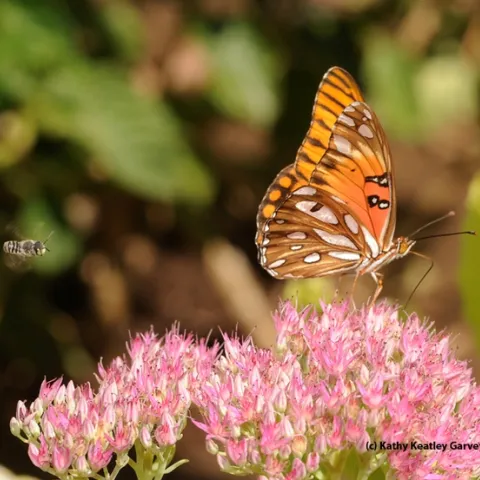
Honey bee sharing a sedum blossom with a Gray Hairstreak. (Photo by Kathy Keatley Garvey)

Seeing Eye-to-Eye on a Sedum

October 23, 2014
By Kathy Keatley Garvey
If you've ever watched a Gray Hairstreak butterfly (Strymon melinus) nectaring a sedum, and then watched a honey bee (Apis mellifera) land on the same flower, it's a study in sharing. "I was here first," says the Gray Hairstreak, sipping nectar. "I was here second," says the honey bee.
View Article
Topics in Subtropics: Article

Zinc and Phosphorus

October 23, 2014
By Ben A Faber
I was recently in an avocado orchard and saw the rounded fruit and small leaves typical of zinc deficient trees. I asked the grower if there were recent leaf analysis of the orchard, and so we looked at them. The leaves were running at 20 ppm which is low. Sufficiency runs at 50 ppm.
View Article
Primary Image
Lygus infected with Bb-Surendra Dara
E-Journal of Entomology and Biologicals: Article

Can entomopathogenic fungus Beauveria bassiana be used for pest management when fungicides are used for disease management?

October 23, 2014
Western tarnished plant bug (Lygus hesperus) killed by the entomopathogenic fungus, Beauveria bassiana (Photo by Surendra Dara) Beneficial fungi such as Beauveria bassiana are pathogenic to insect and mite pests and are commercially available for use in organic and conventional farming.
View Article
Primary Image
CSBA President Bill Lewis of the San Fernando Valley talks bees with Barbara Allen-Diaz, vice president of the UC Agriculture and Natural Resources (UC ANR) at the California Agriculture Day, State Capitol, in March. (Photo by Kathy Keatley Garvey)

A Gathering of Beekeepers: Follow That Buzz!

October 22, 2014
By Kathy Keatley Garvey
Follow that buzz! When the California State Beekeepers' Association, founded in 1889, meets Nov. 18-20 in Valencia for its 2014 convention, it will mark a milestone: 125 years of beekeeping. Not so coincidentally, the theme is "Celebrating 125 Years of California Beekeeping.
View Article
Primary Image
A honey bee and yellow-faced bumble bee, Bombus vosnesenski, share a coneflower. (Photo by Kathy Keatley Garvey)

Bees 'n Blooms

October 21, 2014
By Kathy Keatley Garvey
Bees 'n blooms. Blooms 'n bees. Add "California" to it and you have California Bees and Blooms: A Guide for Gardeners and Naturalists. It's a book that's well-planned, well-executed, well-written and well-photographed. Bees are hungry.
View Article
Primary Image
image 25479
IGIS: Article

Mapping Ebola Over Time

October 20, 2014
By Maggi Kelly
HealthMap, an automated electronic information system that monitors data from electronic media sources (e.g. social media, government websites, physician social networks) in order to visualize and foster an understanding of infectious disease outbreaks around the world.
View Article
Primary Image
Drone fly, Eristalis tenax, sipping nectar from a Mexican sunflower, Tithonia. (Photo by Kathy Keatley Garvey)

A Fly Is a Fly Is a Fly

October 20, 2014
By Kathy Keatley Garvey
A bee is a bee is a bee is a bee. 'Cept when it's a fly. Lately we've been seeing lots of images on social media (including Facebook and Twitter), news media websites, and stock photo sites of "honey bees." But they're actually flies.
View Article
Primary Image
Asilomoar GPS
IGIS: Article

1st Statewide UC California Naturalist Conference - IGIS GPS Workshop

October 20, 2014
By Maggi Kelly
Sean Hogan attended the 1st Statewide California Naturalist Conference, which took place at the Asilomar Conference Grounds in Pacific Grove CA this weekend (October 17th to 19th), and has provided us with this report. By all accounts the conference was a resounding success.
View Article
UC Weed Science (weed control, management, ecology, and minutia): Article

Definition of codistillation or lift-off of herbicides. Repost from Arizona Vegetable IPM Updates

October 20, 2014
By Brad Hanson
I was forwarded this great article written by Barry Tickes, an Area Agricultural Agent with the Yuma Ag Center and part of the University of Arizona and Arizona Agricultural Experiment Station. With Barry's permission, I've posted his explanation of "lift off" or "codistillation" of herbicides.
View Article