A Natural Solution for California's Herds: African Catfish Peptides

California's cattle producers and agricultural communities are all too familiar with the rising challenge of antibiotic resistance, making common bacterial infections harder to treat in livestock. But imagine a future where we could tackle these infections with a natural, powerful alternative. Our research points to just that: antimicrobial peptides (AMPs) found in African catfish.

We're really excited about these peptides because African catfish thrive in pathogen-rich freshwater, naturally producing these robust immune compounds in their skin mucus as a defense. This natural origin makes them highly appealing alternatives to synthetic drugs.

Predicted Safety and Potent Action

One of the most compelling aspects of these AMPs is their predicted safety for mammals. Our initial computer analyses suggest that various catfish AMPs are generally recognized as safe (GRAS). We predict they'll be absorbed in the human intestine without causing liver, brain, or heart toxicity. Furthermore, lab tests on a promising peptide, NACAP-II, confirmed it was non-hemolytic, meaning it didn't damage rabbit red blood cells—a strong indicator of its potential safety for mammalian cells.

Beyond safety, these peptides demonstrate effectiveness against problematic bacteria. One study revealed NACAP-II's strong activity against Extended-Spectrum Beta-Lactamase (ESBL)-producing Escherichia coli—a critical concern for both animal and human health due to its resistance to many common antibiotics. Another peptide, ACAP-IV, also showed antibacterial activity against E. coli and Staphylococcus aureus. We believe these AMPs work by directly disrupting bacterial cell membranes, a mechanism that makes it harder for bacteria to develop resistance compared to how they resist traditional antibiotics.
Primary Image
Close-up of a tagged Monarch butterfly. (Photo by David James, entomologist at Washington State University, Pullman, Wash.)
Bug Squad: Article

Have You Seen Me? A Tagged Monarch?

October 17, 2014
By Kathy Keatley Garvey
The next time you see a Monarch butterfly heading your way--or settled in at an overwintering site in coastal California or in central Mexico--check to see if it's tagged.
View Article
Primary Image
Salt injury to strawberry plants
E-Journal of Entomology and Biologicals: Article

Impact of current drought and recommendations for strawberries and vegetables

October 17, 2014
Average annual precipitation in California is 200 million acre-feet, out of which 42% of water is used for agriculture while 11% is used in the urban areas (municipal and industrial users) and the remaining 47% by the environment (native vegetation, ground water, and oceans) (Doug Parker, personal c...
View Article
Primary Image
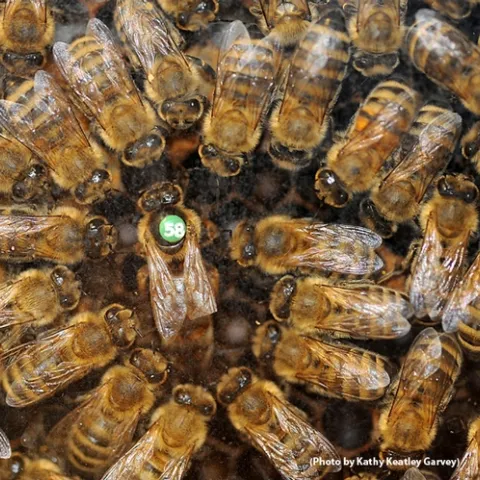
Michael "Kim" Fondrk of UC Davis tends Robert Page's bees in a Dixon, Calif. almond orchard. (Photo by Kathy Keatley Garvey)
Bug Squad: Article

Bee BMP: 'A' for Communication

October 16, 2014
By Kathy Keatley Garvey
Can you say "Bee BMP?" That's a short-cut for "Bee Best Management Practices." The Almond Board of California today unveiled its long-awaited "Honey Bee Best Management Practices for California Almonds.
View Article
UC Weed Science (weed control, management, ecology, and minutia): Article

USDA announces measures to help farmers diversify weed control efforts

October 16, 2014
By Gale Perez
From a PRESS RELEASE from the USDA Office of Communications: Release No. 0227.14 Contact: Brian Mabry (202)720-4623 USDA Announces Measures to Help Farmers Diversify Weed Control Efforts WASHINGTON, Oct. 15, 2014 Agriculture Secretary Tom Vilsack today announced several steps that the U.S.
View Article
Primary Image
Honey bee pollinating an almond blossom. (Photo by Kathy Keatley Garvey
Bug Squad: Article

Best Management Practices for Honey Bees

October 15, 2014
By Kathy Keatley Garvey
The Almond Board of California will unveil its Honey Bee Best Management Practices tomorrow (Thursday, Oct. 16) in an ongoing effort to promote and protect bee health. The board will do so by holding a press conference at 8:30 a.m.
View Article
Primary Image
A male Monarch nectaring on Mexican sunflower (Tithonia). (Photo by Kathy Keatley Garvey)
Bug Squad: Article

Go West, Young Monarch, Go West!

October 14, 2014
By Kathy Keatley Garvey
Westward, ho! The western migration of the Monarch butterflies (Danaus plexippus) to their overwintering sites along the California coast is underway.
View Article
UC Weed Science (weed control, management, ecology, and minutia): Article

A chat with aquatic weed experts

October 14, 2014
By Gale Perez
California Ag Today's Patrick Cavanaugh interviews aquatic weed experts John Madsen (USDA-ARS Exotic & Invasive Weeds Research Unit) and Mike Blankinship (Blankinship & Associates.) Click links below. http://ucanr.edu/blogs/UCDWeedScience/blogfiles/25335.mp3 (audio) http://californiaagtoday.
View Article
UC Weed Science (weed control, management, ecology, and minutia): Article

Olive Pest Management Guideline - updated and republished

October 14, 2014
By Brad Hanson
A quick post today to share a link to the recently revised "UC IPM Pest Management Guidelines for Olive" (UC ANR Publication #3452). You can download the whole document as a pdf here, or use it online at the above link.
View Article
Primary Image
Honey bee "squadron" aiming for the flowering artichokes. (Photo by Kathy Keatley Garvey)
Bug Squad: Article

The Bees and the Blue Angels

October 13, 2014
By Kathy Keatley Garvey
Honey bees and the Blue Angels... Honey bees sometimes seem to fly in formation over such plants as flowering artichokes, but their precision--if you could call it that--never matches that of the Blue Angels. For one, the pollen-packing bees are wobbly and bump into one another.
View Article