A Natural Solution for California's Herds: African Catfish Peptides

California's cattle producers and agricultural communities are all too familiar with the rising challenge of antibiotic resistance, making common bacterial infections harder to treat in livestock. But imagine a future where we could tackle these infections with a natural, powerful alternative. Our research points to just that: antimicrobial peptides (AMPs) found in African catfish.

We're really excited about these peptides because African catfish thrive in pathogen-rich freshwater, naturally producing these robust immune compounds in their skin mucus as a defense. This natural origin makes them highly appealing alternatives to synthetic drugs.

Predicted Safety and Potent Action

One of the most compelling aspects of these AMPs is their predicted safety for mammals. Our initial computer analyses suggest that various catfish AMPs are generally recognized as safe (GRAS). We predict they'll be absorbed in the human intestine without causing liver, brain, or heart toxicity. Furthermore, lab tests on a promising peptide, NACAP-II, confirmed it was non-hemolytic, meaning it didn't damage rabbit red blood cells—a strong indicator of its potential safety for mammalian cells.

Beyond safety, these peptides demonstrate effectiveness against problematic bacteria. One study revealed NACAP-II's strong activity against Extended-Spectrum Beta-Lactamase (ESBL)-producing Escherichia coli—a critical concern for both animal and human health due to its resistance to many common antibiotics. Another peptide, ACAP-IV, also showed antibacterial activity against E. coli and Staphylococcus aureus. We believe these AMPs work by directly disrupting bacterial cell membranes, a mechanism that makes it harder for bacteria to develop resistance compared to how they resist traditional antibiotics.
Primary Image
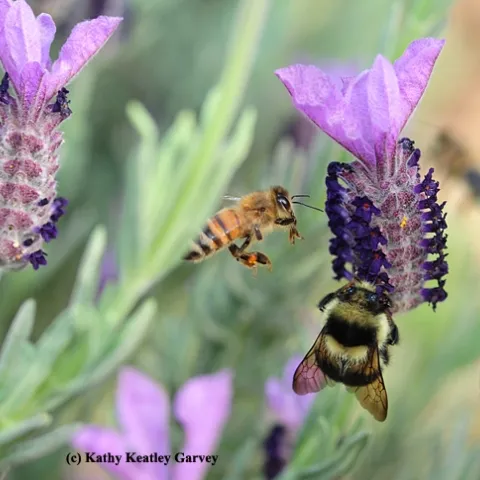
Male wool carder bee heads for the photographer. (Photo by Kathy Keatley Garvey)

Male Wool Carder Bees: In-Your-Face Behavior

October 10, 2014
By Kathy Keatley Garvey
She described it to a "T." That would be "T" for territorial. Lynn Kimsey, director of the Bohart Museum of Entomology and professor of entomology at UC Davis, spotlighted the European wool carder bee in her current edition of the Bohart Museum Society newsletter. The males are aggressive.
View Article
UC Weed Science (weed control, management, ecology, and minutia): Article

UCCE Weed Science Farm Advisor position announcement

October 10, 2014
By Brad Hanson
UCCE Position Announcement If you've ever wished you could be a weed scientist with the University of California Cooperative Extension system (and really, who among us hasn't wished that?
View Article
IGIS: Article

ASPRS scholarship application deadline Oct 31

October 8, 2014
By Maggi Kelly
New for 2015, the DigitalGlobe Foundation Award for the Application of High-Resolution Digital Satellite Imagery will make available one new collection of imagery in addition to the archive imagery previously available.
View Article
Primary Image
A Gulf Fritillary butterfly on purple lantana. (Photo by Kathy Keatley Garvey)
Bug Squad: Article

How's Your Front Yard Looking?

October 8, 2014
By Kathy Keatley Garvey
How's your front yard looking? A little bit brown due to the drought? Thinking of replacing some of your plants with drought-tolerant ones? And hoping to attract some bees, butterflies and other wildlife? You're in luck.
View Article
Primary Image
This is a dead caterpillar killed by an infectious virus disease (Polyhedrosis), as identified by UC Davis butterfly expert Art Shapiro. (Photo by Kathy Keatley Garvey)

Highly Infectious Viral Disease, 'Kind of Like Ebola'

October 7, 2014
By Kathy Keatley Garvey
It's something you don't see every day. I'm used to seeing Gulf Fritillary chrysalids hanging from our passionflower vine (Passiflora) but this thing hanging from our African blue basil was not a chrysalid.
View Article
UC Weed Science (weed control, management, ecology, and minutia): Article

CWSS Research Update & News_09/2014 issue

October 7, 2014
By Gale Perez
Check out the Sept. issue of the California Weed Science Society journal (CWSS Research Update and News).
View Article