A Natural Solution for California's Herds: African Catfish Peptides

California's cattle producers and agricultural communities are all too familiar with the rising challenge of antibiotic resistance, making common bacterial infections harder to treat in livestock. But imagine a future where we could tackle these infections with a natural, powerful alternative. Our research points to just that: antimicrobial peptides (AMPs) found in African catfish.

We're really excited about these peptides because African catfish thrive in pathogen-rich freshwater, naturally producing these robust immune compounds in their skin mucus as a defense. This natural origin makes them highly appealing alternatives to synthetic drugs.

Predicted Safety and Potent Action

One of the most compelling aspects of these AMPs is their predicted safety for mammals. Our initial computer analyses suggest that various catfish AMPs are generally recognized as safe (GRAS). We predict they'll be absorbed in the human intestine without causing liver, brain, or heart toxicity. Furthermore, lab tests on a promising peptide, NACAP-II, confirmed it was non-hemolytic, meaning it didn't damage rabbit red blood cells—a strong indicator of its potential safety for mammalian cells.

Beyond safety, these peptides demonstrate effectiveness against problematic bacteria. One study revealed NACAP-II's strong activity against Extended-Spectrum Beta-Lactamase (ESBL)-producing Escherichia coli—a critical concern for both animal and human health due to its resistance to many common antibiotics. Another peptide, ACAP-IV, also showed antibacterial activity against E. coli and Staphylococcus aureus. We believe these AMPs work by directly disrupting bacterial cell membranes, a mechanism that makes it harder for bacteria to develop resistance compared to how they resist traditional antibiotics.

Primary Image
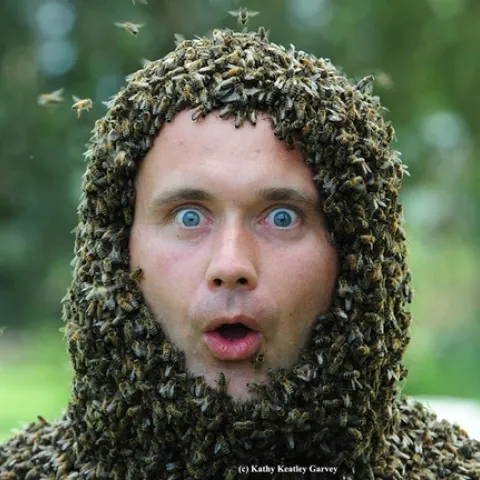
Male Valley carpenter bee draws attention at the Bohart Museum of Entomology's open house on UC Davis Picnic Day. (Photo by Kathy Keatley Garvey)

Golden Boy

April 14, 2014
By Kathy Keatley Garvey
A "golden boy" drew a lot of attention at the Bohart Museum of Entomology last Saturday, April 12 during the campuswide UC Davis Picnic Day. "Golden boy?" A male Valley carpenter bee (Xylocopa varipuncta) to be exact.
View Article
UC Weed Science (weed control, management, ecology, and minutia): Article

JOB OPENING :: Asst. Professor (Weed Science)

April 14, 2014
By Gale Perez
The College of Agricultural Sciences and the College of Science at Southern Illinois University Carbondale has a nine (9) month academic appointment with opportunities for summer research support, joint appointment in the College of Agricultural Sciences and the College of Science at SIU Carbondale.
View Article
Primary Image
A maggot dipped in water-based, non-toxic paint crawls on paper. (Photo by Kathy Keatley Garvey)

Just Me and My Maggot

April 11, 2014
By Kathy Keatley Garvey
If you've never been to Briggs Hall during the annual campuswide Picnic Day at the University of California, Davis, you're missing a special kind of art. Maggot Art. Yes, you read that right. Maggot Art.
View Article
Primary Image
earwigs
Topics in Subtropics: Article

Citrus, Earwigs and Tree Wraps

April 11, 2014
By Ben A Faber
Installing tree wraps on young trees provides protection to the trunk from applications of herbicides during weed management operations. Additionally, the wraps minimize light interception by trunk tissue thereby reducing sucker growth.
View Article
Primary Image
scale Ceroplastes
Topics in Subtropics: Article

Seeing a "new" Scale in Ventura

April 11, 2014
By Ben A Faber
Jane Delahoyde, a PCA here in Ventura, recently found an unusual scale in lemon here. It is barnacle scale with a typically long Latin name - Ceroplastes cirripediformis. It is unlikely to be any worse than other scales, but it's something to keep our eyes on.
View Article
Primary Image
Fish-eye view of the honey tasting at Briggs Hall during the UC Davis Picnic Day. (Photo by Kathy Keatley Garvey)

Honey, Let's Go Honey Tasting!

April 10, 2014
By Kathy Keatley Garvey
Want to sample some honey? How about almond, yellow starthistle, leatherwood, cultivated buckwheat, safflower and wild oak?
View Article
Colusa County: Article

Plant Clinic

April 10, 2014
Plant Clinic Friday April 11 10am - 4pm Griff's Feed and Seed, Colusa Ask Us!...
View Article
Primary Image
Honey bees on an onion umbel. (Photo by Kathy Keatley Garvey)

Bees and Onions Go Together: Pollination Partners

April 9, 2014
By Kathy Keatley Garvey
The University of California, Davis, is a world leader in seed, plant and agricultural sciences. Some 100 seed and seed-related companies are located near UC Davis and benefit greatly from its proximity, but the influence of UC Davis extends throughout the USA and far beyond.--Seed Central.
View Article
Cooperative Extension Ventura County: Article

Vol. 12, No. 1, Winter 2014 (Jan-Mar)

April 9, 2014
The Spanish Avocado Industry Strategizing for Water Cutbacks - Avocado and Citrus California Agricultural Production Statistics Maintaining the Citrus Orchard with a Reduced Irrigation Allotment The 2014 Drought in California...
View Article
Primary Image
fungiferous mite Wintershmedii
Topics in Subtropics: Article

Seeing a "new" Mite in Ventura

April 9, 2014
By Ben A Faber
Bob Hill, a local Ventura PCA, saw an interesting mite he had never seen before and asked if I could id it. Well, I sent it in to Mark Hoddle and UCR and he turned it over to his student Ricky Lara to id it.
View Article