A Natural Solution for California's Herds: African Catfish Peptides

California's cattle producers and agricultural communities are all too familiar with the rising challenge of antibiotic resistance, making common bacterial infections harder to treat in livestock. But imagine a future where we could tackle these infections with a natural, powerful alternative. Our research points to just that: antimicrobial peptides (AMPs) found in African catfish.

We're really excited about these peptides because African catfish thrive in pathogen-rich freshwater, naturally producing these robust immune compounds in their skin mucus as a defense. This natural origin makes them highly appealing alternatives to synthetic drugs.

Predicted Safety and Potent Action

One of the most compelling aspects of these AMPs is their predicted safety for mammals. Our initial computer analyses suggest that various catfish AMPs are generally recognized as safe (GRAS). We predict they'll be absorbed in the human intestine without causing liver, brain, or heart toxicity. Furthermore, lab tests on a promising peptide, NACAP-II, confirmed it was non-hemolytic, meaning it didn't damage rabbit red blood cells—a strong indicator of its potential safety for mammalian cells.

Beyond safety, these peptides demonstrate effectiveness against problematic bacteria. One study revealed NACAP-II's strong activity against Extended-Spectrum Beta-Lactamase (ESBL)-producing Escherichia coli—a critical concern for both animal and human health due to its resistance to many common antibiotics. Another peptide, ACAP-IV, also showed antibacterial activity against E. coli and Staphylococcus aureus. We believe these AMPs work by directly disrupting bacterial cell membranes, a mechanism that makes it harder for bacteria to develop resistance compared to how they resist traditional antibiotics.
Primary Image
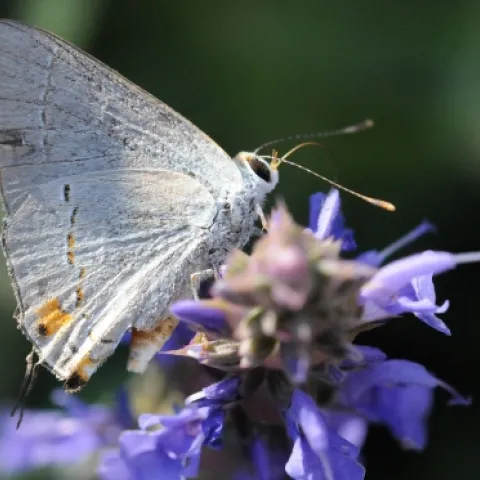
A male gray hairstreak butterfly (Strymon melinus) nectars on sage. (Photo by Kathy Keatley Garvey)

Gray Hairstreak

September 10, 2008
By Kathy Keatley Garvey
"Omigosh, what's that? A gray hairstreak?" If it's in your hair, you consult a mirror, your favorite salon, or just ignore it. If you're an entomologist or a lepidopterist, a gray hairstreak is delightful.
View Article
Primary Image
This is a bee nesting block built to attract native pollinators. (Photo by Kathy Keatley Garvey)

Build It And They Will Come

September 9, 2008
By Kathy Keatley Garvey
Build it and they will come. Baseball's Field of Dreams? No, a bee nesting block. Think "bee condo." It's an artificial nesting site made of wood and drilled with different-sized holes and depths to accommodate the diversity of native pollinators. Often the bee block is nailed to a fence post.
View Article
Primary Image
This floral visitor is a cuckoo bee, "probably the genus Triepeolus (maybe Epeolus) and probably a male," said UC Davis emeritus professor Robbin Thorp. (Photo by Kathy Keatley Garvey)

Cuckoo! Cuckoo! Cuckoo!

September 8, 2008
By Kathy Keatley Garvey
We've all heard of the cuckoo clock. And most of us have heard of the cuckoo bird (Cuculus canorus), which lays its eggs in the nest of birds of other species. But the cuckoo bee? Yes, there is a cuckoo bee. The female lays her eggs in the nests of other solitary nesting bees. They resemble wasps.
View Article
Primary Image
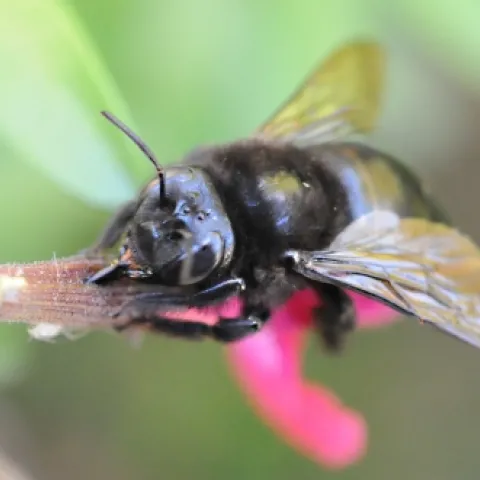
A female carpenter bee (Xylocopa tabaniformis orpifex) pierces the corolla of salvia to rob the nectar. (Identified by Robbin Thorp, UC Davis emeritus professor of entomology.) (Photo by Kathy Keatley Garvey)

I've Been Robbed!

September 5, 2008
By Kathy Keatley Garvey
Robber at work. No, this isn't a bank heist or a gas station hold-up or a home invasion. A carpenter bee is slitting the sides of salvia (sage) to steal the nectar. Floral larceny! Book 'em, Danno! Carpenter bees are nectar robbers.
View Article
Primary Image
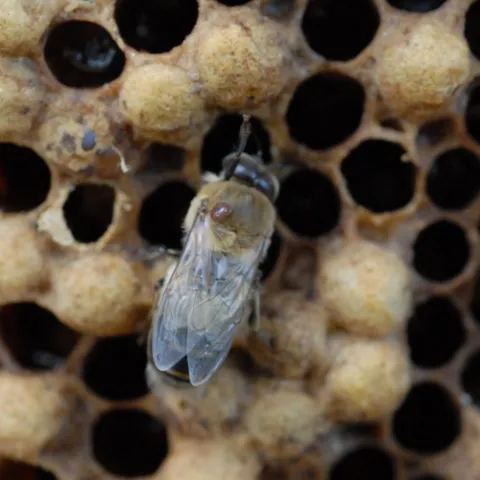
A female varroa mite on a drone (male bee). The mite is the reddish-brown parasite on the bee's thorax. (Photo by Kathy Keatley Garvey)
Bug Squad: Article

Mighty Mite

September 4, 2008
By Kathy Keatley Garvey
It's a mighty mite and it's causing beekeepers fits. The varroa mite (see photo below) is an external parasite that attacks honey bees. It sucks blood from the adults (apparently preferring drones, the male bees) and from the brood (immature bees).
View Article
Primary Image
Fran Keller is an enthusiastic entomologist and an outstanding teacher. Plus, she's an accomplished artist, illustrator, and a nature and insect photographer.
Bug Squad: Article

Teacher Extraordinaire

September 3, 2008
By Kathy Keatley Garvey
Okay, be honest. If you were attending class at 7:30 a.m., could you get excited about flies? No? How about the gender differences? Still no? You would if Mary Frances Fran Keller were there teaching you. You won't find anyone more enthusiastic about entomology than Fran Keller.
View Article
Primary Image
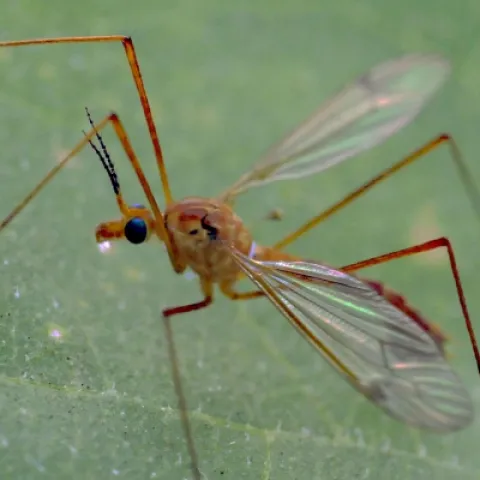
The crane fly is sometimes called a mosquito hawk or a gollywhopper.(Photo by Kathy Keatley Garvey)
Bug Squad: Article

Gollywhoppers in Love

September 2, 2008
By Kathy Keatley Garvey
He didn't bring her flowers. They were already sharing a sunflower leaf. He didn't bring her candy. They'd already dined on nectar. It was Labor Day and the two crane flies looked quite friendly in our bee friendly garden. More than friendly. I think they were in love.
View Article
Primary Image
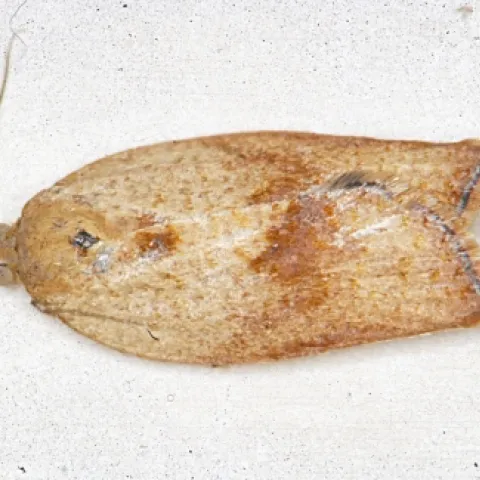
Light brown apple moth, female. (Photo courtesy of David Williams, principal scientist, Perennial Horticulture, Department of Primary Industries, Victoria, Australia.)
Bug Squad: Article

Ain't No Moths on Me

September 1, 2008
By Kathy Keatley Garvey
Bam! LBAM is back in the news. The California Department of Food and Agriculture announced Aug. 29 that it has established a 19-square-mile quarantine straddling portions of two counties after the light brown apple moth (LBAM) was found July 23 in Napa County and Aug. 10 in Sonoma County.
View Article
Primary Image
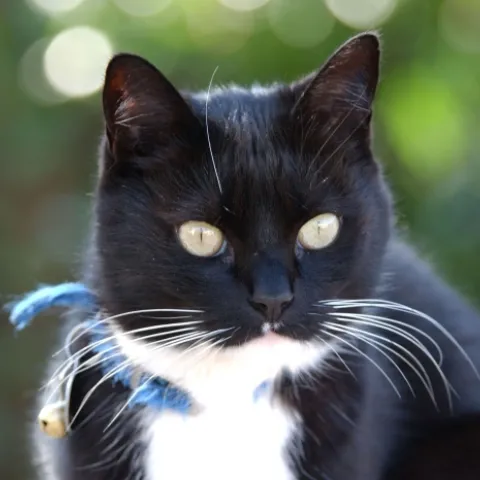
Xena the Warrior Princess is a feline entomologist. She specializes in butterflies and sphinx moths. (Photo by Kathy Keatley Garvey)
Bug Squad: Article

Big on Butterflies

August 29, 2008
By Kathy Keatley Garvey
Our cat is an entomologist. She has no formal training in the science of insects, but she can catch insects with the best of 'em. Plus, her credentials include a butterfly mark on her leg. Xena the Warrior Princess is a rescue cat.
View Article
Primary Image
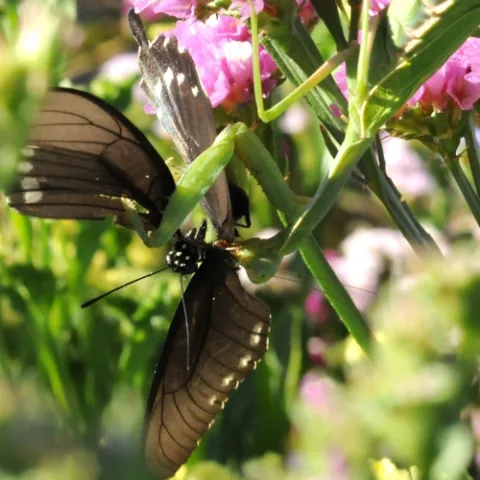
A praying mantis snares a pipevine swallowtail butterfly. (Photo by Kathy Keatley Garvey)

Let Us Prey

August 28, 2008
By Kathy Keatley Garvey
Robert Bugg saw it first. That's entomologist Robert L. Bugg. Bugg, who received his doctorate in entomology at UC Davis, does research on the biological control of insect pests; cover crops; and restoration ecology. And he saw it first. Look, he said.
View Article