A Natural Solution for California's Herds: African Catfish Peptides

California's cattle producers and agricultural communities are all too familiar with the rising challenge of antibiotic resistance, making common bacterial infections harder to treat in livestock. But imagine a future where we could tackle these infections with a natural, powerful alternative. Our research points to just that: antimicrobial peptides (AMPs) found in African catfish.

We're really excited about these peptides because African catfish thrive in pathogen-rich freshwater, naturally producing these robust immune compounds in their skin mucus as a defense. This natural origin makes them highly appealing alternatives to synthetic drugs.

Predicted Safety and Potent Action

One of the most compelling aspects of these AMPs is their predicted safety for mammals. Our initial computer analyses suggest that various catfish AMPs are generally recognized as safe (GRAS). We predict they'll be absorbed in the human intestine without causing liver, brain, or heart toxicity. Furthermore, lab tests on a promising peptide, NACAP-II, confirmed it was non-hemolytic, meaning it didn't damage rabbit red blood cells—a strong indicator of its potential safety for mammalian cells.

Beyond safety, these peptides demonstrate effectiveness against problematic bacteria. One study revealed NACAP-II's strong activity against Extended-Spectrum Beta-Lactamase (ESBL)-producing Escherichia coli—a critical concern for both animal and human health due to its resistance to many common antibiotics. Another peptide, ACAP-IV, also showed antibacterial activity against E. coli and Staphylococcus aureus. We believe these AMPs work by directly disrupting bacterial cell membranes, a mechanism that makes it harder for bacteria to develop resistance compared to how they resist traditional antibiotics.

Primary Image
avocado fruits
Topics in Subtropics: Article

The Best Free Text on Avocado Production

October 14, 2013
By Ben A Faber
Gary Bender has made his manual on avocado production available on his website. And it's free. Take a look at it to see if you might be missing something in your orchard: http://ucanr.
View Article
Primary Image
A pair of mating Gulf Fritillary butterflies on a passionflower vine. (Photo by Kathy Keatley Garvey)
Bug Squad: Article

Good Things Come in Twos, Too!

October 11, 2013
By Kathy Keatley Garvey
There's an old saying that "good things come in threes." Well, they also come in twos. When insect photographers manage to get two insects in the same photo, it's a "two-for.
View Article
UC Weed Science (weed control, management, ecology, and minutia): Article

A tale of two goosegrasses

October 11, 2013
By Brad Hanson
In the past couple of years, I've gotten a lot of questions about goosegrass in orchard production systems, particularly about suspected glyphosate-resistant biotypes.
View Article
Primary Image
broad mite on fruit
Topics in Subtropics: Article

Citrus Broad Mite

October 11, 2013
By Ben A Faber
In coastal lemons, there has been a major increase of broad mite and the damage it causes on fruit and leaves this year. Broad mites are often found in depressions on fruit where the females lay their eggs, which are dimpled, translucent, and covered in white speckles.
View Article
Primary Image
Squash bee, Peponapis pruinosa. (Photo by Kathy Keatley Garvey)
Bug Squad: Article

All About Pollination

October 10, 2013
By Kathy Keatley Garvey
Pollination--what should we know? How can we attract pollinators to our gardens and agricultural landscapes? Rachael Long, Yolo County farm advisor and director of the Yolo County Cooperative Extension program, has lined up a group of outstanding speakers at her Pollination Workshop on Friday, Oct.
View Article
Primary Image
Polyphagous shothole borer
Topics in Subtropics: Article

A Caution on Free "Compost/Mulch"

October 10, 2013
By Gary S Bender
The polyphagous shothole borers (Euwallacea sp.) that spreads fungal diseases (Fusarium sp. and possibly Graphium sp.) to susceptible trees in Los Angeles County have now been found in mid and northern Orange County and western San Bernardino County.
View Article
Primary Image
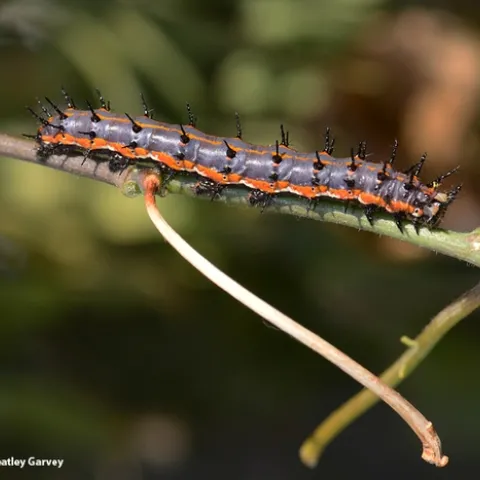
Melanic phase of a Gulf Fritillary caterpillar, rare in California. (Photo by Kathy Keatley Garvey
Bug Squad: Article

NIMBY? Yes, When It Comes to Butterflies!

October 9, 2013
By Kathy Keatley Garvey
NIMBY isn't always a negative or contentious term. NIMBY--"Not in My Back Yard"--is a term used to target unwanted development projects in a neighborhood.
View Article
Primary Image
pshb 2013
Topics in Subtropics: Article

Polyphagous Shot Hole Borer Expands

October 9, 2013
By Ben A Faber
This is an update on our recent findings on PSHB/Fusarium dieback. As of October 4, 2013, PSHB/Fusarium dieback was detected in Glendora in northern Los Angeles county and Laguna Niguel in southern Orange County.
View Article
Primary Image
image 18625
IGIS: Article

California Geoportal Offers One-Stop Shop for Statewide GIS Data

October 8, 2013
By Maggi Kelly
The California Geoportal, officially launched in March 2013 (see here for related launch press release), augments and in some ways replaces the original Cal-Atlas statewide GIS data download webpage with a more simplified, smooth, and more intuitive website for all GIS related data in the state.
View Article
Primary Image
Steve Daubert checks out the caterpillar of a moth, an Arctiid. (Photo by Kathy Keatley Garvey)
Bug Squad: Article

In Search of Butterflies

October 8, 2013
By Kathy Keatley Garvey
What an enthusiastic group that gathered for Steve Daubert's "Butterfly Ecology Talk and Tour" on Sunday morning, Sept. 29 on the Wyatt Deck, UC Davis Arboretum. Sponsored by the UC Davis Arboretum, the free event drew a plethora of butterfly enthusiasts of all ages, plus several canines.
View Article