A Natural Solution for California's Herds: African Catfish Peptides

California's cattle producers and agricultural communities are all too familiar with the rising challenge of antibiotic resistance, making common bacterial infections harder to treat in livestock. But imagine a future where we could tackle these infections with a natural, powerful alternative. Our research points to just that: antimicrobial peptides (AMPs) found in African catfish.

We're really excited about these peptides because African catfish thrive in pathogen-rich freshwater, naturally producing these robust immune compounds in their skin mucus as a defense. This natural origin makes them highly appealing alternatives to synthetic drugs.

Predicted Safety and Potent Action

One of the most compelling aspects of these AMPs is their predicted safety for mammals. Our initial computer analyses suggest that various catfish AMPs are generally recognized as safe (GRAS). We predict they'll be absorbed in the human intestine without causing liver, brain, or heart toxicity. Furthermore, lab tests on a promising peptide, NACAP-II, confirmed it was non-hemolytic, meaning it didn't damage rabbit red blood cells—a strong indicator of its potential safety for mammalian cells.

Beyond safety, these peptides demonstrate effectiveness against problematic bacteria. One study revealed NACAP-II's strong activity against Extended-Spectrum Beta-Lactamase (ESBL)-producing Escherichia coli—a critical concern for both animal and human health due to its resistance to many common antibiotics. Another peptide, ACAP-IV, also showed antibacterial activity against E. coli and Staphylococcus aureus. We believe these AMPs work by directly disrupting bacterial cell membranes, a mechanism that makes it harder for bacteria to develop resistance compared to how they resist traditional antibiotics.

Primary Image
Brevipalpus
Topics in Subtropics: Article

Brevipalpus Mites and Citrus Leprosis Virus Disease

July 24, 2013
By Ben A Faber
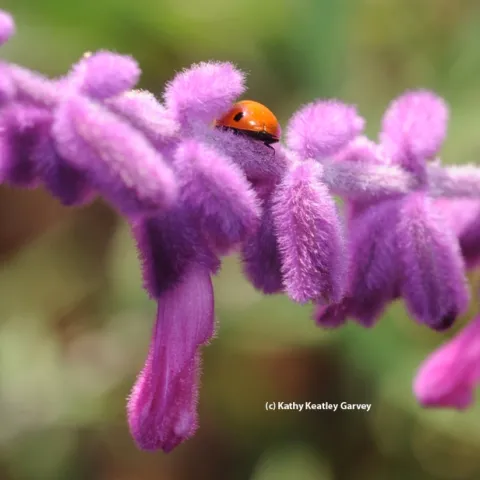
Brevipalpus mite species belong to a larger group or family of mites the Tenuipalpidae, referred to as flat mites. The genus Brevipalpus is considered the most important one in the family. The mites are small ranging in size from 200-400 micrometers in length, flattened and frequently red in color.
View Article
Primary Image
A cellar spider eyes a honey bee in the catmint (Nepeta). (Photo by Kathy Keatley Garvey)
Bug Squad: Article

All Wrapped Up

July 23, 2013
By Kathy Keatley Garvey
Just call it a missed opportunity. Catmint (genus Nepeta) draws scores of insects, from honey bees to leafcutter bees to European wool carder bees. It also draws spiders. We usually see a cellar spider (family Pholcidae) trapping prey in its web.
View Article
Primary Image
Gulf fritillary butterfly. Agraulis vanillae, lands on Mexican sunflower, Tithonia. (Photo by Kathy Keatley Garvey)
Bug Squad: Article

Touchdown! At Last!

July 22, 2013
By Kathy Keatley Garvey
For months, I've been waiting ah, so patiently (well, not always s-o-o-o patiently) for the gulf fritillary butterfly to touch down on our Mexican sunflower, Tithonia. A perfect match, I figured.
View Article
Primary Image
windbreak
Topics in Subtropics: Article

Water competition

July 22, 2013
By Ben A Faber
Along the coast, it is very common to see windbreaks protecting the citrus and avocado groves. Invariably the first two rows next to the eucalyptus trees are shorter and less thrifty than the citrus further away from the windbreak.
View Article
Primary Image
A male mountain carpenter bee, Xylocopa tabaniformis orpifex, nectaring on bulbine. (Photo by Kathy Keatley Garvey)
Bug Squad: Article

Big on the Bulbine

July 19, 2013
By Kathy Keatley Garvey
Look at the Xylocopa on the Xanthorrhoeaceae. If that sounds like a mouthful, think of the mountain or foothill carpenter bees, Xylocopa tabaniformis orpifex, on bulbine from the genus Bulbine in the family Xanthorrhoeaceae.
View Article
UC Weed Science (weed control, management, ecology, and minutia): Article

Propanil resistant sedges in CA rice (from UC Rice Blog)

July 19, 2013
By Brad Hanson
A repost of an article by Luis Espino (UCCE Farm Advisor, Colusa Co) on the UC Rice Blog. You can see the originl post HERE He also had a post on a similar topic earlier HERE that had some results from Albert Fischer and Jim Eckert's research on smallflower umbrella sedge.
View Article
Primary Image
citrus tear stain
Topics in Subtropics: Article

Citrus anthracnose or tear staining of fruit

July 19, 2013
By Ben A Faber
It's been a dry year and you don't expect it, but there's been a lot of "tear staining" of fruit. It has become most apparent this spring with the dew along the coast and the humidity. I've had a number of calls from growers this year because it has downgraded their fruit.
View Article
Primary Image
The Miss Bee Haven Project starts with a lump of clay. (Photo by Kathy Keatley Garvey)
Bug Squad: Article

The Making of a Bee

July 18, 2013
By Kathy Keatley Garvey
Take one nationally celebrated artist and one nationally renowned entomologist. Blend together. Add their deep concern for the declining honey bee population. Then just add bees. Ceramic bees.
View Article
UC Weed Science (weed control, management, ecology, and minutia): Article

Organic Weed Management for Trees, Vines, Veggies and more

July 18, 2013
By Gale Perez
Join UC Farm Advisor Janet Caprile for an overview of weed management techniques for perennial and annual cropping systems that don't rely on synthetic herbicides or chemicals. Wednesday, July 31, 2013 Livermore, California For more information, click HERE.
View Article