A Natural Solution for California's Herds: African Catfish Peptides

California's cattle producers and agricultural communities are all too familiar with the rising challenge of antibiotic resistance, making common bacterial infections harder to treat in livestock. But imagine a future where we could tackle these infections with a natural, powerful alternative. Our research points to just that: antimicrobial peptides (AMPs) found in African catfish.

We're really excited about these peptides because African catfish thrive in pathogen-rich freshwater, naturally producing these robust immune compounds in their skin mucus as a defense. This natural origin makes them highly appealing alternatives to synthetic drugs.

Predicted Safety and Potent Action

One of the most compelling aspects of these AMPs is their predicted safety for mammals. Our initial computer analyses suggest that various catfish AMPs are generally recognized as safe (GRAS). We predict they'll be absorbed in the human intestine without causing liver, brain, or heart toxicity. Furthermore, lab tests on a promising peptide, NACAP-II, confirmed it was non-hemolytic, meaning it didn't damage rabbit red blood cells—a strong indicator of its potential safety for mammalian cells.

Beyond safety, these peptides demonstrate effectiveness against problematic bacteria. One study revealed NACAP-II's strong activity against Extended-Spectrum Beta-Lactamase (ESBL)-producing Escherichia coli—a critical concern for both animal and human health due to its resistance to many common antibiotics. Another peptide, ACAP-IV, also showed antibacterial activity against E. coli and Staphylococcus aureus. We believe these AMPs work by directly disrupting bacterial cell membranes, a mechanism that makes it harder for bacteria to develop resistance compared to how they resist traditional antibiotics.
Primary Image
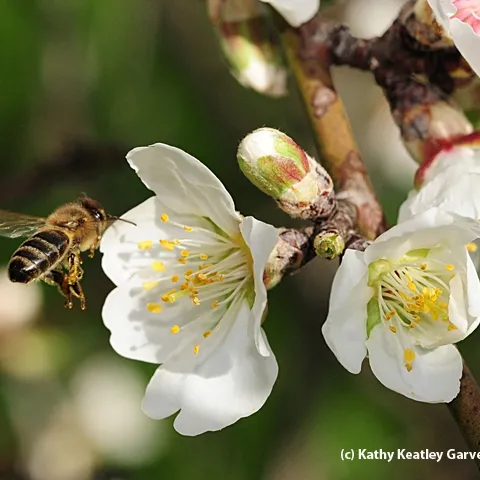
A honey bee can beat its wings 230 times every second. (Photo by Kathy Keatley Garvey)

How Fast Can a Honey Bee Fly?

July 17, 2013
By Kathy Keatley Garvey
How fast can a honey bee fly? We captured these photos today of a honey bee nectaring on catmint (genus Nepeta). The bee was moving fast. To blur the wings, we set the shutter speed at 1/640 of a second with an f-stop of 13 and IS0 of 800.
View Article
Primary Image
IMG 3791
UC Rice Blog: Article

Propanil-Resistant Sedge?

July 17, 2013
By Luis Espino
I've been getting calls about sedge surviving propanil applications. Last year, research conducted by Albert Fischer showed that there are populations of smallflower umbrellasedge that are truly resistant to propanil (read the article here).
View Article
Topics in Subtropics: Article

Farmers Should Make a Skin Check a Priority

July 17, 2013
By Ben A Faber
Farming has plenty of challenges. One of the hazards that farmers worry about the least are the dangers from working in the sun year-round. Harvest time can provide a reminder for farmers to pay attention to the condition of their skin.
View Article
Primary Image
Honey bees foraging on a passion flower blossom. (Photo by Kathy Keatley Garvey)
Bug Squad: Article

A Passion for Passion Flowers

July 16, 2013
By Kathy Keatley Garvey
Honey bees are passionate about passion flowers (Passiflora). The intricate tropical flower is their private merry-go-round, their favorite hide 'n seek place, their gathering spot.
View Article
Primary Image
Bumble bee, Bombus vosnesenski, on woolly sunflower. (Photo by Kathy Keatley Garvey)

Bumble Bees at Bodega

July 15, 2013
By Kathy Keatley Garvey
If you're on your way to Bodega Bay in Sonoma County, stop at Bodega Head and see all the yellow-faced bumble bees on a yellow coastal plant, Eriophyllum, commonly known as the woolly sunflower. The bumble bees, Bombus vosnesenskii, are back and they particularly like the Eriophyllum.
View Article
UC Weed Science (weed control, management, ecology, and minutia): Article

2013 Weed Day wrap up

July 15, 2013
By Brad Hanson
I thought I share a rundown of last week's 57th Annual Weed Day hosted by the UC Davis Weed Science Program and the UC Weed Research and Information Center. This year the program was organized and (mostly) hosted by CE Weed Specialist Joe DiTomaso.
View Article
Primary Image
Western tiger swallowtail on a purple coneflower. (Photo by Kathy Keatley Garvey

Purple Coneflower Never Looked So Good

July 12, 2013
By Kathy Keatley Garvey
You never know what you'll see on a purple coneflower (Echinacea purpurea). Honey bees. Check. Sweat bees. Check. Hummingbirds. Check. But sometimes these rough-and-tumble blossoms are graced with a Western tiger swallowtail butterfly (Papilio rutulus).
View Article