A Natural Solution for California's Herds: African Catfish Peptides

California's cattle producers and agricultural communities are all too familiar with the rising challenge of antibiotic resistance, making common bacterial infections harder to treat in livestock. But imagine a future where we could tackle these infections with a natural, powerful alternative. Our research points to just that: antimicrobial peptides (AMPs) found in African catfish.

We're really excited about these peptides because African catfish thrive in pathogen-rich freshwater, naturally producing these robust immune compounds in their skin mucus as a defense. This natural origin makes them highly appealing alternatives to synthetic drugs.

Predicted Safety and Potent Action

One of the most compelling aspects of these AMPs is their predicted safety for mammals. Our initial computer analyses suggest that various catfish AMPs are generally recognized as safe (GRAS). We predict they'll be absorbed in the human intestine without causing liver, brain, or heart toxicity. Furthermore, lab tests on a promising peptide, NACAP-II, confirmed it was non-hemolytic, meaning it didn't damage rabbit red blood cells—a strong indicator of its potential safety for mammalian cells.

Beyond safety, these peptides demonstrate effectiveness against problematic bacteria. One study revealed NACAP-II's strong activity against Extended-Spectrum Beta-Lactamase (ESBL)-producing Escherichia coli—a critical concern for both animal and human health due to its resistance to many common antibiotics. Another peptide, ACAP-IV, also showed antibacterial activity against E. coli and Staphylococcus aureus. We believe these AMPs work by directly disrupting bacterial cell membranes, a mechanism that makes it harder for bacteria to develop resistance compared to how they resist traditional antibiotics.
Primary Image
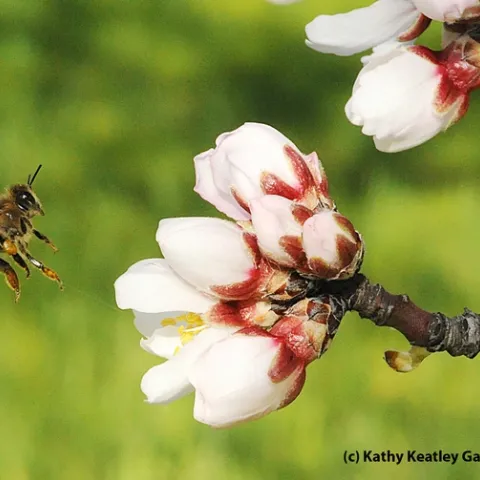
This photo of a honey bee on an almond blossom will appear on the WAS conference t-shirt. (Photo by Kathy Keatley Garvey)
Bug Squad: Article

A Two-Fold Bee Conference

August 28, 2012
By Kathy Keatley Garvey
Seattle will be the place to "bee" on Oct. 4-7. That's where the Western Apicultural Society (WAS) will hold its annual meeting--and this year it's in conjunction with the Washington State Beekeepers' Association.
View Article
Primary Image
What are you looking at? A praying mantis, with a female sweat bee grasped in its spiked forelegs, looks at the camera. (Photo by Kathy Keatley Garvey)
Bug Squad: Article

'Oh, Is This One of Your Bees?'

August 27, 2012
By Kathy Keatley Garvey
The photo just begs for a caption. The praying mantis, with a female sweat bee grasped in its spiked forelegs, suddenly turns its head to look at the photographer. Actually, three photographers: Davis insect photographers/bee enthusiasts Allan Jones and Gary Zamzow and I.
View Article
Primary Image
Branched arista of the antenna is a characteristic feature of SWD
E-Journal of Entomology and Biologicals: Article

Spotted wing drosophila in Santa Maria strawberries

August 27, 2012
Spotted wing drosophila (SWD), Drosophila suzukii has become a potential concern for strawberries following its damage to cherries, blackberries, raspberries, and blueberries in coastal California. Other species of Drosophila are morphologically not equipped to attack ripening strawberries.
View Article
Primary Image
Dairy-cows
Conservation Agriculture: Article

Dairy feed's amenability to conservation ag is focus of latest documentary episode

August 27, 2012
By Jeannette Warnert
Dairy feed production is particularly amenable to conservation agricultural practices, according to four dairy operators featured in Part 4 of the Conservation Agriculture documentary series, released today on the Conservation Agriculture Systems Innovation website. (The video is also posted below.
View Article
Primary Image
Female digger bee, Anthophora urbana, on zinnia. (Photo by Kathy Keatley Garvey),
Bug Squad: Article

Diggin' the Digger Bee

August 24, 2012
By Kathy Keatley Garvey
Diggin' the digger bee... We spotted this female digger bee, Anthophora urbana, zooming in on some zinnias at UC Davis. She buzzed loudly, virtually owning the zinnia patch. Smaller sweat bees scattered.
View Article
Primary Image
Male mountain or foothill carpenter bee, Xylocopa tabaniformis orpifex, on salvia. (Photo by Kathy Keatley Garvey)
Bug Squad: Article

Meet a Carpenter Bee

August 23, 2012
By Kathy Keatley Garvey
Meet a carpenter bee. This one (below) is a male carpenter bee, Xylocopa tabaniformis orpifex, as identified by native pollinator specialist Robbin Thorp, emeritus professor of entomology at the University of California, Davis. It's also called a "mountain" or "foothill" carpenter bee.
View Article
Primary Image
Western tiger swallowtail, Papilio rutulus, nectars on a zinnia, unaware of the danger lurking below. (Photo by Kathy Keatley Garvey)
Bug Squad: Article

Tiger by the Tail? Not This Time!

August 22, 2012
By Kathy Keatley Garvey
Don't look now, but a garden spider almost grabbed a tiger by the tail. The tiger? That would be the Western tiger swallowtail, Papilio rutulus. The ragged wings of the butterfly (below) show signs of a close encounter with a predator--maybe another spider, a praying mantis or a bird.
View Article
Primary Image
Unsuspecting honey bee lands on a zinnia occupied by a praying mantis lying in wait. (Photo by Kathy Keatley Garvey)
Bug Squad: Article

It Was Not to Bee

August 21, 2012
By Kathy Keatley Garvey
The drama unfolds slowly. The crafty praying mantis that's perched atop a zinnia raises its spiked, grasping forelegs and silently waits for unsuspecting prey. A sweat bee cruises by. Then a second one. Then a third. They do not land and the praying mantis does not move.
View Article
Primary Image
Syrphid fly (female Sphaerophoria), as identified by senior insect biosystematist Martin Hauser of the CDFA. (Photo by Kathy Keatley Gavrey)
Bug Squad: Article

The Girl and the Bubble

August 20, 2012
By Kathy Keatley Garvey
Ah, the little intricacies of life... We were walking along a stretch of the coastal town of Bodega Bay when we spotted something we'd never seen before: a bubble on a syrphid fly. Syrphid flies, also known as hover flies or flower flies, are pollinators, just like honey bees.
View Article