A Natural Solution for California's Herds: African Catfish Peptides

California's cattle producers and agricultural communities are all too familiar with the rising challenge of antibiotic resistance, making common bacterial infections harder to treat in livestock. But imagine a future where we could tackle these infections with a natural, powerful alternative. Our research points to just that: antimicrobial peptides (AMPs) found in African catfish.

We're really excited about these peptides because African catfish thrive in pathogen-rich freshwater, naturally producing these robust immune compounds in their skin mucus as a defense. This natural origin makes them highly appealing alternatives to synthetic drugs.

Predicted Safety and Potent Action

One of the most compelling aspects of these AMPs is their predicted safety for mammals. Our initial computer analyses suggest that various catfish AMPs are generally recognized as safe (GRAS). We predict they'll be absorbed in the human intestine without causing liver, brain, or heart toxicity. Furthermore, lab tests on a promising peptide, NACAP-II, confirmed it was non-hemolytic, meaning it didn't damage rabbit red blood cells—a strong indicator of its potential safety for mammalian cells.

Beyond safety, these peptides demonstrate effectiveness against problematic bacteria. One study revealed NACAP-II's strong activity against Extended-Spectrum Beta-Lactamase (ESBL)-producing Escherichia coli—a critical concern for both animal and human health due to its resistance to many common antibiotics. Another peptide, ACAP-IV, also showed antibacterial activity against E. coli and Staphylococcus aureus. We believe these AMPs work by directly disrupting bacterial cell membranes, a mechanism that makes it harder for bacteria to develop resistance compared to how they resist traditional antibiotics.
UC Rice Blog: Article

Waterbird Habitat Enhancement Program

September 20, 2012
By Luis Espino
In 2011, the Natural Resources Conservation Service (NRCS) developed a program to assist rice producers adopt and apply conservation practices to provide and maintain shallow water wetlands, mudflats, nesting islands, and other associated wildlife structures that provide for seasonal or year-round b...
View Article
Primary Image
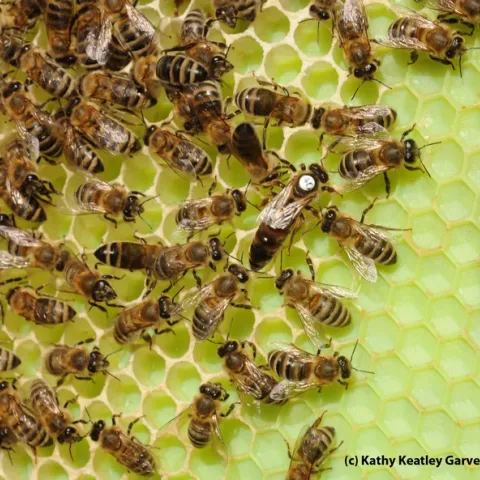
A frame of honey at the Harry H. Laidlaw Jr. Honey Bee Research Facility, UC Davis. (Photo by Kathy Keatley Garvey

A Taste of Honey

September 19, 2012
By Kathy Keatley Garvey
If you want to learn more about bees, honey and pollination, then you'll want to attend the debut event of the newly formed Honey and Pollination Center at the University of California, Davis. Themed "Bounty of Pollination: More Than Just Honey," the event is set from 1 to 5:30 p.m.
View Article
Cooperative Extension Ventura County: Article

Vol. 10, No. 2 -- Summer 2012

September 19, 2012
This issue contains the following articles: Simazine Degradation in CA Citrus Orchards Lime-induced Iron Chlorosis Avocado Trunk Cankers Asphyxiation Tree Wraps Stem and Leaf Blight...
View Article
Primary Image
Honey bee is snared in the web of a garden spider. (Photo by Kathy Keatley Garvey)
Bug Squad: Article

Let It Bee

September 18, 2012
By Kathy Keatley Garvey
Let it be, let it be, let it be, let it be Whisper words of wisdom, let it be --Paul McCartney When Paul McCartney of The Beatles wrote "Let It Be," released in 1970, he wasn't writing about honey bees. No, he was actually recounting what his mother (who died when he was 14) told him in a dream.
View Article
Primary Image
Derek Tully (right) and fellow scout Willie Hawkins work on the fence surrounding the half-acre pollinator garden. (Photo by Kathy Keatley Garvey)
Bug Squad: Article

A Honey of a Fence

September 17, 2012
By Kathy Keatley Garvey
It's a honey of a garden and a honey of a fence. So agreed the visitors attending the open house and recognition ceremony last Saturday, Sept. 15 at the Hagen-Dazs Honey Bee Haven, a half-acre pollinator garden next to the UC Davis Department of Entomology's Harry H. Laidlaw Jr.
View Article
Primary Image
Pregnant praying mantis. (Photo by Kathy Keatley Garvey)
Bug Squad: Article

Mother to Be

September 14, 2012
By Kathy Keatley Garvey
Ever seen a pregnant praying mantis? Someone on wikianswers.com asked the question: "What does a pregnant praying mantis look like?" The question drew only one response: "Big and fat.
View Article
Primary Image
Fisheye of Mexican sunflowers (Tithonia) in the Haagen-Dazs Honey Bee Haven. (Photo by Kathy Keatley Garvey)
Bug Squad: Article

Fisheye View of the Garden

September 13, 2012
By Kathy Keatley Garvey
When I was teaching photography, I encouraged my students to go for the angles--from a bug's eye view to a bird's eye view. Holding a camera chest-high or at eye level renders the "same-o, same o" photos. Yet another creative way to see the world is through a fisheye lens.
View Article
Primary Image
ACP

Asian Citrus Psyllid

September 13, 2012
Asian Citrus Psyllid and Huanglongbing Trying to stay abreast of the insect and disease it carries to citrus?
View Article
Primary Image
Italian bee nectaring on lavender. (Photo by Kathy Keatley Garvey)
Bug Squad: Article

Flower Lovers: The Bees

September 13, 2012
By Kathy Keatley Garvey
What do you know about bees, and what would you like to learn about them? Visit the University of California, Davis campus on Saturday, Sept. 15, and you will see (1) bee specimens from all over the world and (2) bees and other pollinators in their natural habitat.
View Article