A Natural Solution for California's Herds: African Catfish Peptides

California's cattle producers and agricultural communities are all too familiar with the rising challenge of antibiotic resistance, making common bacterial infections harder to treat in livestock. But imagine a future where we could tackle these infections with a natural, powerful alternative. Our research points to just that: antimicrobial peptides (AMPs) found in African catfish.

We're really excited about these peptides because African catfish thrive in pathogen-rich freshwater, naturally producing these robust immune compounds in their skin mucus as a defense. This natural origin makes them highly appealing alternatives to synthetic drugs.

Predicted Safety and Potent Action

One of the most compelling aspects of these AMPs is their predicted safety for mammals. Our initial computer analyses suggest that various catfish AMPs are generally recognized as safe (GRAS). We predict they'll be absorbed in the human intestine without causing liver, brain, or heart toxicity. Furthermore, lab tests on a promising peptide, NACAP-II, confirmed it was non-hemolytic, meaning it didn't damage rabbit red blood cells—a strong indicator of its potential safety for mammalian cells.

Beyond safety, these peptides demonstrate effectiveness against problematic bacteria. One study revealed NACAP-II's strong activity against Extended-Spectrum Beta-Lactamase (ESBL)-producing Escherichia coli—a critical concern for both animal and human health due to its resistance to many common antibiotics. Another peptide, ACAP-IV, also showed antibacterial activity against E. coli and Staphylococcus aureus. We believe these AMPs work by directly disrupting bacterial cell membranes, a mechanism that makes it harder for bacteria to develop resistance compared to how they resist traditional antibiotics.
Primary Image
earwigs

Earwigs and Tree Wraps

July 9, 2012
By Ben A Faber
European earwig Wrap removed - whitewashed Tree Wraps Author - Neil O'Connell Installing tree wraps on young trees provides protection to the trunk from applications of herbicides during weed management operations.
View Article
Primary Image
Jumping spider eating a honey bee. (Photo by Kathy Keatley Garvey)
Bug Squad: Article

The Predator

July 6, 2012
By Kathy Keatley Garvey
I know. Jumping spiders have to eat, but do they have to snag the bees? Last weekend as we were checking the lavender patch in our yard, we noticed something partially hidden--and moving--on a post. It was a jumping spider eating a honey bee.
View Article
UC Weed Science (weed control, management, ecology, and minutia): Article

Last day to receive a DISCOUNT on Weed Day 2012

July 6, 2012
By Gale Perez
If you havent registered for Weed Day 2012, today is the LAST DAY to receive the early-bird DISCOUNT on the registration fee. To register, click HERE.
View Article
Primary Image
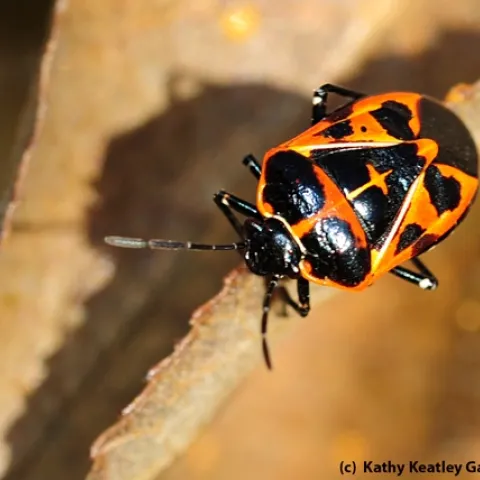
Harlequin bug, Murgantia histronica, on weeds at the Benicia Marina. (Photo by Kathy Keatley Garvey)
Bug Squad: Article

This Bug Is Not Welcome

July 5, 2012
By Kathy Keatley Garvey
It boasts striking colors, but you don't want this bug anywhere near your garden. It sucks. Literally. This is a harlequin bug, Murgantia histronica, as identified by Lynn Kimsey, director of the Bohart Museum of Entomology and professor of entomology at the University of California, Davis.
View Article
Primary Image
Summertime...and the living is easy...A female sweat bee, genus Halictus, floats on a leaf in a swimming pool. (Photo by Kathy Keatley Garvey)
Bug Squad: Article

Summertime...and the Livin' Is Easy

July 4, 2012
By Kathy Keatley Garvey
Today's the Fourth of July and folks are splashing in their pools. So, what happens when a bee falls in? Sometimes they get lucky--if there's a human around to rescue them. And sometimes their luck extends to a floating leaf. This tiny female sweat bee, genus Halictus (probably H.
View Article
Primary Image
Meloid blister beetle, which produces a toxin known as cantharidin, peers at the camera. (Photo by Kathy Keatley Garvey)
Bug Squad: Article

Caution: Toxic!

July 3, 2012
By Kathy Keatley Garvey
It was a reddish-orange beetle, moving a little but not a lot. We spotted it on a sunflower bordering the Avant Garden in Benicia.
View Article
Primary Image
Green-eyed wasp, genus Tachytes, in a nectarine tree. This one is a female, as identified by Lynn Kimsey, director of the Bohart Museum of Entomology. (Photo by Kathy Keatley Garvey)
Bug Squad: Article

Green-Eyed Gal

July 2, 2012
By Kathy Keatley Garvey
We saw her touch down in our nectarine tree last weekend. Big green compound eyes glowed at us. She moved up and down a branch, foraging for food, and then took off. A wasp. The carnivore cousin of the vegetarian honey bee. They belong to the same order, Hymenoptera.
View Article