A Natural Solution for California's Herds: African Catfish Peptides

California's cattle producers and agricultural communities are all too familiar with the rising challenge of antibiotic resistance, making common bacterial infections harder to treat in livestock. But imagine a future where we could tackle these infections with a natural, powerful alternative. Our research points to just that: antimicrobial peptides (AMPs) found in African catfish.

We're really excited about these peptides because African catfish thrive in pathogen-rich freshwater, naturally producing these robust immune compounds in their skin mucus as a defense. This natural origin makes them highly appealing alternatives to synthetic drugs.

Predicted Safety and Potent Action

One of the most compelling aspects of these AMPs is their predicted safety for mammals. Our initial computer analyses suggest that various catfish AMPs are generally recognized as safe (GRAS). We predict they'll be absorbed in the human intestine without causing liver, brain, or heart toxicity. Furthermore, lab tests on a promising peptide, NACAP-II, confirmed it was non-hemolytic, meaning it didn't damage rabbit red blood cells—a strong indicator of its potential safety for mammalian cells.

Beyond safety, these peptides demonstrate effectiveness against problematic bacteria. One study revealed NACAP-II's strong activity against Extended-Spectrum Beta-Lactamase (ESBL)-producing Escherichia coli—a critical concern for both animal and human health due to its resistance to many common antibiotics. Another peptide, ACAP-IV, also showed antibacterial activity against E. coli and Staphylococcus aureus. We believe these AMPs work by directly disrupting bacterial cell membranes, a mechanism that makes it harder for bacteria to develop resistance compared to how they resist traditional antibiotics.
Primary Image
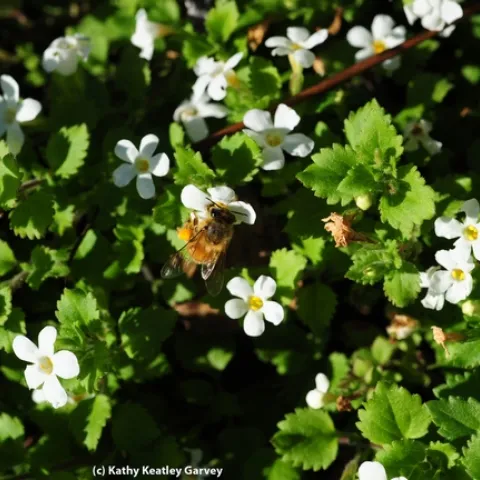
Honey bee heads for a sunflower in a field off Pedrick Road, Dixon. (Photo by Kathy Keatley Garvey)
Bug Squad: Article

Here Come the Sun(Flowers)

July 20, 2012
By Kathy Keatley Garvey
You can't drive by a sunflower field without smiling. Their golden heads turned toward the sun, their fringed petals aglow, sunflowers set an amicable scene in a world sometimes darkened by strife and sorrow. Take, for example, the sunflower fields along Pedrick Road in Dixon, Calif.
View Article
Primary Image
Honey bee nectars a zinnia, unaware of a predator eyeing her every move. (Photo by Kathy Keatley Garvey)
Bug Squad: Article

What's Peering Over the Petals?

July 19, 2012
By Kathy Keatley Garvey
There are many reasons why honey bees don't come home at night. One of them: a stealthy praying mantis. If you like to photograph flowers, odds are that some day you'll see more than one insect on a blossom.
View Article
Primary Image
Beekeeper Brian Fishback shows Alyssa Fine the bee sculpture in the Haagen-Dazs Honey Bee Haven at UC Davis. (Photo by Kathy Keatley Garvey)
Bug Squad: Article

A Honey of a Visit

July 18, 2012
By Kathy Keatley Garvey
When youngsters meet Alyssa Fine, the first thing they ask is Do you ever get stung? They also ask if the bee population is still declining and if shes a beekeeper. Yes, yes, and yes. Alyssa Fine, 23, of Monongahela, Penn., is accustomed to answering questions.
View Article

Simazine degradation in California citrus orchards

July 18, 2012
By Brad Hanson
Today I thought I'd share a recent research report on the the phenomenon of "enhanced" degradation of the herbicide simazine in citrus orchard soils. Click here for a link to the publication in the open-source journal, Air, Soil, and Water Research (Abit et al. 2012.
View Article
UC Weed Science (weed control, management, ecology, and minutia): Article

Simazine degradation in California orchard soils

July 18, 2012
By Brad Hanson
Today I thought I'd share a recent research report on the the phenomenon of "enhanced" degradation of the herbicide simazine in citrus orchard soils. Click here for a link to the publication in the open-source journal, Air, Soil, and Water Research (Abit et al. 2012.
View Article
UC Weed Science (weed control, management, ecology, and minutia): Article

Ecologically-Based Invasive Plant Management Field School & Learning Fair

July 18, 2012
By Joseph DiTomaso
In conjunction with the USDA Range Management group out of Oregon and many Weed Scientists throughout the western US, a two day field school will focus on improving the management and threat of invasive plants, and especially cheatgrass and medusahead.
View Article
UC Weed Science (weed control, management, ecology, and minutia): Article

WSSA Press Release: Invasive Aquatic Plants Conference

July 18, 2012
By Brad Hanson
A quick repost this morning on the upcoming meeting of the Aquatic Plant Management Society. Invasive aquatic weeds are a huge problem in some river, canal, and lake/pond systems in California and around the world.
View Article
Primary Image
Honey bee nectaring on a zinnia in the Haagen-Dazs Honey Bee Haven. (Photo by Kathy Keatley Garvey)
Bug Squad: Article

Are Bees Finding the 'Zen' in Zinnias?

July 17, 2012
By Kathy Keatley Garvey
Eye-catching zinnias grace the Hagen-Dazs Honey Bee Haven, the half-acre bee friendly garden planted in the fall of 2009 next to the Harry H. Laidlaw Jr. Honey Bee Research Facility on Bee Biology Road, University of California, Davis.
View Article
Primary Image
Female digger bee, Anthophora bomboides stanfordiana, heads for her nest. (Photo by Kathy Keatley Garvey)
Bug Squad: Article

Diggin' the Bees in Bodega

July 16, 2012
By Kathy Keatley Garvey
They can fool you. Just like replica designer bags, shoes and sunglasses meant to look like the real thing (think Louis Vuitton, Jimmy Choo and Prada), those digger bees on Bodega Head, overlooking Bodega Bay, look like bumble bees. Especially the females.
View Article
UC Weed Science (weed control, management, ecology, and minutia): Article

READ THE @$%#' LABEL

July 14, 2012
By Cheryl A Wilen
I think there's enough blame to go around on this one. http://www.cnn.com/video/?hpt=hp_c2#/video/us/2012/07/11/pkg-mn-lawn-accidentally-killed.kare 1. Employees should have asked the guy about what he needed to do 2.
View Article