A Natural Solution for California's Herds: African Catfish Peptides

California's cattle producers and agricultural communities are all too familiar with the rising challenge of antibiotic resistance, making common bacterial infections harder to treat in livestock. But imagine a future where we could tackle these infections with a natural, powerful alternative. Our research points to just that: antimicrobial peptides (AMPs) found in African catfish.

We're really excited about these peptides because African catfish thrive in pathogen-rich freshwater, naturally producing these robust immune compounds in their skin mucus as a defense. This natural origin makes them highly appealing alternatives to synthetic drugs.

Predicted Safety and Potent Action

One of the most compelling aspects of these AMPs is their predicted safety for mammals. Our initial computer analyses suggest that various catfish AMPs are generally recognized as safe (GRAS). We predict they'll be absorbed in the human intestine without causing liver, brain, or heart toxicity. Furthermore, lab tests on a promising peptide, NACAP-II, confirmed it was non-hemolytic, meaning it didn't damage rabbit red blood cells—a strong indicator of its potential safety for mammalian cells.

Beyond safety, these peptides demonstrate effectiveness against problematic bacteria. One study revealed NACAP-II's strong activity against Extended-Spectrum Beta-Lactamase (ESBL)-producing Escherichia coli—a critical concern for both animal and human health due to its resistance to many common antibiotics. Another peptide, ACAP-IV, also showed antibacterial activity against E. coli and Staphylococcus aureus. We believe these AMPs work by directly disrupting bacterial cell membranes, a mechanism that makes it harder for bacteria to develop resistance compared to how they resist traditional antibiotics.
Primary Image
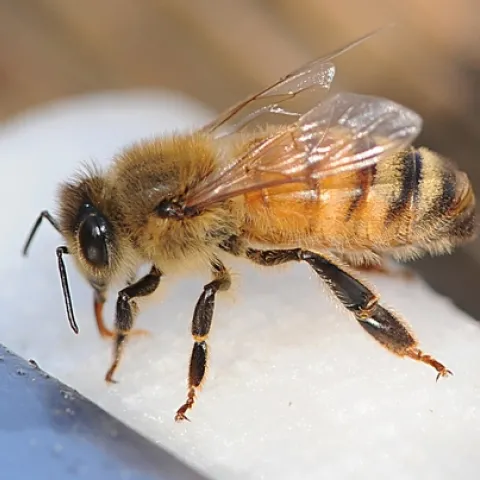
A HONEY BEE heads for the only blossom on the nectarine branch. (Photo by Kathy Keatley Garvey)
Bug Squad: Article

Nectarines Bursting Into Bloom

February 21, 2011
It's Presidents' Day and far too early for nectarines to burst into bloom. The unseasonable weather, however, fooled 'em. Didn't fool the honey bees.
View Article
Primary Image
EGGS inside honey bee cells will turn into larvae, which will increase in weight 1000 times during the six days that they feed. (Photo by Kathy Keatley Garvey)
Bug Squad: Article

A Weighty Matter in the Hive

February 18, 2011
Think what it would be like if you increased your weight by 1000 times in six days. But that's exactly what worker bee larvae do in the honey bee colony.
View Article
Primary Image
Podosphaera aphanis-conidial chains-David Gadoury
E-Journal of Entomology and Biologicals: Article

New name for strawberry powdery mildew pathogen

February 18, 2011
Identity is an important issue whether it is for an individual, a company or even a disease causing organism. In this case, it is the plant pathogenic fungus that causes powdery mildew on strawberries and several other crops.
View Article
Primary Image
HONEY BEE heads for almond blossoms at the Harry H. Laidlaw Jr. Honey Bee Research Facility at the University of California, Davis. (Photo by Kathy Keatley Garvey)
Bug Squad: Article

Flight of the Honey Bee

February 17, 2011
Friday, Feb. 11 seemed like a glorious spring day. Almond trees at the Harry H. Laidlaw Jr. Honey Bee Research Facility at the University of California, Davis burst into bloom. Early birds...err...early bees...began foraging among the blossoms. A faux spring. Then the rains came.
View Article
Primary Image
QUEEN BEE and her colony. (Photo by Kathy Keatley Garvey)
Bug Squad: Article

Bee-utiful Find

February 16, 2011
It was a bee-utiful find: A how-to book published in 1890 on rearing honey bees. We found the book, ABC of Bee Culture: A Cyclopedia of Everything Pertaining to the Care of the Honey Bee; Bees, Honey, Hives, Implements, Honey-Plants, Etc. by A. I.
View Article
Primary Image
OVERWINTERING ladybug perches on top of a tangerine tree leaf as temperatures hit 75 degrees. This is an introduced species, Coccinella septempunctata, as identified by Natalia Vandenberg, a USDA employee with the Systematic Entomology Lab, Smithsonian's National Museum of Natural History. (Photo by Kathy Keatley Garvey)
Bug Squad: Article

Ladybugs in February

February 15, 2011
The overwintering ladybugs tucked in the leaves of our tangerine tree are gone. Sunny temperatures hit 75 degrees, and off they went. Guess they thought it was spring. Anyhow, they made a glorious sight as emerged from the folds of a tangerine leaf.
View Article
Primary Image
HONEY BEE on a comb of honey at the Harry H. Laidlaw Jr. Honey Bee Research Facility at the University of California, Davis. (Photo by Kathy Keatley Garvey)
Bug Squad: Article

A Honey of a Day

February 14, 2011
It's Valentine's Day and it's a honey of a day. Valentine cards proclaim "Bee Mine" and "Bee My Valentine." Invariably, there's a happy honey bee buzzing around a flower on a Valentine's Day card.
View Article
UC Weed Science (weed control, management, ecology, and minutia): Article

WSSA Awards and Current Research on Gyphosate-Resistant Junglerice

February 13, 2011
By Brad Hanson
I had the opportunity last week to attend the Weed Science Society of America (WSSA) annual meeting which was held in Portland OR this year. The meeting was really interesting as usual with many interesting oral and poster research presentations.
View Article
Primary Image
ALMOND BLOSSUMS at the Harry H. Laidlaw Jr. Honey Bee Research Facility, UC Davis, burst into bloom today. Honey bees came in twos and threes. (Photo by Kathy Keatley Garvey)
Bug Squad: Article

Oh, Hap-Bee Day!

February 11, 2011
It happened. Remember when Chicken Little ran around yelling "The sky is falling! The sky is falling!" For almond growers, beekeepers, entomologists, researchers and artists, it's "The almonds are blooming! The almonds are blooming!" Finally, the almond trees at the Harry H. Laidlaw Jr.
View Article
Primary Image
NAME CARS after insects? How about "The Hisser," the Madagascar Hissing Cockroach? This photo was taken in the Bohart Museum of Entomology at UC Davis where visitors love to hold them. (Photo by Kathy Keatley Garvey)
Bug Squad: Article

The Beetle With Racing Stripes

February 10, 2011
Didn't you just love that commercial for the Volkswagen Beetle during the Super Bowl? While the Green Bay Packers were beetle-ing up the Pittsburg Steelers, 31-25, Volkswagen brought out its delightful Super Bug commercial. It starred a black beetle with racing stripes.
View Article