A Natural Solution for California's Herds: African Catfish Peptides

California's cattle producers and agricultural communities are all too familiar with the rising challenge of antibiotic resistance, making common bacterial infections harder to treat in livestock. But imagine a future where we could tackle these infections with a natural, powerful alternative. Our research points to just that: antimicrobial peptides (AMPs) found in African catfish.

We're really excited about these peptides because African catfish thrive in pathogen-rich freshwater, naturally producing these robust immune compounds in their skin mucus as a defense. This natural origin makes them highly appealing alternatives to synthetic drugs.

Predicted Safety and Potent Action

One of the most compelling aspects of these AMPs is their predicted safety for mammals. Our initial computer analyses suggest that various catfish AMPs are generally recognized as safe (GRAS). We predict they'll be absorbed in the human intestine without causing liver, brain, or heart toxicity. Furthermore, lab tests on a promising peptide, NACAP-II, confirmed it was non-hemolytic, meaning it didn't damage rabbit red blood cells—a strong indicator of its potential safety for mammalian cells.

Beyond safety, these peptides demonstrate effectiveness against problematic bacteria. One study revealed NACAP-II's strong activity against Extended-Spectrum Beta-Lactamase (ESBL)-producing Escherichia coli—a critical concern for both animal and human health due to its resistance to many common antibiotics. Another peptide, ACAP-IV, also showed antibacterial activity against E. coli and Staphylococcus aureus. We believe these AMPs work by directly disrupting bacterial cell membranes, a mechanism that makes it harder for bacteria to develop resistance compared to how they resist traditional antibiotics.
UC Weed Science (weed control, management, ecology, and minutia): Article

Resistance to glufosinate (Rely) reported

March 6, 2011
By Brad Hanson
A quick post today on a recent report of resistance to glufosinate, the active ingredient in Rely herbicide (also sold as Liberty, Ignite, Basta, etc in other markets).
View Article
Primary Image
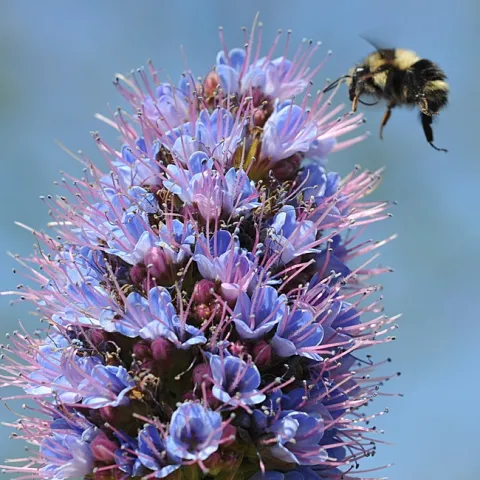
EARLY RISER--Black-tail bumble bee (Bombus melanopygus) forages at 9:30 a.m., Friday, March 4 in ceanothus at the Haagen-Dazs Honey Bee Haven at UC Davis. (Photo by Kathy Keatley Garvey)
Bug Squad: Article

A Welcome Visitor

March 4, 2011
At first I thought it was a yellow-faced bumble bee. Sort of like applying the adage, "When all you have is a hammer, everything looks like a nail." That's because most of the bumble bees I see are the yellow-faced bumble bees (Bombus vosnesenskii).
View Article
Primary Image
BUTTERFLY GURU Art Shapiro, outside his office at Storer Hall, UC Davis campus. (Photo by Kathy Keatley Garvey)
Bug Squad: Article

The Butterfly Man

March 3, 2011
Move over, Justin Bieber. Butterfly guru Art Shapiro, professor of evolution and ecology at the University of California, Davis, says he's now a "cover boy," too. Shapiro is featured in the current edition of Sacramento News & Review.
View Article
Primary Image
CREMATOGASTER ANTS--Myrmecologist or ant specialist Bonnie Blaimer studies theses ants in Madagascar. “This genus fascinates me particularly because of its species diversity and dominance in tropical forests, and its intriguing natural history,” she says. “Most species are canopy-nesting in dead twigs and branches or under bark, or they make elaborate independent carton-nest from wood fibers. Some species are suspected to be temporary social parasites, and many tend scale insects or mealybugs." (Photo by B
Bug Squad: Article

In Pursuit of Ants

March 2, 2011
Just call it the ABC of ants. (A) Ants, (B) Bonnie Blaimer and (C) Crematogaster. Add a double "M" and you have a myrmecologist studying ants in Madagascar.
View Article
Primary Image
SOAPBERRY BUG scrambles up a tree at UC Davis. Biologist Hugh Dingle, emeritus professor of entomology at UC Davis, studies soapberry bugs. (Photo by Kathy Keatley Garvey)
Bug Squad: Article

Don't Say the "R" Word

March 1, 2011
For being "retired," Hugh Dingle is one busy scientist. Dingle, an emeritus professor in the UC Davis Department of Entomology, recently returned to Davis after living in Australia for seven years and doing research at the University of Brisbane, Australia.
View Article
Primary Image
HONEY BEE forages in a nectarine blossom. (Photo by Kathy Keatley Garvey)
Bug Squad: Article

Pollen Power

February 28, 2011
Cool temperatures and honey bees do not a good team make. Since honey bees don't forage until temperatures hit 50 to 55 degrees, we haven't seen many bees gathering pollen from our nectarine trees. If you love nectarines, there's a lot to love.
View Article
UC Weed Science (weed control, management, ecology, and minutia): Article

Calculating Volatile Organic Compounds (VOC) from herbicides

February 27, 2011
By Brad Hanson
Earlier this month, I attended the 2011 Plant and Soil Conference which was held in Fresno this year. This annual meeting put on by the California Chapter of the American Society of Agronomy (http://calasa.ucdavis.
View Article
Primary Image
HOVER FLY foraging on cape mallow at the Haagen-Dazs Honey Bee Haven at UC Davis. The haven is known as a half-acre "bee friendly garden," but it's also a "pollinator-friendly garden." Located on Bee Biology Road, west of the central campus, it is open year-around from dawn to dusk. Admission is free.(Photo by Kathy Keatley Garvey)
Bug Squad: Article

Around the Cape

February 25, 2011
It's not just honey bees that forage among the cape mallows in the Hagen-Dazs Honey Bee Haven at the Harry H. Laidlaw Jr. Honey Bee Research Facility at the University of California, Davis. The brilliant magenta flowers also draw assorted other insects. Such as flies...hover flies.
View Article