A Natural Solution for California's Herds: African Catfish Peptides

California's cattle producers and agricultural communities are all too familiar with the rising challenge of antibiotic resistance, making common bacterial infections harder to treat in livestock. But imagine a future where we could tackle these infections with a natural, powerful alternative. Our research points to just that: antimicrobial peptides (AMPs) found in African catfish.

We're really excited about these peptides because African catfish thrive in pathogen-rich freshwater, naturally producing these robust immune compounds in their skin mucus as a defense. This natural origin makes them highly appealing alternatives to synthetic drugs.

Predicted Safety and Potent Action

One of the most compelling aspects of these AMPs is their predicted safety for mammals. Our initial computer analyses suggest that various catfish AMPs are generally recognized as safe (GRAS). We predict they'll be absorbed in the human intestine without causing liver, brain, or heart toxicity. Furthermore, lab tests on a promising peptide, NACAP-II, confirmed it was non-hemolytic, meaning it didn't damage rabbit red blood cells—a strong indicator of its potential safety for mammalian cells.

Beyond safety, these peptides demonstrate effectiveness against problematic bacteria. One study revealed NACAP-II's strong activity against Extended-Spectrum Beta-Lactamase (ESBL)-producing Escherichia coli—a critical concern for both animal and human health due to its resistance to many common antibiotics. Another peptide, ACAP-IV, also showed antibacterial activity against E. coli and Staphylococcus aureus. We believe these AMPs work by directly disrupting bacterial cell membranes, a mechanism that makes it harder for bacteria to develop resistance compared to how they resist traditional antibiotics.
Primary Image
Hillary Thomas is studying the saltcedar beetle (Diorhabda elongata): a good bug on a bad weed. (Photo by Kathy Keatley Garvey)
Bug Squad: Article

Good Bug, Bad Weed

August 20, 2008
Hillary Thomas' biological control research on a leaf-eating beetle that targets saltcedar has scored a bullseye. Thomas, a doctoral candidate in entomology at UC Davis, has received a $15,000 Robert and Peggy van den Bosch Memorial Scholarship to support her research.
View Article
Primary Image
Svastra obliqua expurgata (Cockerell) leaves the flower. (Photo by Kathy Keatley Garvey)
Bug Squad: Article

Carrying a Lot of 'Baggage'

August 19, 2008
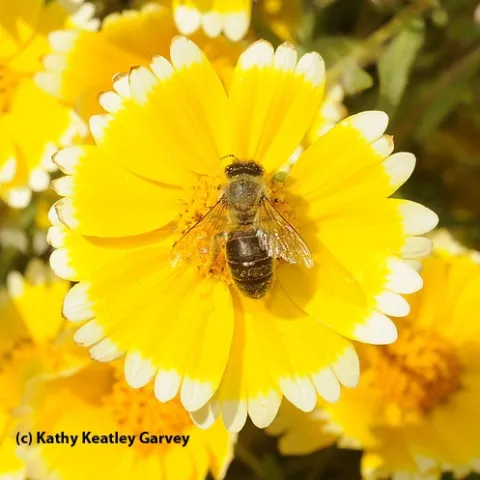
If she were boarding an airline, she'd be charged double for baggage. But she didn't and she wasn't. She's a pollen-packed sunflower bee enjoying our sunflower. Not a honey bee but a sunflower bee. A native bee.
View Article
Primary Image
Culex quinquefasciatus, the Southern house mosquito, finishes feeding on non-DEET treated skin. (Photo by Kathy Keatley Garvey)
Bug Squad: Article

The Secret's Out

August 18, 2008
We know it works, but how? Just how does DEET work? Does it jam the senses of a mosquito? Does it mask the smell of the host? You spray the chemical repellent on your arm and thankfully, those darn skeeters leave you alone.
View Article
Primary Image
Mediterranean fruit fly (Photo by Jack Kelly Clark)
Bug Squad: Article

Medfly Wars

August 15, 2008
The war is overagain, wrote reporter Pat Brennan of the Orange County Register in a news article published Aug. 14. Brennan was referring to the war against the Mediterranean fruit fly, a tiny pest that targets some 260 crops.
View Article
Primary Image
This male carpenter bee (Xylocopa tabaniformis orpifex Smith NB) visits salvia (sage). (Photo by Kathy Keatley Garvey)
Bug Squad: Article

If I Were a Carpenter...Bee

August 14, 2008
I've got black bumblebees buzzing around our backyard like crazy, the caller said. They're loud. Very loud. They're dive-bombing and scaring the cat and dog. I've never seen anything like this before. The unwelcome visitors were not bumblebees. They were carpenter bees.
View Article
Primary Image
Here's a close-up of what the stinging apparatus looks like in the skin. (Photo by Kathy Keatley Garvey)
Bug Squad: Article

The Sting

August 13, 2008
Ouch! So, you've been stung by a bee. If you're a beekeeper, an occasional sting is a natural part of beekeeping. UC Davis apiculturist Eric Mussen says that the average beekeeper may be stung approximately 3000 times a year.
View Article
Primary Image
"Wanna make something of it?" Ten-lined June beetle. (Photo by Kathy Keatley Garvey)
Bug Squad: Article

Writing with Light

August 12, 2008
I've always loved the wit and wisdom of insect-inspired poets. God in His wisdom made the fly And then forgot to tell us why. - - Ogden Nash "The Fly" We hope that, when the insects take over the world, they will remember with gratitude how we took them along on all our picnics.
View Article
Colusa County: Article

August 2007

August 12, 2008
Announcing our new Rice Advisor Resistant Watergrass Control Field Meeting - September 5, 2007...
View Article
Primary Image
“California's Gold” artists include (from left) students Stacy Matsuura, Joji Kume, Frank Sousa, Lesli Hamamoto, community member Joy Elson, professor Diane Ullman, alumna Feiyian Yoong and community member Barbara Engel.
Bug Squad: Article

California's Gold and Nature's Gallery

August 11, 2008
When the California State Fair, Sacramento, opens Friday, Aug. 15 for an 18-day run, don't miss "California's Gold" and "Nature's Gallery" in the UC Davis Centennial Pavilion (Building 3).
View Article
Primary Image
Richard Bohart (1913-2007) on May 15, 2006, when he received the International Society of Hymenopterists Distinguished Research Medal, one of three ever awarded. (Photo by Kathy Keatley Garvey)
Bug Squad: Article

What's Entomology?

August 8, 2008
I'm standing in line at the photo center, waiting to pay for the dozen 8x10 photos of noted entomologist Richard Bohart that I'd ordered for his UC Davis memorial. Doc, as he was called, died Feb. 1, 2007 in Berkeley at age 93 after a career spanning 70 years--33 at UC Davis.
View Article