California's cattle producers and agricultural communities are all too familiar with the rising challenge of antibiotic resistance, making common bacterial infections harder to treat in livestock. But imagine a future where we could tackle these infections with a natural, powerful alternative. Our research points to just that: antimicrobial peptides (AMPs) found in African catfish.
We're really excited about these peptides because African catfish thrive in pathogen-rich freshwater, naturally producing these robust immune compounds in their skin mucus as a defense. This natural origin makes them highly appealing alternatives to synthetic drugs.
Predicted Safety and Potent Action
One of the most compelling aspects of these AMPs is their predicted safety for mammals. Our initial computer analyses suggest that various catfish AMPs are generally recognized as safe (GRAS). We predict they'll be absorbed in the human intestine without causing liver, brain, or heart toxicity. Furthermore, lab tests on a promising peptide, NACAP-II, confirmed it was non-hemolytic, meaning it didn't damage rabbit red blood cells—a strong indicator of its potential safety for mammalian cells.
Beyond safety, these peptides demonstrate effectiveness against problematic bacteria. One study revealed NACAP-II's strong activity against Extended-Spectrum Beta-Lactamase (ESBL)-producing Escherichia coli—a critical concern for both animal and human health due to its resistance to many common antibiotics. Another peptide, ACAP-IV, also showed antibacterial activity against E. coli and Staphylococcus aureus. We believe these AMPs work by directly disrupting bacterial cell membranes, a mechanism that makes it harder for bacteria to develop resistance compared to how they resist traditional antibiotics.
USDA APHIS HPAI Poultry Innovation Grand Challenge FY25
Right place, wrong plant

What’s worse than a weed? The answer is an invasive plant. While weeds are plants that grow where they are not wanted, invasives are always non-native plants introduced (intentionally or accidentally) that spread rapidly and cause harm to the environment, economy, or human health. Invasive plants are aliens competing with our native species.
Marin’s mild Mediterranean climate, dry summers, and wet winters allow us to have fantastic gardens displaying plants from around the world. Sometimes, our “garden plants “jump the fence and become serious wildland weeds, threatening California’s biodiversity. You may be familiar with invasive Scotch broom (Cytisus scoparius), native to North Africa and parts of Europe, and pampas grass (Cortaderia selloana), native to South America, both mistakenly introduced as ornamental plants. The California Invasive Plant Council (www.calipc.org) can help identify hundreds of invasive plants that are a threat to maintaining a healthy ecosystem based on scientific criteria and expert reviews.

climbing fences. All parts of the plant are toxic. Photo: Alice Cason
An easy way to prevent invasives from taking over our gardens is not to buy them. A nonprofit organization called Plant Right (Invasive Plant List – PlantRight) lists horticultural invasive plants as the highest priority available for sale in California. They work with nurseries and commercial growers to recommend the right alternatives while banning the invasive ones.
To remove invasives, use methods that minimize harm to people and the environment following Integrated Pest Management ( IPM) principles. The best method may be mechanical removal or cultural control, such as hoeing, hand pulling, or sheet mulching. A weed wrench is a great tool that causes less soil disturbance. Soil solarization, covering with black plastic that is left in place for 4- 6 weeks, can also be highly effective. Using herbicides is the last resort only after reading all the instructions and safety precautions. Remove seeds before they disperse and germinate. Some seeds, like Scotch broom, for example, can remain dormant for up to 50 years.

One of the most problematic invasive plants is English Ivy (Hedera helix). Native to Europe, Western Asia, and North Africa, it spreads aggressively, rooting where stems touch the soil to develop roots. It also propagates via seeds. It can climb fences, strangle trees, invade natural areas, and outcompete native vegetation, degrading wildlife habitats. All parts of the plant, including the leaves, stems, and berries, are toxic. It also harbors pests such as rats and snails.
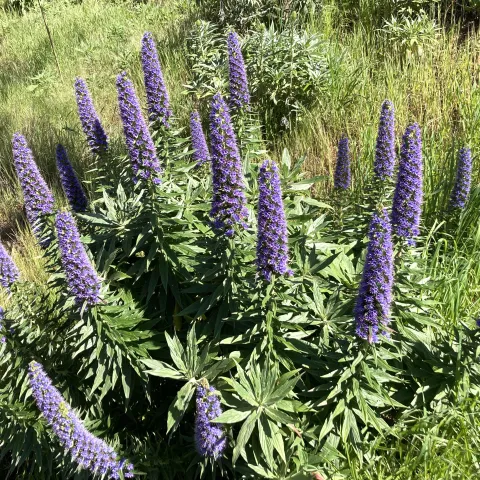
Another invasive plant on the watch list is Pride of Madeira (Echium candicans), a rapidly growing evergreen shrub native to Madeira, a region of Portugal and the Canary Islands. It grows 4- 6 feet tall and wide with long, narrow gray-green leaves. In the spring and summer, large flower stalks bear bluish-purple flowers. The flowers attract pollinators and are unpalatable to deer. It is listed as “Limited” by the California Invasive Plant Council as a plant to avoid. It will take over your yard, the nearby medians, and open spaces. Do not plant it near a natural open space (or your garden). Young plants can appear thirty feet from the parent plant. Cut off the flower stalks before seeds mature to avoid having to remove many seedlings and prevent fire hazards.
Marin Master Gardeners recommend using drought-tolerant, low-maintenance native plants that thrive in our local climate and soil. Native grasses, wildflowers, and shrubs create visually appealing, environmentally friendly landscapes that support our local ecosystems.
The California Native Plant Society has created and updated the website Calscape (Calscape.org) to help people pick perfect native plants for their gardens. It provides lists by zip code, sources plants in your local nurseries, and gives pictures, garden plans, and growing tips. Most plants behave well in their intended roles. By choosing suitable replacements for the plants that are problems, we can save trouble in the garden and help protect our natural California landscape.
By Alice Cason, March 22, 2025