

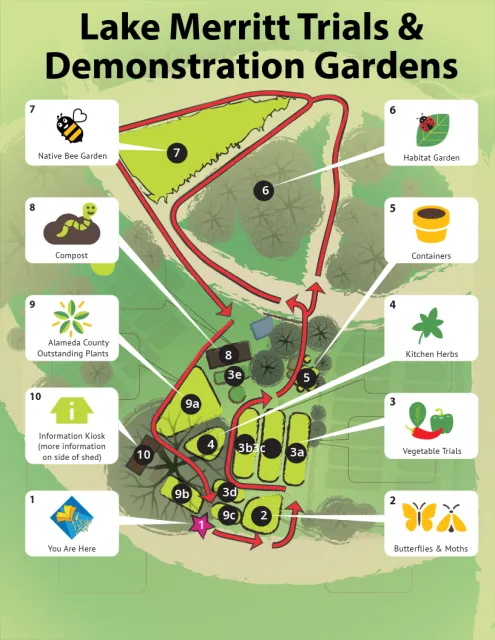
Station 1: You Are Here
Welcome to the Lake Merritt Trials Garden, a project of the UC Master Gardeners of Alameda County.
Explore our area and take our self-guided tour. A station topic denoted with an asterisk * means that free handout(s) are available at our garden shed on our website.
Our Master Gardeners are trained volunteers of the University of California Cooperative Extension, and we provide research-based garden advice and information to the residents of Alameda County.
Station 2: Butterfly & Moth Habitat*

This pesticide-free area contains a variety of plants to support pollinators (butterflies, moths, insects). Flowers provide nectar for the adults; leaves and grasses provide food for their larvae/caterpillars, which in turn feed baby birds. Pollinators have declined over time due to the loss of habitat and other environmental factors such as pesticide (Neonicotinoids and B. thuringiensis) usage. Home gardeners are encouraged to create a pesticide-free garden that supports pollinators and other wildlife!
Stations 3a-e: Vegetable Trials*

These five beds are used to test varieties of vegetables to determine which do best in our marine-influenced local climate. Trials are performed annually on tomatoes and other common summer vegetables. In the winter, we test a few cool-season vegetables. Based on our trial results, recommendations are updated annually.
Learn more about our vegetable and herb planting recommendations (PDF).
Station 4: Kitchen Herb Bed

This bed contains common kitchen herbs, both perennial and annual, that can be grown in our area.
Learn more about our vegetable and herb planting recommendations (PDF).
Station 5: Container Gardening *

The various containers in this area provide examples of vegetables, fruits, and herbs that can be grown successfully in containers. We also demonstrate two different types of watering systems, which are crucial to having success in containers—drip irrigation and a self-watering container.
Learn about our top tips for container gardening (PDF).
Station 6: Habitat Garden*

This section was designed to support multiple species of butterflies and moths by providing year-round bloom for food and a variety of host plants for their caterpillars. This larger area, similar to Station 2, also supports birds and bees.
Habitat Garden Features:
- Most plants are California natives, which provide the food for most of our native butterflies and moths and their caterpillars.
Station 7: Native Bee Pollinator Garden*

This section was designed to support populations of the many native bee species found in Alameda County. This garden also attracts other pollinators such as hummingbirds and butterflies.
Pollinator Garden Features:
- Plants were selected so that something is blooming year-round to ensure a continuous source of pollen and nectar for the bees.
- Areas of bare soil (no mulch) are present. 70% of native bees are ground nesting!
- Nesting blocks are for the 30% of bees that are cavity nesting.
Learn more about the 12 native bees you might see at Lake Merritt (PDF). We also have flowering plant recommendations (PDF) to attract native bees to your garden.
Station 8: Compost System*

This 3-bin compost system is designed and is most appropriate for a garden generating large amounts of green and brown material. The signage on the bins describes the composting process. For many home gardeners, a smaller system may be more appropriate. These alternatives are described in our home composting handout (PDF).
Station 9a-c: Outstanding Plants for Alameda County*

The plants in these three beds are on our “Outstanding Plants for Alameda County” list. They were selected for their:
- Adaptation to our growing environment
- Beauty
- Habitat value
- Water-conserving characteristics
Station 10: Trials Garden Information Shed

The following handouts are available here and are also on our website.
- All the Buzz — Creating an Urban Garden Friendly to Native Bees (PDF)
- Create a Monarch Butterfly Habitat (PDF)
- Composting is Good for Your Garden and the Environment (PDF)
- Container Gardening Tip Sheet (PDF)
- Trials Garden Vegetable Trials Results — Recommendations
- Vegetable and Herb Planting Recommendations (PDF)
- Outstanding Plants for Alameda County & More Outstanding Plants (web only)
- Trials Garden Recommended Plants to Attract Pollinators (PDF, web only)
- Twelve Native Bees You Might See at Lake Merritt (PDF, web only)
Thank you for taking the tour!
Have a gardening question? We'll help.
Visit our Help Desk page to submit your question and see additional ways you can reach us.