

In both rural and urban environments, fuel for wildfires can be any combustible material, including live and dead vegetation, wood products like fences and stairs, and petroleum products such as lawn furniture, artificial turf, and garbage cans. Even a well-hydrated “green” plants can burn with the right amount of heat or flame exposure.
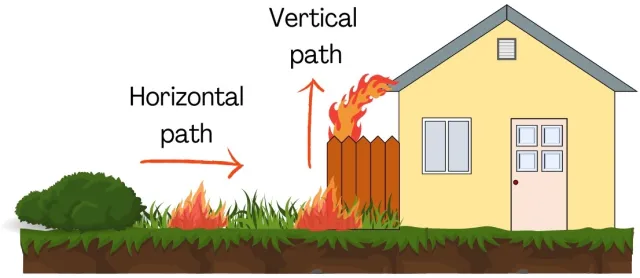
Once ignited, these fuels can create a direct pathway for fire to reach the home. There can be both horizontal and vertical pathways, such as grass connecting different shrubs to plantings or tall herbaceous plants directly against wooden fences that are connected to homes. In these examples, fires can easily travel horizontally between the shrubs to the plantings using the grass in between or fire can burn up to the eaves through vertically climbing up the wooden fence.
The risk of fire spreading to your house can be reduced by removing these potential pathways through defensible space. Creating defensible space involves the careful selection, location, and maintenance of vegetation and other combustible materials near structures provide defense from an approaching wildfire burning or to minimize the spread of a structure fire to wildlands or surrounding areas. By focusing on the placement and maintenance of vegetation and combustibles, you can create a fire-smart landscape that incorporates elements of beauty, safety, and privacy.
When it comes to wildfire preparedness, working from the house outward is key. In addition to structure hardening, develop and implement a three-zone defensible space strategy that prioritizes protecting the areas closest to the home. Start by assessing your situation and identifying potential risks and solutions by using the resources below.
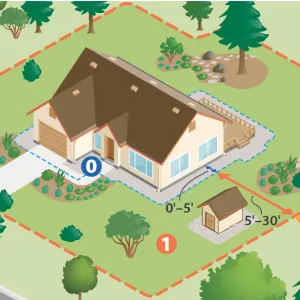
Implement Defensible Space
Defensible space describes the area adjacent to a structure where vegetation and other combustible materials are carefully located and maintained to provide defense from an approaching wildfire burning or to minimize the spread of a structure fire to wildlands or surrounding areas.
Learn how to design and implement a effective defensible space strategy around your home here.
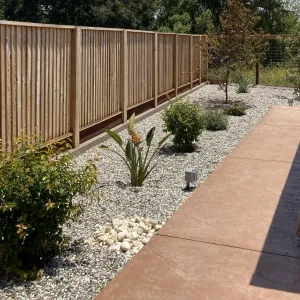
Right Plant, Right Place, Right Care
Fire safe landscaping requires maintenance (e.g., pruning, irrigation, and clean-up). You can enhance the fire-resiliency of your near-home landscaping by following this simple framework: Right Plant, Right Place, Right Care.
Learn how to maintain plants to improve their fire resilience here.
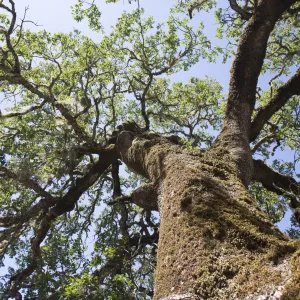
Learn How to Care For Trees
Trees have many beneficial qualities, but from a fire safety perspective, trees overhanging a home can cause physical damage to the house from branches rubbing on the roof or walls, but more importantly, they produce leaves and debris that accumulate on the roof, in gutters, or the surrounding landscape.
Learn how to improve the health and fire resilience of your near-home trees here.

Understand the Role of Mulches
Mulch can play an important role in your landscaping, but it can also potentially introduce a new combustible material into your landscape. For this reason, it is important to consider the type, location, and quantity of mulch used to best achieve your goals and help protect your property and home from fire.
Additional Resources
Check out these defensible space-related resources from UC ANR Fire Network Members and our colleagues!