
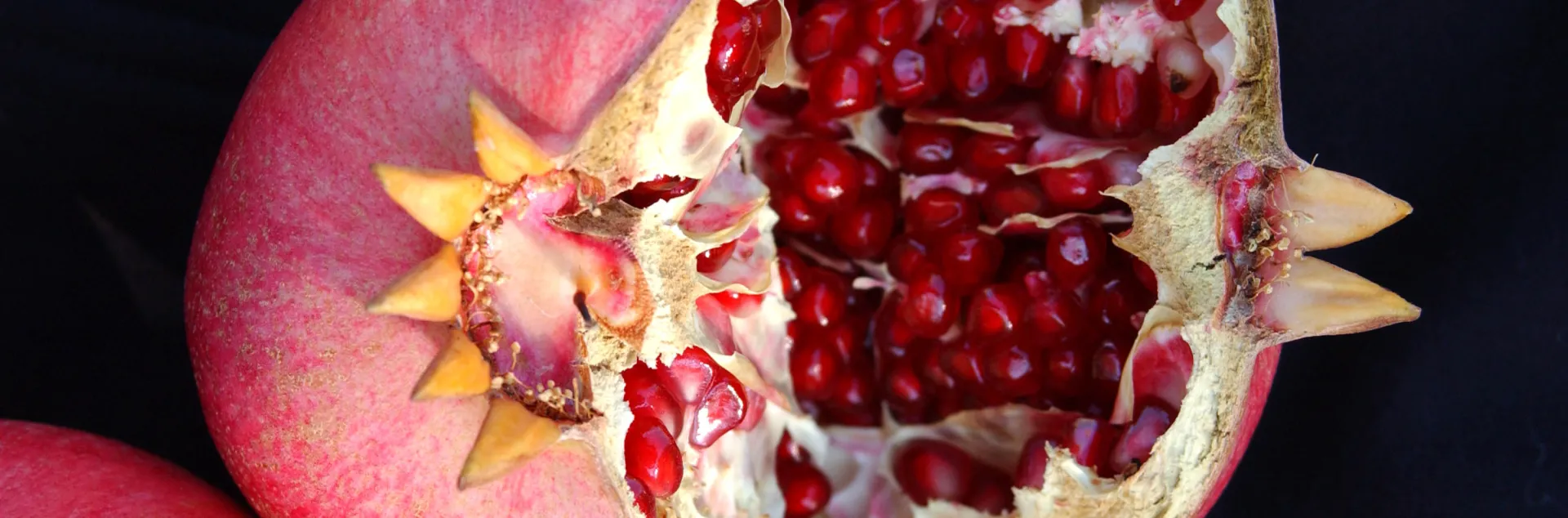
Pomegranates

How to Select Pomegranates
Fresh pomegranates are in season from the end of September through November; you can often find them at a local grocery store or farmers market. When selecting a pomegranate, look for three main characteristics:
1. Shape: As a pomegranate ripens, the shape of the fruit changes. An unripe pomegranate will have a round shape; however, as the inner seeds expand and fill with juice, the sides of the pomegranate will push against the outer skin, creating flat surfaces. Thus, a ripe pomegranate will have a rounded-square shape. Also, check the outer skin for any brown spots or bruises. The skin should be smooth and firm; multiple soft spots signify an overripe pomegranate.
2. Weight: Select pomegranates that feel heavy, as this signals the fruit is full of fresh seeds and juice. The heavier the pomegranate, the more liquid it contains, so avoid choosing light pomegranates, which may have dried out.
3. Color: Pomegranates come in different colors: Ariana pomegranates are deep red, while Golden Globe pomegranates are yellowish. Regardless of the variety, the color should be bright. Faded and dull skin coloring may be a sign the fruit is overripe. While the shape and weight of the pomegranate are more important than the color, you can still use the color of the fruit as a final indication of its ripeness.

How Long Do Pomegranates Last?
Pomegranates last one to two weeks when stored at room temperature on a counter top away from direct sunlight. If you keep whole pomegranates in the refrigerator, the shelf life extends to two months. However, once you remove the pomegranate seeds from the fruit, they last about five to seven days with cold storage in the refrigerator. For long-term storage, freeze your pomegranate seeds for up to one year (steps for freezing pomegranate seeds follow).
1. Chop the pomegranate into quarters.
With a sharp knife, cut the pomegranate into quarters carefully. Or, you can cut the bottom to expose the membranes that the pomegranate has and use them to guide yourself to make the cuts.
2. Extract the seeds from the pomegranate.
In a large bowl with water, put the pieces of pomegranate, and with your thumbs or fingers, remove the seeds of the pomegranate, so you will not run the risk of staining since the pomegranate causes stains which can be difficult to remove. The membranes will float to the top of the bowl and the seeds will sink to the bottom of the bowl.
3. Strain and dry the pomegranate seeds.
When you have entirely separated the seeds from the membranes of the pomegranate, strain them and then dry them with a clean dishcloth or paper towels.
4. Freeze the pomegranate seeds.
Spread the pomegranate seeds on a tray with waxed paper or parchment paper, and keep them apart so they do not stick together, and freeze for 4 or 6 hours. Transfer the frozen seeds to a freezer safe bag or container that can be tightly closed. Write the storage date on the bag or the container. Store the pomegranate seeds in the freezer for 12 months
How to dehydrate a pomegranate:
Chop the pomegranate into quarters.
Cut the pomegranates into quarters with a sharp knife, following the patterns of the inner membranes.
Remove the seeds from the pomegranate.
In a large bowl of water, place the pieces of pomegranate and gently remove the seeds with your thumbs or fingers, so you will not run the risk of staining your counter or clothes.
Strain and dry the pomegranate seeds with absorbent paper towels or a clean towel.
Dehydrate the pomegranate.
If you use an oven, preheat it to 200 degrees. Then on a tray with a nonstick silicon sheet or parchment paper, spread the pomegranate seeds so they are not touching. Bake for 4 or 6 hours {see instructions below for food dehydrator to test for doneness and storage}
If you have a food dehydrator, spread the pomegranate seeds on trays of the dehydrator without piling them up. Set the temperature to 150 degrees and dehydrate for 8 to 12 hours.
You will know that pomegranate seeds have dried properly when they are wrinkled and dry to the touch.
Wait for the seeds to cool before storing them in a container, so the dehydrated seeds internal steam will dissipate and not generate moisture.
Use a glass container that is air tight when sealed. Plastic containers or freezer bags can be used too, making sure to attach a storage date label to the container.
Store the dehydrated fruit in a cool, dark place. The dehydrated pomegranate seeds will remain in good condition for a year at room temperature.
You can also store the dehydrated pomegranate seeds in the freezer for up to to 5 years.
Pomegranate Syrup
Chop the pomegranates into quarters with a sharp knife, or cut off the bottom of the pomegranate and chop it following the inner membranes.
Remove the seeds from the pomegranate.
In a large bowl with water, add the pieces of pomegranate, and with your thumbs, remove the seeds, so you will not run the risk of staining yourself or your counter.
Extract the juice from the pomegranate. You can crush the seeds in a bowl using a masher, or you can liquefy the seeds of the pomegranate in a blender or food processor, then proceed to strain the juice.
Prepare the pomegranate syrup.
If you have 28 fluid ounces of pomegranate juice, then you should add 14 ounces of sugar and a tablespoon of Real Lemon Juice. Cook over high heat until it comes to a boil, then simmer and cook until a third of the contents are reduced. When pomegranate syrup cools, it should have a consistency similar to honey.
Transfer the pomegranate syrup to an airtight glass container or a freezer safe container
Place the pomegranate syrup in the coldest part of the refrigerator and it will keep for 1 or 2 weeks.
You can also store pomegranate syrup in the freezer for 2 or 3 months; just remember to put it in a container or bag that is freezer safe and that closes tightly.
For more recipes go to: mfp.ucanr.edu or the USDA and Cooperative Extension Programs