
Seeds come in countless sizes, from tiny grains almost too small to see to massive coconut size, but their universal purpose is to start new life.
If stored properly, seeds can remain viable for years. The oldest known seed to sprout was a roughly 2,000-year-old Judean date palm, excavated from Herod the Great’s palace at Masada and germinated in 2005 after being preserved in a cool, dry place.
What is a Seed?
Seeds are typically the product of sexual reproduction, formed through the fertilization of male and female plant cells. After they are created, seeds enter a dormant state, waiting for the right combination of warmth, moisture, and oxygen to begin growing. At their core, seeds are dormant plants in miniature form, equipped with everything needed to start life: a protective outer shell, a food reserve, and an undeveloped embryo. A seed can be described as a survival capsule—tough, nourishing, and ready to thrive once conditions are right.
A seed is made up of three main components:
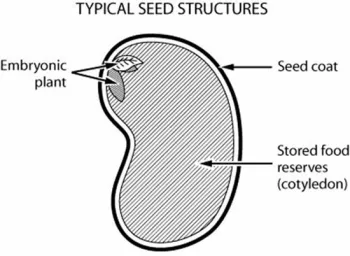
Embryo: The embryo is an immature plant containing a root, stem, and one or more seed leaves. It consists of the radicle (future root), hypocotyl (future stem), and epicotyl (future leaves).
Seed coat: The hard outer layer that shields the embryo from damage and disease.
Cotyledon(s): These seed leaves store and provide nutrients to the embryo, often becoming the first parts of the seedling capable of photosynthesis.
Most garden plants are divided into two groups:
Monocots (monocotyledons): Plants with a single seed leaf. Their endosperm stores extra food, supplying energy-rich nutrients essential for germination. Examples include grasses, lilies, palms, and corn.
Dicots (dicotyledons): Plants with two seed leaves, which usually look different from the mature leaves. Dicots are more common and include tomatoes, squash, beans, and most vegetables.
The Lifecycle of a Seed
Seeds progress through distinct stages:
- Dormancy: The seed is alive but inactive, waiting for favorable warmth, oxygen, and moisture to break dormancy.
- Germination: Dormancy ends, the seed absorbs water, swells, and the embryo begins growing into a seedling.
- Emergence: The root pushes down, the stem pushes up, and the seedling breaks through the soil surface.
- Growth: Seed leaves nourish the young seedling. True leaves form and the plant begins making its own food via photosynthesis.
The seedling relies on the seed’s internal food supply until it develops roots and leaves to create energy. Germination—when the dormant embryo activates—begins as the seed takes in water and ends when the seedling can survive independently. Four environmental factors are key:
- Water (triggers metabolic activity)
- Oxygen (for respiration)
- Temperature (optimal range varies by species)
- Light (necessary for some seeds, not for others)
When these needs are met, water and air reach the embryo, which awakens and begins to grow. The shoot emerges, seed leaves unfold and turn green, feeding the seedling until true leaves develop and photosynthesis takes over. As the plant matures, the cotyledons wither and fall away.
Most annuals, biennials, and many perennials start life from germination. Woody perennials may show both vegetative and reproductive growth at the same time, but germination is essential for propagation. Each species has its preferred temperature range for germination, and success depends on how closely the environment matches these needs.
Breaking Dormancy and Germination Challenges
Seeds sometimes fail to germinate due to dormancy—a natural adaptation that prevents sprouting until conditions are favorable. Dormancy may be caused by a hard seed coat or internal signals that suppress growth. Triggers like temperature, moisture, and day length can break dormancy.
To encourage germination, gardeners may use scarification (scratching the seed coat) or stratification (chilling the seeds). Seed quality also matters. Germination rates drop over time, especially without proper storage. It’s helpful to check seed viability and plant extra seeds, as not all will sprout or grow into healthy plants.