A Natural Solution for California's Herds: African Catfish Peptides

California's cattle producers and agricultural communities are all too familiar with the rising challenge of antibiotic resistance, making common bacterial infections harder to treat in livestock. But imagine a future where we could tackle these infections with a natural, powerful alternative. Our research points to just that: antimicrobial peptides (AMPs) found in African catfish.

We're really excited about these peptides because African catfish thrive in pathogen-rich freshwater, naturally producing these robust immune compounds in their skin mucus as a defense. This natural origin makes them highly appealing alternatives to synthetic drugs.

Predicted Safety and Potent Action

One of the most compelling aspects of these AMPs is their predicted safety for mammals. Our initial computer analyses suggest that various catfish AMPs are generally recognized as safe (GRAS). We predict they'll be absorbed in the human intestine without causing liver, brain, or heart toxicity. Furthermore, lab tests on a promising peptide, NACAP-II, confirmed it was non-hemolytic, meaning it didn't damage rabbit red blood cells—a strong indicator of its potential safety for mammalian cells.

Beyond safety, these peptides demonstrate effectiveness against problematic bacteria. One study revealed NACAP-II's strong activity against Extended-Spectrum Beta-Lactamase (ESBL)-producing Escherichia coli—a critical concern for both animal and human health due to its resistance to many common antibiotics. Another peptide, ACAP-IV, also showed antibacterial activity against E. coli and Staphylococcus aureus. We believe these AMPs work by directly disrupting bacterial cell membranes, a mechanism that makes it harder for bacteria to develop resistance compared to how they resist traditional antibiotics.
Forestry Research and Outreach: Page

Forest Landowner Videos

UCCE Forest Research and Management has developed the videos below to aid private forest landowners with creating and implementing a forest management plan.
View Page
Primary Image
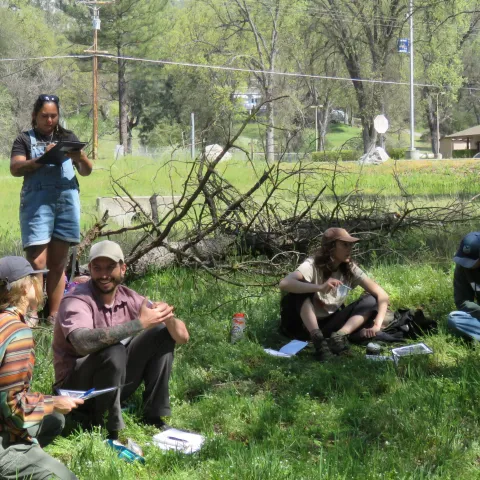
Group of people sitting and standing outside participate in a forestry class.
Forestry Research and Outreach: Page

California Tree School

From finding your way in the woods to planning a prescribed burn, UC ANR's California Tree School is a chance to explore foundational forestry concepts in a community space.
View Page
Forestry Research and Outreach: Page

Riparian Ecology Webinar

Webinar Series on the Ecology and Active Management of Riparian Vegetation in Forested Landscapes Recent regulatory proposals and research suggest that active management of riparian ecosystems can yield benefits to water quality and associated aquatic habitats.
View Page
Forestry Research and Outreach: Page

Collaboration in Natural Resource Management

Collaboration is increasingly being emphasized by land management agencies and stakeholders to address natural resource management issues and implement adaptive management. SNAMP collaborative field trip on the Tahoe National Forest involving multiple agencies and stakeholders.
View Page
Forestry Research and Outreach: Page

Douglas-fir (Pseudotsuga menziesii)

Needles are yellowish-green, 1-inch-long and arranged in a spiral around the branchlets, like a bottlebrush. Cones are oblong, 2 to 4 inches long with three-pointed bracts and are located primarily in the upper crown. Bark on young trees is thin, smooth, and gray, with numerous resin blisters.
View Page
Forestry Research and Outreach: Page

Lodgepole pine (Pinus contorta)

Lodgepole pine is a species which grows throughout the west, as far north as the Yukon and south to Baja California. It ranges east to the Black Hills of South Dakota and west all the way to the Pacific Ocean.
View Page
Forestry Research and Outreach: Page

Coast Redwood (Sequoia sempervirens)

The coast redwood, also called the California redwood, is the tallest living thing in the world. It also grows to great volume. One grove of trees in Humboldt Redwoods State park contains the largest measured concentration of living material, or biomass, in the world.
View Page
Forestry Research and Outreach: Page

Ponderosa Pine (Pinus ponderosa)

The ponderosa pine, also known as the yellow pine, is one of the most widely distributed tree species in the West, growing from southern Canada into Mexico, and from Nebraska and Oklahoma all the way to the Pacific Coast. The largest recorded diameter was over 8 1/2 feet.
View Page
Forestry Research and Outreach: Page

Giant Sequoia (Sequoiadendron giganteum)

Identification: Needles are bluish-green and scale-like with short, thick, sharp points. Cones are small and woody, generally 2-3" long. Bark is reddish-brown, fibrous, and very thick.
View Page